The Oura Ring smart ring is very frustrating. Not because it’s rubbish — quite the opposite, actually. It’s because I don’t think it’s reaching its potential, and I’m sounding like a broken record.
That’s not good for any product, but it’s even worse when it has a monthly subscription fee attached. I’ve worn the third-generation ring since late 2021, and I voiced some frustrations about it a year after that time. These continue to this day, yet the Oura Ring is still here on my finger, and it’s time to talk about why.
Is the Oura Ring in stasis?

When I last wrote about the Oura Ring, I complained it had not received significant product updates for a while, and there was nothing on the horizon (publicly) to look forward to. Between then and now, little has really changed. The only notable feature update in 2023 introduced Chronotypes for sleep, which while interesting, hasn’t changed the way I use the ring or assess my data.
I wondered if I was mistaken —that I’d maybe just missed some of the advancements. It doesn’t seem so. This year Oura has acquired a company called Proxy, which works on digital identification systems, and the announcement post hints that it may make payments and biometric security and identification systems possible for the future. Oura also worked out a deal with Best Buy, so people can try the ring on in a retail store before buying.
This is all interesting for Oura as a business, but not impactful for wearers. Outside of Chronotypes, the Oura Ring seems to be a bit stuck. For example, Oura’s new sleep staging system was introduced in November 2022 and today remains in beta, plus there’s still no general workout mode — the Oura Ring only tracks walking, running, or cycling — and no new feature innovations using the additional sensors inside the third-generation Ring have been announced or even hinted at.
The monthly payment problem

I understand Oura will want to make sure any new features are fully tested, and that this takes time. But additional workout modes were promised in “the coming months” a year ago, so it has to be assumed such features are not a priority anymore. Oura is likely wary of overpromising and underdelivering, but when does this just become a cover for not actually having anything in the works at all? And if promised workout modes aren’t a priority, what is? Unfortunately, I’ve no idea, and that’s a different kind of problem.
I wouldn’t feel so strongly about Oura’s missed deadlines and general silence over future plans if the Oura Ring was a pay-once product. But it’s not — it costs $6 per month (after six months of ownership) on top of the initial outlay for the ring itself.
I should take the Oura Ring off and just forget all about it … right?
When you pay $10 per month to Netflix, you expect new movies and TV shows to be added on a regular basis to make it feel like you’re getting something for you money. It therefore doesn’t sound unreasonable to want more value than just the ability to collate data from Oura’s ongoing subscription fee. After all, without all that data wearers are providing, it wouldn’t be able to do things like shout about predicting COVID infections.
So, at this point, I should take the Oura Ring off and just forget all about it … right? That’s not going to happen, because — frustratingly — it’s absolutely brilliant.
What? The product I’ve been moaning about not being updated with new features and costing $6 per month is brilliant?
Yes, the Oura Ring remains the wearable I’ve worn the most, and I can’t imagine why I’d want to take it off. It’s so convenient, so good-looking, and it fits in with my lifestyle so well that I don’t know what I’d replace it with. I don’t want to wear a smartwatch all the time, most fitness bands aren’t very attractive, and there aren’t any other decent competing smart rings available yet.
Problems aside, the Oura Ring is just so good


The app is absolutely reliable, the ring has almost never failed to connect to it, and syncing data only takes a few moments. These fundamentals aren’t always a given, but are an essential to living with and continually using a product. The data in the app is in-depth enough without being overwhelming, and it’s presented in an easily digestible manner. You get what you need from it in a few moments, and I really like that accessibility.
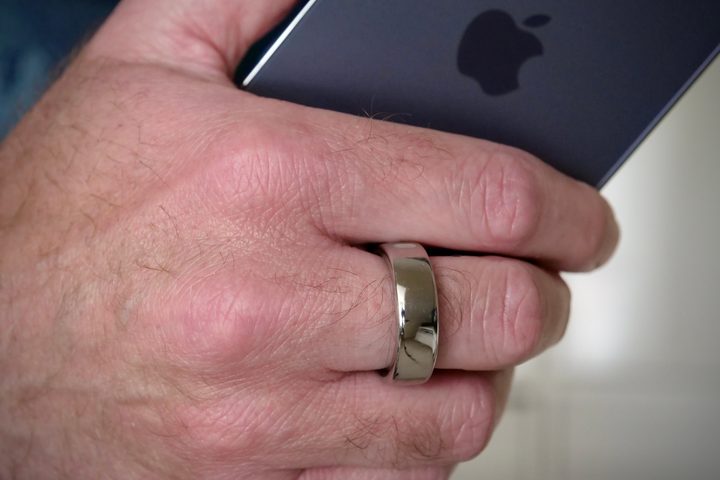
I’ve been wearing the silver Horizon version of the Oura Ring third-generation since September 2022, so how has that polished titanium surface held up during this time? I wear it every day, all day, but my lifestyle is fairly norma,l so it should look close to the way it did when I first put it on. It has held up fairly well. Look closely and the surface has been marred by micro scratches and scuffs, but it doesn’t seem to have lost the highly polished gleam that made it so eye-catching initially. I notice the scratches, but I don’t think others would unless they examined it closely.

Despite it not looking quite as showroom-fresh as I would like, the battery has not suffered at all during this time. I’m consistently impressed by how durable the tiny battery is inside the Oura Ring. It still lasts five days without a charge, but I simply still put it on the charging plinth most mornings when I shower and get ready for the day, and it never needs any further attention than that. The ring’s low maintenance is another reason why it’s hard to find a direct replacement.
Confusing, frustrating, brilliant

The Oura Ring uses sleep and basic activity tracking to present a comprehensive enough overview of your general health and well-being, which is enough for me as a non-athlete. Sleep tracking may be the Oura Ring’s forte, but with an extra general workout mode to join the others and a feature push, it really could become a true alternative to a fitness band.
The Oura Ring makes me sigh when it should make me smile. It’s so nearly there, but Oura’s silence and seeming unwillingness to push the Ring’s functionality forward hurts it — and frustrates me as a vocal supporter of the product. Yet, I don’t think I’ll stop wearing it. Welcome to one of the best, most confusing, and most frustrating products I’ve used in a long time.