
It takes a lot to protect a cell network. Hurricanes, earthquakes, and tornadoes can snap towers in half like toothpicks. Hackers probe back-end networks for vulnerabilities; and smartphone-touting concertgoers, fair attendees, and sports fans push cell sites to their limits.
Verizon Wireless, the largest wireless network in the U.S. by number of subscribers, spends a lot of time thinking about how to keep its grid from going down. During a tour of the carrier’s network switching center in Yonkers, New York, we got an inside look at the equipment designed to withstand everything from gale-force winds to Mariah Carey concerts.
“Our switches have to survive everything,” Michelle White, executive director at Verizon, told Digital Trends. “You go back to when [the terrorist attacks on] 9/11 happened and a lot of people became really attached to their devices because they used them to stay in touch with family and friends. The value we bring to our customer is highlighted through those crises.”
Entering through the (padlocked) front door
From the outside, Verizon’s Yonkers, New York office looks conspicuously normal. The gray low-rise building, which is located about an hour north of Midtown Manhattan by train, is nestled in an overgrown forest hillside dotted with hotels. But it’s not your average office building. A metal barricade and padlocked double doors keep out onlookers without the proper security clearance. You won’t find its exact address on the map — type it into Google, and you’ll find a nearby perimeter highway.



“One of the easiest ways for someone to hurt us is our communications,” Christine Williams, a Verizon network supervisor and our tour guide, said. “That’s why we do everything in our power to shield the network. We have firewalls [and] and entire team devoted to security.”
That might sound a little hyperbolic, but the Yonkers building is an attractive target. This switching center handles call, text message, and data routing for one of Verizon’s largest markets: New York City. It’s one of two that service the greater New York area, Williams explained, as we entered the bowels of the building’s equipment floor.
The building’s switching room routes more than 300 million data connections.
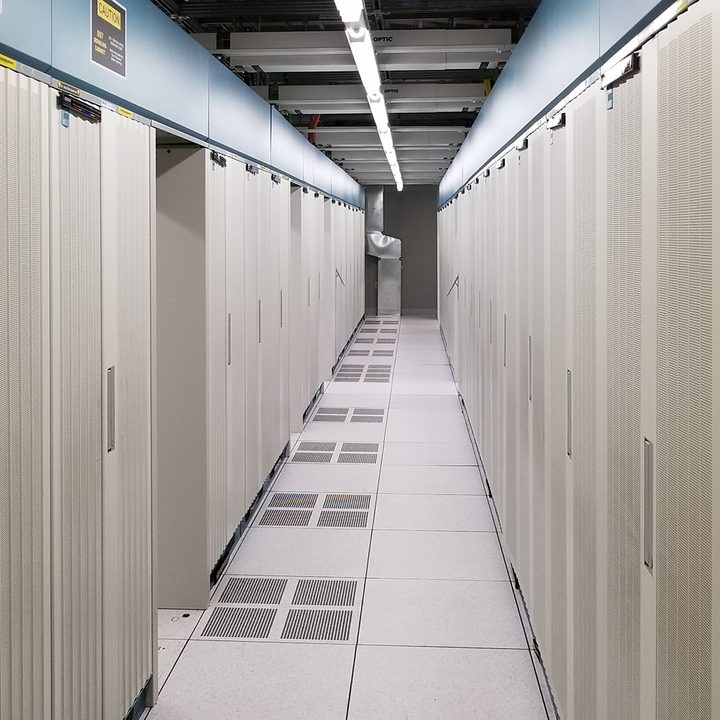
The building’s switching room — rows of servers, AC units, and circuit breakers — routes more than 300 million data connections through multicolored fiber-optic wires. If you send an email to a coworker, Snapchat message a friend, or post a picture to Instagram from Midtown Manhattan, the Bronx, or Queens, chances are it’ll hit the Yonkers building’s wires first. It’s also responsible for routing voice calls.
“When you’re on the local cell tower or wherever you may be, the switch is running that call,” Williams said. “If you’re making a landline call to somebody, it connects you to every [other switch] out there. And if you’re calling a mobile center, it would hit this switch, travel long distance across the country, and connect to another local switch to find your corresponding person.”
Protecting the brain
It’s like a big computer, White said. The switch is “the brains” that have the information on how your calls should be handled.
Just like brains, they’re temperamental. The switches need to be kept within a certain temperature range to prevent overheating, and they draw power from a custom circuit that converts incoming AC (alternating current) power to DC (direct current).
Why DC instead of AC? The voltage in AC current — the kind that powers your hairdryer and coffee pot — periodically reverses, which can affect the switches’ stability. DC current, on the other hand, supplies electricity at a constant voltage.

“With the regular power outside, there are spikes — it goes up and down, and the computers don’t like that,” White said. “So we work off DC batteries.”
They switches are also insulated to protect against flooding. Four long hallways buffer the switching room against any rainwater that might make it past the past the facility’s surrounding hillside, and data is piped in through two separate fiber feeds on either end of the building.
“We put all the important equipment interior to the building, surrounded by hallways so that if there’s a flood or hurricane or any kind of natural disaster,” Williams said. “It’d have to go through a lot to get to our most critical processing.”
The same is true of the building’s backup power. Two diesel-powered generators, each the size of an entire room, supply enough electricity to power a 400-home subdivision. If the building’s two connections to the power grid were cut or if severe weather knocks out local power, for example — they can supply enough energy to run the building’s switches for eight hours.
“It’s sort of like the portable generators you use to power your house when there’s a flood or outage, but on a much bigger scale.” Williams said. “They run simultaneously, and each one of them by themselves could handle all the AC and DC power the facility needs. Even when there’s a little bit of a loss, they start powering the air conditioners, lights, and everything that doesn’t run off of DC power.”
Ready for game day
The Yonkers building handles more than just switching. A cement parking lot houses what White called the “farmyard” equipment: portable towers and generators with colorful acronyms like COWS (Cell on Wheels), COLTS (Cells on Light Trucks), and GOATS (Generators on Trailers).
“We’re usually heavily involved behind the scenes. We pull out all the stops.”
They’re smaller, modular versions of the cell towers that dot the side of the road, and they’re used to bolster local network capacity. Ahead of events like festivals, fairs, and football games, Verizon engineers decide which (and how much) equipment to deploy based on data like historical attendance, time of day, and traffic.
They aren’t cheap. Verizon charges municipalities more than $50,000 to set up a COW, and the event organizers are on their own when it comes to the generator required to power it.
Natural disasters are a different story. During the recent Rim Fire near Yosemite National Park, Verizon volunteered phones, mobile hot spots, and solar-powered network equipment to emergency personnel. In 2015, when two convicts escaped a New York’s upstate Clinton Correctional Facility, the carrier established a satellite uplink so that investigators could stay in touch.
“We’re usually heavily involved behind the scenes,” White said. “We pull out all the stops.”
Next-gen readiness
White doesn’t expect the Yonkers switch to change all that much in the coming years. The most dramatic upgrades will be on the inside, where network techs will swap out and consolidate switches as Verizon transitions to Gigabit 4G LTE and 5G — the do it all network of the future.
Right now, roughly half of the building’s server room houses 3G switches and call-only computers. Its 4G equipment takes up a single metal rack.
“Everything’s shrinking,” Williams said. “We don’t need as much space as we used to.”
The old equipment is less power-efficient and slower, too, which is one of the reasons Verizon plans to sunset its 3G network in the next three to four years. It’ll transition customers to 4G LTE, which can handle talk, text, and data simultaneously.


