  1. Home
  2. Social Media
  3. News

Millions believe actor Richard Gere’s ‘moving’ Facebook hoax about homelessness

Add as a preferred source on Google

If you’ve spent any amount of time on Facebook, you’ve likely witnessed or fallen victim to the number of hoaxes that pop up, from celebrity deaths (who haven’t died) to supposed body of a mermaid. Facebook hoaxes have become so commonplace that even large news outlets once considered trustworthy, have claimed Morgan Freeman has died at least five times.

richard gere homeless
Image used with permission by copyright holder

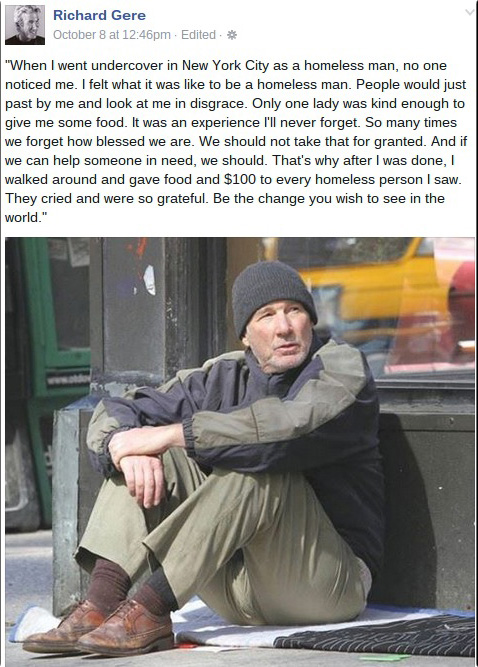
In the latest hoax, however, the claim wasn’t that anyone died, but instead involved a celebrity participating in an act of good will. According to multiple Facebook posts, actor Richard Gere had gone undercover as an unrecognizable homeless person and was ignored and treated as homeless people are often treated (poorly), with only one person offering him food. According to the Facebook story, Gere was so compelled to help that he personally handed out hundreds of dollars to those living on the streets.

Recommended Videos

Unfortunately, most of the story is a hoax, or misleading at the least. According to Snopes, a popular online debunker, Gere did pose as a homeless person for the movie, Time Out of Mind, in which he plays a homeless man working on repairing his relationship with his daughter. The photos shared with the now viral post were taken during the filming of the movie, and while it may be true that he wasn’t recognized or treated differently, whether he passed out hundreds of dollars afterward is unconfirmed.

Hollywood superstar Richard Gere dresses as an undercover homeless guy to see how many people actually notice him and…

Posted by Hypnosis Training on Sunday, October 18, 2015

The Richard Gere hoax follows a long history of Facebook pranks as old as Facebook itself. Many don’t even include famous people: In addition to celebrity hoaxes, fake statuses like the Facebook privacy warning, although debunked over and over, make their way into our feeds at least once every year. Most recently, a downloadable “dislike” button which resulted in hacked Facebook accounts, reappeared shortly after the rumor of a new Facebook dislike button made its rounds.

The homeless Richard Gere post has been shared and liked millions of times, and is an indication of the speed in which fake statuses and false information can go viral. According to WeLiveSecurity.com, a website and company specializing in Internet security, there are a few ways to tell if a story is fake, through examination of the post itself before you decide to press the like or share button. Otherwise, you can always check Snopes or the Facebook page, which often serves as its own myth buster.

Christina Majaski
Former Digital Trends Contributor
Christina has written for print and online publications since 2003. In her spare time, she wastes an exorbitant amount of…
X’s creator payouts are changing, and original content is the new currency
The platform is replacing Revenue Sharing with a program designed to reward creators who actually make something.
X Twitter on iPhone

X is changing the rules for creators yet again. This time, the platform wants to put less emphasis on simply generating engagement and more on actually making something original. X is replacing its controversial Creator Revenue Sharing program with a new initiative called Original Content Rewards, which will officially launch on September 8, 2026. The existing Revenue Sharing program will continue paying participating creators through September 7, after which the new system takes over.

X wants to reward creators, not engagement farmers

Read more
Snapchat’s Spotlight algorithm now favors human-made videos over AI-generated ones
Snapchat is taking a firm stance against AI slop.
Snapchat-App-Store-open-on-iPhone

If you've been uploading fully AI-generated videos on Snapchat in hopes of earning rewards, it might be time to rethink your strategy. Snapchat has announced changes to Spotlight that prioritize authentic, original creativity over content created entirely by artificial intelligence. The company says its recommendation system will now favor videos made by real creators, while fully AI-generated submissions will no longer qualify for monetization.

So what's changing on Spotlight?

Read more
LinkedIn is crowdsourcing its fight against AI slop
The company is rolling out a new button that lets you flag posts that seem AI generated.
LinkedIn seems like AI slop button

LinkedIn has a serious AI slop problem, and it's now turning to its own users to help fix it. The platform is rolling out a new button that lets users flag posts they suspect were generated by AI. It plans to use that feedback to fine-tune the system that decides how much reach a post gets outside a user's own network, based on how AI-generated it appears.

The announcement comes shortly after an analysis by Pangram found that more than forty percent of long-form LinkedIn posts are fully AI-generated, and it suggests that the reach-trimming measures the company rolled out earlier this year haven't been enough on their own.

Read more