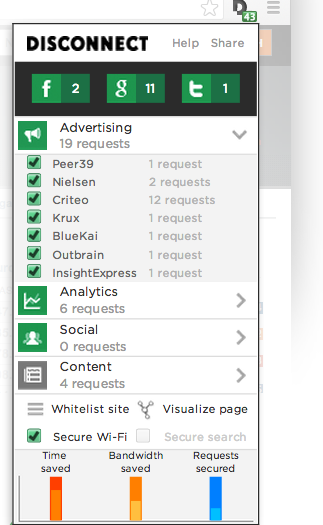
 If you hate targeted ads, the Internet can be a very frustrating place. Online juggernauts like Twitter, Facebook, and Google keep developing partnerships with third-party sites that track your every mouse hover, all while developing native tracking programs. The goal: targeting you for ads with scary accuracy, and even if the objective is peddling wares and not peeping at your personal life, it’s at least invasive and at most a gross abuse of power. And the companies keep introducing new ways to bombard you, like how Facebook is testing targeted ads in its Graph Search and tightening its partnerships with third-party trackers.
A browser app called Disconnect can minimize the amount of tracking that happens on your desktop. Developed by a team that includes a former Google programmer, Disconnect lets you see who follows you, and it allows you to sever the trail that Google, Facebook, Twitter and thousands of third-party tracking businesses use to follow you. Disconnect says it also makes loading Web pages 27 percent faster, and it also lets you encrypt your data to boost security. The Disconnect team explains how their program still allows for intentional sharing, but caps unintentional information disclosure: “We don’t prevent Facebook or Google from tracking stuff you intentionally share on their websites. We do prevent third-party tracking – tracking of data you’re unintentionally sharing with Facebook, Google, and thousands of other companies while you’re not on those company’s websites. For example, Facebook tracks the non-Facebook webpages you visit that contain Like buttons and other Facebook widgets, and Disconnect prevents that.”
The most recent version, Disconnect 2, launched this week, and it offers a more robust roster of ad-fighting measures. It’s also pay-what-you-can, and lets you decide to split the amount of money between their organization and charities. 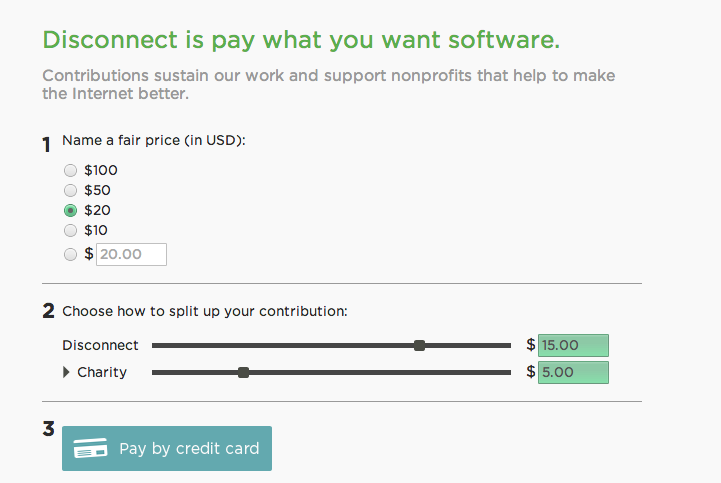
We asked the Disconnect team why they chose the pay-what-you-can model, and they say that they want the technology to be available to everyone, not just people who can afford it. “We think pay-what-you-want has the potential to become a really disruptive business model. Still too early to draw conclusions on amount of contributions but we’re pleasantly surprised so far!”
Right now Disconnect is only available for desktop, so we asked when it’s coming to mobile. No word yet, though the team says they do want to expand to more platforms. And the team is planning on debuting some premium features, though they are not sure what those will be yet – and they’d like to preserve the pay-what-you-can model as much as possible.
And if you’re wondering which major website has the most nefarious tracking techniques, Casey Oppenheim, one of the founders, told us which one he’d block first: “Personally, its a tough choice between Facebook and Google but I’d go with Google because they just have so much of my private data – through search, analytics, and apps – all tied to my real-name account.”
Luckily, using Disconnect you don’t have to choose just one source to block, and since the team continues to develop the service, hopefully their efforts will keep up with the tracking technologies introduced by major web companies.
Editors' Recommendations
- Can’t stand using Instagram in 2022? This app fixes everything you hate about it
- WhatsApp now lets you control who can see your profile
- Facebook says Apple didn’t let it tell users about App Store tax
- Zuckerberg to tell Congress that Instagram, WhatsApp needed Facebook to succeed
- You can now video call your Tinder matches within the app