 Facebook recently unveiled a revamp on its Lists feature. Taking a page out of Google+’s book, the site has turned a little more focus toward curator user privacy and encouraging its users to have a hand in doing that by helping the site fill its Smart Lists as well as creating their own.
The update has made Lists far easier to use, and also revealed a few changes to how the site’s News Feed works. Like the Google+ Circles, you now have dedicated streams for each of your Lists–Close Friends, Acquaintances, Family, Work, etc. We did note when originally covering this launch that users would know they were part of a list. As Facebook put it:
“If you choose to share with one of your default lists (Close Friends, Acquaintances, Restricted) or a custom list, the people on that list will be able to see the other people included on that list; however, they won’t be able to see the name of that list. If you choose to share with one of your smart lists, the people on that list will be able to see the name of the list.”
We immediately thought this was a little strange: Why do people need to know what list they are on–or that they are on one at all? With Circles, you’re notified that someone has started following you, meaning they’ve added you to a Circle, but that’s basically the equivalent of friending you. So we were obviously a little mystified but couldn’t quite put our finger on what the embarrassing fallout from this could be.
Until now. Listen up, List users–unless you want to publicly out how you think of all your Facebook friends. If you don’t use lists exactly as they are intended and labeled, you might be sending some very embarrassing notifications around. For instance, if you decide to add your significant other and their family to your Family list, be aware they are going to be notified you think of them as such. Which has its own weird drawbacks.
Also, seeing as people can see everyone else on your default and custom lists when you choose to share with them, it might not be very difficult to deduce what type of list they are on. You might want to take that into account when choosing to segment your friends. Why your personal Lists are anyone else’s information, we’re still uncertain.
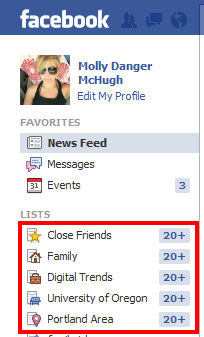 We’re also not huge fans of the dedicated News Feeds’ showing how many updates are coming from each. It’s turning out to be more work: We understand it’s to help you see the important things you’re missing via that ever-changing main stream, but some of us are pretty content skimming over it all.
And one more thing: If you are going to use these lists, we suggest immediately turning off the feature that sends you a notification every time one of your Close Friends does something on Facebook. Facebook explains how here.