 In the last few weeks, you, your friends, and family may have received a decidedly spammy sounding email alerting you to the fact that Facebook’s potentially owes you money per a proposed $20 million settlement. The good news is that the email is completely legitimate, and, if you’ve received it, you’re eligible to cash in on the settlement. The not-so-great news is you’ll only receive up to $10. At best. At this point, you may be wondering if partaking in this thing is even worth your time. We’re here to tell you that it is.
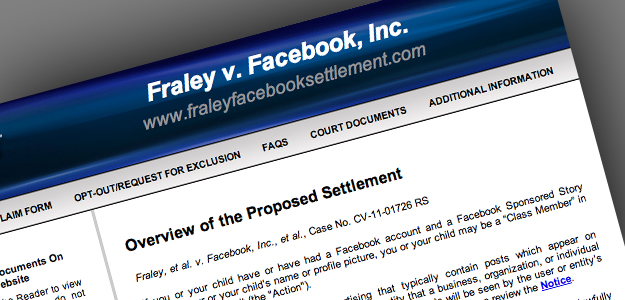
The settlement comes as a result of a recent class action lawsuit, Angel Fraley v. Facebook, Inc, that held that Facebook allegedly used the likenesses of its users in a Sponsored Story prior to December 2, 2012. While Facebook initially denied responsibility, Zuck and company opted to settle. Thus, you and any number of the 150 million Facebook in the States are eligible for up to… 10 bucks. At most. All you have to do is fill out a claim form by May 2 and wait for judgement to pass in June. Simple.
Bear in mind, however, that the chances of you receiving even a single Hamilton depends on how many people make a claim. According to the suit’s framers, if the final settlement comes to $12 million and 1.2 million authorized claims get filed, then you’ll get $10. If 2.4 million claims are filed against that sum, you’ll get $5.
But the real kicker is that, in all likelihood, you won’t see a dime. With 150 potential claimants waiting in the wings, Facebook may simply opt to divide that total among a number of non-profit organizations. Among them are the Center for Democracy and Technology, Electronic Frontier Foundation, MacArthur Foundation, Joan Ganz Cooney Center, and Berkman Center for Internet and Society, among others. All organizations devoted to teaching children and adults how to use social media safely while keeping companies like Facebook honest.
To us, neither eventuality sounds that bad. On top of all this, Facebook will also be forced to adjust its terms of service to make clear when and how it uses our information for Sponsored Stories even if you you don’t do a thing.
In the end, this lawsuit was designed to hold Facebook accountable for using data for advertising. That the company is willing to set aside money to express that they take the matter seriously is pretty cool on its part – so sign up to claim what’s yours. And even if you don’t get any money, some of it will be going to organizations that look out for your privacy. It’s all reason enough to take five minutes and get involved.