Astronomers have found a planet in the habitable zone of a red dwarf star, but its orbit is so elongated that it would have wildly variable temperatures and likely couldn’t support life.
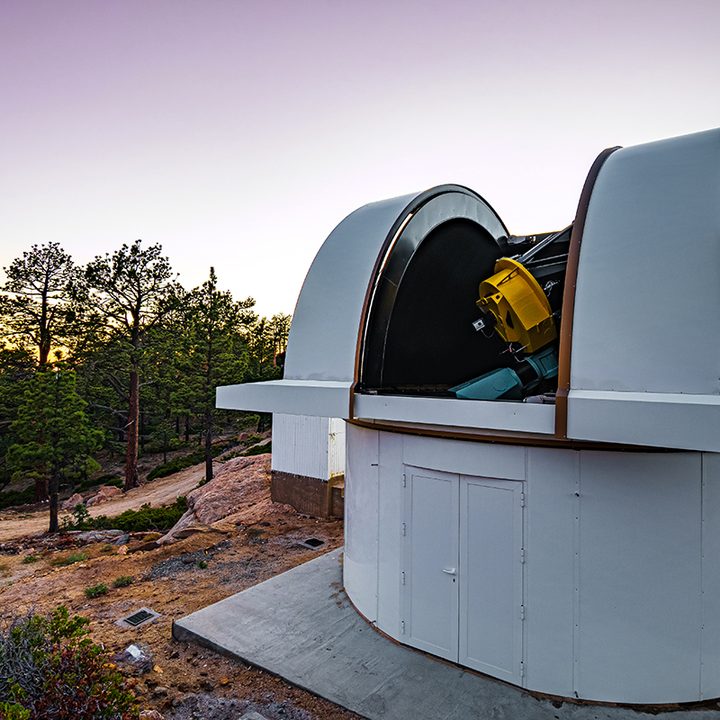
The planet, named TOI-2257 b, was first spotted using data from NASA’s planet-hunting telescope TESS (Transiting Exoplanet Survey Satellite) and then observed in more detail using the Las Cumbres Observatory Global Telescope and the SAINT-EX telescope in Mexico. Using the SAINT-EX observations, the researchers were able to confirm that a planet was orbiting the red dwarf star every 35 days.
As red dwarf stars are smaller and cooler than our sun, the habitable zone around them, or the area in which liquid water could exist on the surface of an orbiting planet, is also different. Planets orbiting red dwarf stars could have liquid water even if they orbit much closer than the Earth orbits the sun. And having the planet close to the star also makes it easier to detect.
However, even though TOI-2257 b is in the habitable zone, don’t make any plans to move there just yet. The first issue with habitability is that the planet has a radius 2.2 times that of Earth, meaning it is large and likely gaseous with high atmospheric pressure. The second and most intriguing fact about this planet is that it has a highly eccentric orbit, meaning that its orbit traces an elliptical or oval shape rather than a circle. Sometimes the planet is close to its star, and other times it is further away.
In fact, it has the most eccentric orbit of a planet around a cool star discovered to date. And that has a big effect on surface temperatures there.
“We found that TOI-2257 b does not have a circular, concentric orbit,” lead researcher Nicole Schanche explained in a statement. “In terms of potential habitability, this is bad news. While the planet’s average temperature is comfortable, it varies from -80°C to about 100°C depending on where in its orbit the planet is, far from or close to the star.”
The researchers are curious as to why the planet’s orbit is so eccentric, which could be due to a giant planet in the same system affecting this planet’s orbit. To learn more, the researchers hope that the planet could be studied further using the James Webb Space Telescope.