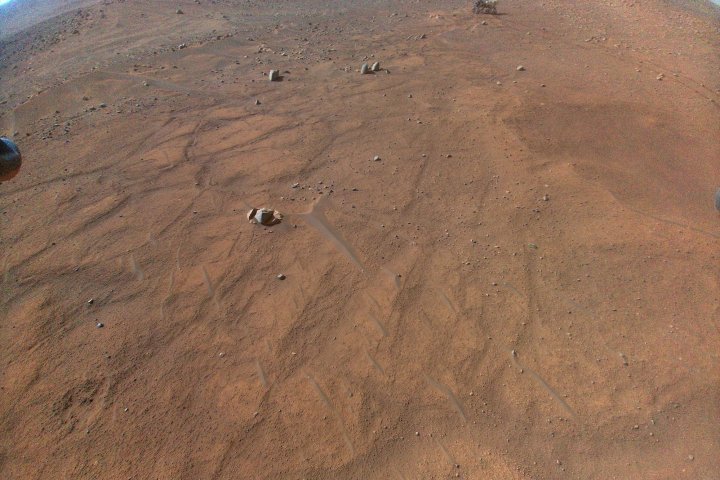
NASA’s Mars Helicopter, Ingenuity, captured an aerial image of the Perseverance rover during its latest flight at the end of last week.
The aircraft and rover arrived together on the red planet in February 2021, and since then both have been operating inside the Jezero Crater, a dried-up lake that scientists believe could contain evidence of ancient life.
In an image shared by NASA’s Jet Propulsion Laboratory (JPL), which is overseeing the current Mars mission, we can just spot part of the Perseverance rover at the top of the frame, and also some tire tracks leading up to it.
After experiencing an off-nominal scenario during Flight 53, the #MarsHelicopter worked as planned to execute an immediate safe landing. Shortly after, Ingenuity went on to complete Flight 54 with no issues, even spotting its buddy @NASAPersevere. https://t.co/SEh5NWTzjA pic.twitter.com/jK9T77fM5I
— NASA JPL (@NASAJPL) August 7, 2023
The image was taken during Ingenuity’s shortest flight since November last year, taking to the skies for a mere 24.4 seconds (its longest flight to date is 169.5 seconds). The brief flight — its 54th since the first one in April 2021 — was a test “hop” that saw the helicopter climb to an altitude of 5 meters (16 feet) before landing again.
The purpose was to check Ingenuity’s systems and gather data following an anomaly on the previous flight that caused the aircraft to automatically cut short its intended mission.
“Flight 53 was planned as a 136-second scouting flight dedicated to collecting imagery of the planet’s surface for the Perseverance Mars rover science team,” JPL explained in a post on its website. “The complicated flight profile included flying north 203 meters (666 feet) at an altitude of 15 meters (6 feet) and a speed of 5.6 mph (2.5 meters per second), then descending vertically to 2.5 meters (8 feet), where it would hover and obtain imagery of a rocky outcrop. Ingenuity would then climb straight up to 10 meters (33 feet) to allow its hazard divert system to initiate before descending vertically to touch down.”
But after flying the first half of its autonomous journey, a flight-contingency program was triggered, prompting the automatic deployment of a program called ‘Land_Now,” which is designed to put the helicopter on the surface as soon as possible if it experiences any one of a few dozen off-nominal scenarios, JPL said.
At the current time, the team believes the early landing was triggered when images from the aircraft’s navigation camera failed to sync up as expected with data from the helicopter’s inertial measurement unit, which measures Ingenuity’s acceleration and rotational rates, “data that makes it possible to estimate where the helicopter is, how fast it is moving, and how it is oriented in space.”
Something similar happened on Flight 6 in May 2021, prompting the team to update the helicopter’s software to deal with such a situation. But on Flight 53, the quantity of dropped navigation images exceeded what the software patch can cope with.
The team is now evaluating the data from Flight 54 before confirming its next step.
“The team is working to better understand what occurred in Flight 53, and with Flight 54’s success we’re confident that our baby is ready to keep soaring ahead on Mars,” JPL said.