1. Home
  2. Tablets
  3. Computing
  4. News

Demand for PCs will stay strong in 2021, but the future doesn’t look as bright

Add as a preferred source on Google

PCs began seeing an unprecedented surge in demand in 2020, but that won’t last forever. According to the latest forecast from the International Data Corporation (IDC) Worldwide Quarterly Personal Computing Device Tracker, the overall shipments of PCs worldwide are expected to grow throughout 2021 before dropping off in 2022.

IDC predicts the shipments of personal computing devices to grow 14.2% to 347 million units in 2021. This figure is down from its earlier prediction in May of 18% growth. Supply constraints are the main reason for the decrease. IDC predicted growth in the tablet market as well, but at a much slower pace of 3.4%.
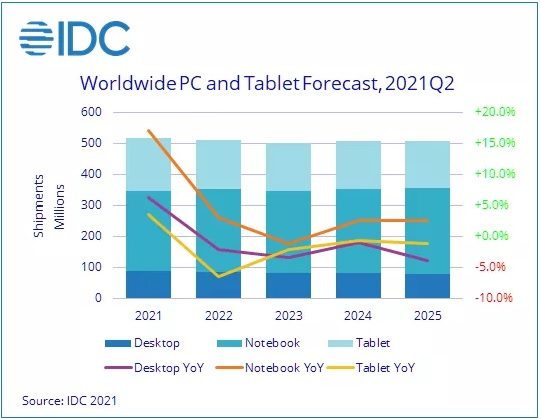
A chart looking ahead at the worldwide PC and tablet forecast.
Image used with permission by copyright holder

“We continue to believe the PC and tablet markets are supply-constrained and that demand is still there,” said Ryan Reith, program vice president with IDC’s Worldwide Mobile Device Tracker. “The lengthening of the supply shortages combined with ongoing logistical issues are presenting the industry with some big challenges.”

Recommended Videos

During the 2021-2025 forecast period, all PC devices, including desktops, notebooks, and workstations, are expected to see a 3.2% rise while tablets are expected to decline by 1.5%. Despite short-term supply chain and logistical challenges, notebook PCs will remain the biggest driver of PC growth.

PCs played a huge role in consumers’ lives during the pandemic. They ensured safe working, learning, gaming and much more over the last one-and-a-half years. Even though things are slowly going back to normal, personal computing devices are expected to retain a central role in most consumers’ personal lives.

IDC predicted a much lower estimate for PC demand before the pandemic hit. “In November of 2019, we published our last prepandemic forecast, which stretched out to 2023. At that juncture, we projected a total market of 367 million units in 2023. Today, we are expecting over half a billion units of personal computing devices to be shipped that year.”

Forecasts suggest that the latter years of the 2021-2025 period will witness an increase in consumer spending on areas such as travel and leisure – categories that were most affected by the lockdown – instead of technology. However, even when that happens, the total demand for PC devices will still be greater than what it would have been if many people had not spent the last few months working, learning, connecting, and gaming online.

Dua Rashid
Former Computing Writer
Dua is a media studies graduate student at The New School. She has been hooked on technology since she was a kid and used to…
ASUS Pad Review: A pleasing OLED tablet that leaves its true potential untapped
OLED ambition without the flagship tablet tax
ASUS Pad Review in hand

See at Asus

Quick Take

Read more
Apple may host another launch on October 27, with new Macs and an OLED iPad mini expected
Apple’s late-October hardware plans may include a touch-screen MacBook Pro, M6 iMac, and refreshed iPad mini.
Computer, Electronics, Laptop

Apple is reportedly planning to launch a new slate of devices late in October, and this event will focus on Macs, it seems. Earlier today, Apple confirmed that a smart home-focused event is lined up for October 13, which leaves the doors open for another busy event where the company is expected to launch a highly anticipated MacBook Pro overhaul with the touch-sensitive OLED screen, a new iPad, and more computing gear.

“The product launch is scheduled on or around Tuesday, Oct. 27, according to people with knowledge of the matter. The end-of-month announcements will also include versions of the 14-inch MacBook Pro and iMac with M6 chips,” says the report.

Read more
Amazon is doing with Android tablets what Apple still won’t do with the iPad
Amazon's new tablets have an idea that other Androids should copy
Amazon Alexa Tablet 12 Pro pen

I did not expect Amazon to be the company that made me reconsider what an Android tablet should actually be. The company's Fire tablets have been quite the opposite of what you'd expect from an Android experience. Despite running on the Android OS, they ran a fork of Android, which pushed users toward Amazon’s own apps and services, and famously shipped without the Google Play Store.

That's not to say they were entirely terrible. In our review of the Fire Max 11, we praised it for its hardware package and overall value. Though its sparse app selection was also one of the biggest things holding it back. Installing Google Play yourself made the tablet dramatically more useful.

Read more