
After months of anticipation, Fitbit is finally ready to reveal its new smartwatch. It’s called the Ionic, and it combines the company’s prowess in activity monitoring with a dedicated app store, Wi-Fi and Bluetooth connectivity, and NFC for tap-and-pay transactions.
The Ionic packs a wealth of capabilities its predecessor, the Blaze, lacked. However, Fitbit is still positioning it more as a smartwatch for customers who are primarily interested in health and fitness. It boasts improved heart rate monitoring, which the company says is more accurate than in previous products. There’s also a blood oxygen saturation (SpO2) sensor to provide additional health insights, like the ability to track conditions such as sleep apnea.
When it’s time for action, there’s Fitbit Coach — the company’s new software for delivering personalized, guided workouts on the fly. Runners can track their journeys with the GPS-assisted Run Detect feature that automatically kicks in when you get moving. For swimmers, there’s a dedicated swim exercise mode with lap counting.
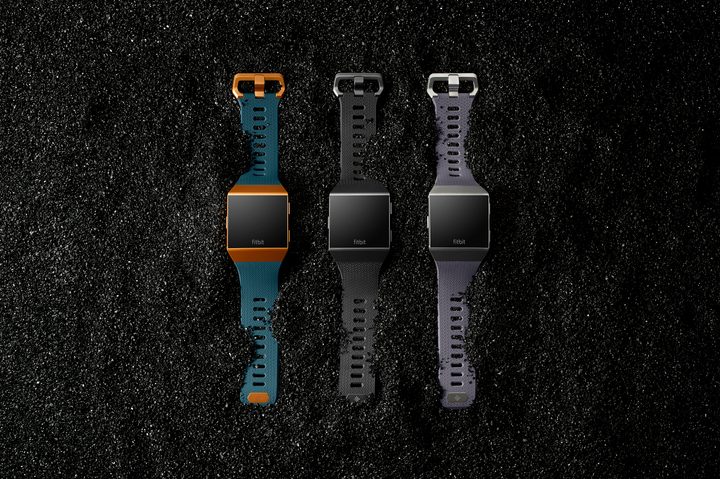
Speaking of swimming, the Ionic is rated water-resistant at 50 meters, and Fitbit says it’s extremely lightweight and comfortable to wear. The watch face has been constructed with nano-molding technology to blend metal and plastic into a unibody form. It looks a little chunky from the exterior, with large bezels around the bright, 1,000-nit, Gorilla Glass 3-clad display — but if you look closely, there’s a subtle curve to the form. It’s available in silver gray, smoke gray, and burnt orange.
Fitness aside, Fitbit has put a tremendous amount of work into making this a feature-complete daily smartwatch for the average user — and to do it, they’ve developed a new operating system and app platform. It’s called Fitbit OS, and the company says it will serve as the software basis for many of its future products. Watch faces and third-party apps will be housed in a hub called the App Gallery. Fitbit has already partnered with the likes of Pandora, Starbucks, AccuWeather, and Strava as some of the first examples on the store.
With the Ionic, Fitbit is also launching Fitbit Pay — it’s NFC-based payment platform that leverages the company’s acquisition of startup Coin a little over a year ago. Visa, American Express, and MasterCard have confirmed to Digital Trends that they are on board. The wearables maker says American Express is also on the way, in addition to support for credit and debit cards from the world’s top banks.
But perhaps the Ionic’s most welcome feature will be its battery life — if it matches Fitbit’s estimations. The Ionic is said to last over four days on a single charge, or up to 10 hours of continuous GPS use or music playback.
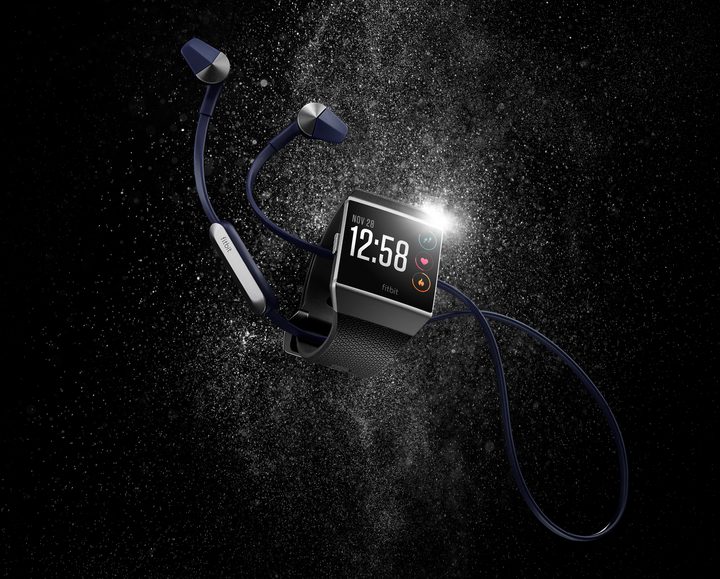
Music is actually a significant aspect of the Ionic. There’s 2.5GB of local storage on the device — good for about 300 songs — as well as the aforementioned Pandora integration. But Fitbit is also launching its first set of Bluetooth headphones alongside the watch, called the Flyer. Developed to work with the Ionic, the sweatproof, durable earbuds deliver audio optimized for workouts.
Verizon has told Digital Trends it will be the exclusive wireless partner for the Ionic, which will go on sale at retailers everywhere in October. The Ionic will run $300, and Verizon says it has started taking pre-orders on Monday, though the device is not yet live on its store at the time of writing.
Update: Fitbit has officially announced the Ionic.


