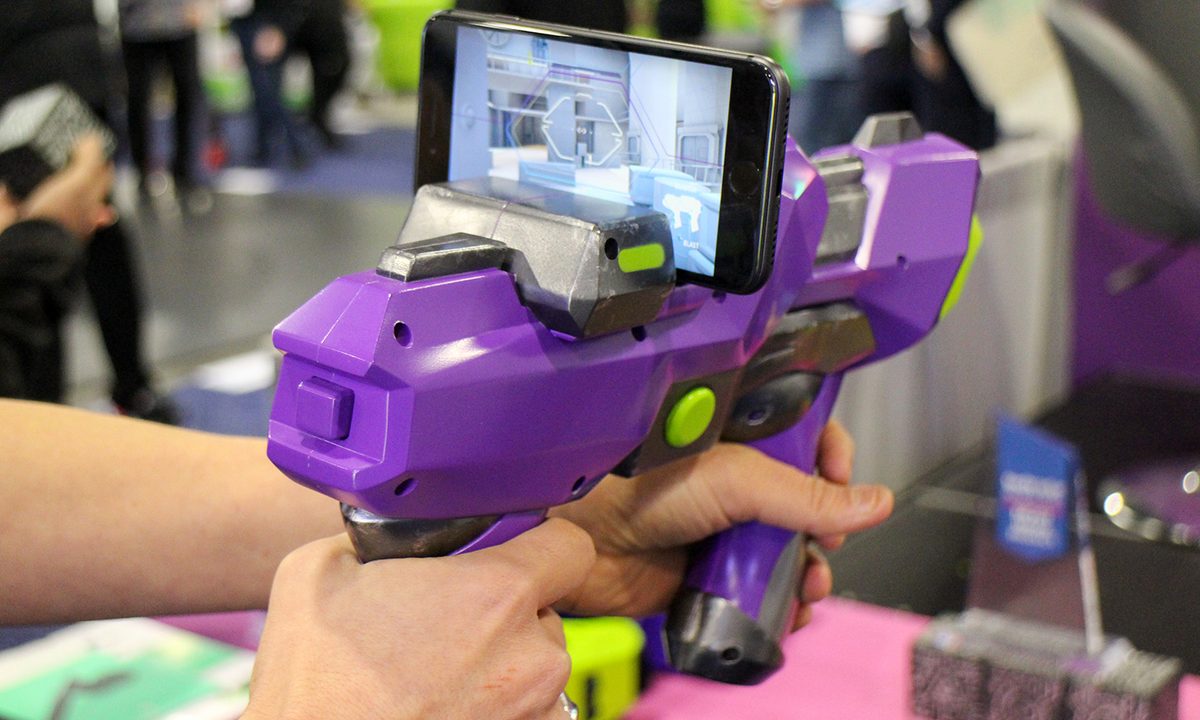
“The Merge Blaster provides free-roaming AR game fun without using a headset.”
- Great early gaming experience
- 6DoF tech works really well
- Blaster looks cool
- No price yet
“Why you can trust Digital Trends – We have a 20-year history of testing, reviewing, and rating products, services and apps to help you make a sound buying decision. Find out more about how we test and score products.“
Augmented reality games sound really cool, but often they’re a disappointment when you try them out. Whether it’s having to wear a headset to play, or the game itself not performing very well, you give up after having only a few goes at it.
The Merge Blaster is an accessory for your smartphone
That’s not the case with the Merge Blaster. We had only a few tries and wanted more. Lots more. It’s one of the most fun AR game experiences we’ve had, and a great demonstration of the new six degrees of freedom (6DoF) technology that’s changing mobile AR and VR experiences. In our Merge Blaster hands-on review, we explain why we liked it so much.
The Merge Blaster is an accessory for your smartphone. It employs positional tracking technology to understand where it is, making use of Apple’s ARKit, Google’s ARCore, and other similar platforms. It’s shaped like a futuristic weapon, and equipped with four different buttons and triggers. These allow you to shoot your weapons, jump, reload, and perform other in-game functions. The gun is light, comfortable to hold, and looks really cool.
On the top is a mounting point for your smartphone. This is the clever part of the Merge Blaster: It doesn’t need you to wear a headset, removing a huge barrier to enjoying free-roaming AR games. Instead, the phone acts as your window into the virtual world.


We played a sci-fi first-person shooter, where you zap robots trying to take you down. The 6DoF tech understands what you’re doing and how you move. You don’t just look left or right, you move left or right. To get closer to the robots, you actually have to move toward them. Everything is tracked on the phone, and the game world syncs to your movement.
It’s surprisingly immersive, but above all, it’s really fun. We were on the CES show floor demoing the Merge Blaster, and weaving in and out of the crowd flow was slightly more awkward than playing in an open area, but definitely no less enjoyable.
The game’s secret is its accuracy. Whether it’s ducking behind cover or sharpshooting an enemy robot, it was exactly on point and not frustrating at all. Add the satisfaction of holding the Blaster itself, and you’ve got a gaming experience you’ll want to repeat.
Merge is still working on the Blaster. The version in our pictures is a prototype, and although the design may not change, the paint and finish will be improved. Merge also has an SDK for developers to build software for the Blaster, and we’re hoping for more games at release. The shooter is a good start, though.
We also tried the Lenovo Mirage Solo mobile VR headset at CES 2018, which uses 6DoF technology, and found the Merge Blaster’s software experience superior because it eliminated the dizziness felt during the ski game on Lenovo’s headset.
There’s no final price for the Merge Blaster, but the company’s VR headset is very reasonably priced, so we’re hoping the Blaster will be similar. The release date will be sometime during summer 2018. We can’t wait for this one.