The United States Patent and Trademark Office granted Apple a new patent (PDF) on Tuesday that describes a VR headset for a smartphone. Called “Head-Mounted Display Apparatus For Retaining A Portable Electronic Device With Display,” the patent details a device similar to Samsung’s Gear VR headset, although this design appears to favor smaller phones and customers who wear glasses.
If you’re not familiar with how the Gear VR headset works, it depends on a smartphone to provide a huge portion of the hardware to generate a virtual experience. The headset itself provides the lenses, a proximity sensor, a touchpad, a Home button, a Back button, and a wheel to sharpen the focus for each user. The phone itself plugs into a built-in jack and snaps in front of the lenses, controlling the touchpad and buttons. Audio is produced through the phone’s headphone jack, not the headset itself.
What’s great about Gear VR is that it supports Samsung’s larger phones, like the Galaxy S6 Edge Plus, which has a 5.7-inch screen. However, Apple’s solution would depend on a smaller screen. Based on the patent, if customers insert a “Plus” size iPhone, the system will display the content smaller than the actual screen, and possibly in a lower resolution, depending on the proximity of the user’s eyes.
“The system is not limited to displaying one image frame,” the patent states. “In some cases, it may be beneficial to provide multiple redundant image frames (dual image frames) in order to implement stereo-like viewing. In cases such as these, the image frames may be displayed at two locations within the display screen. The timing or image characteristics of the dual image frames relative to one another may be varied to provide an enhanced viewing effect.”
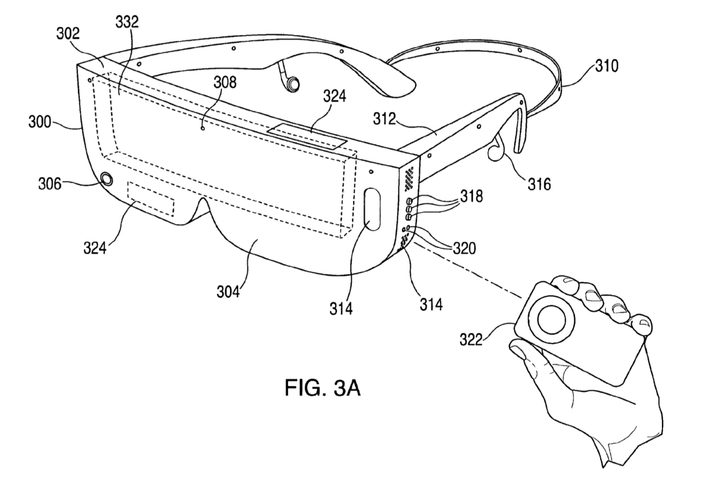
As seen in the diagram above, the company illustrates what appears to be a heavy set of glasses rather than an engulfing headset. The arms (312) play host to built-in, dangling earphones (316) resembling the pair that comes with the company’s iPhone. There’s also a head strap (310) connected to the arms to keep the glasses secure against the wearer’s head, and to possibly hold on to the specs when they’re slipped off for a moment.
Other ingredients shown in the illustration detail the camera region on the front (306), a speaker mounted on the temple (308), and an area for ports to connect external devices (314). Additional connectors or jacks are mounted on the side (320) just below a strip of buttons (318) for navigation, display adjustment, volume, playback, and more. The separate hand-held device (322) represents a remote control, such as the company’s own Apple Remote.
As for where all the hardware is installed, that’s in section 324, as shown in the image. This area will contain memory, sensors, the processor, communications circuity, battery, and so on. Actually, the patent states that these regions can be scattered throughout the form factor, inside or out. Hopefully, that doesn’t mean we’ll be sitting with a pair of glasses on our face sporting long, Wi-Fi antennas like corny couch potatoes from outer space.
“In one example, they are placed in the lower sections on the right and left of the nose support region of the main body,” the patent states. “This section would otherwise not be used because of the configuration of the portable electronic device.”
Apple is seemingly taking a step up from Samsung’s Gear VR headset to provide a sleek solution for iPhone owners that sports its own rechargeable battery. This is just a newly landed patent, of course, and doesn’t mean a solution will hit the market anytime soon.