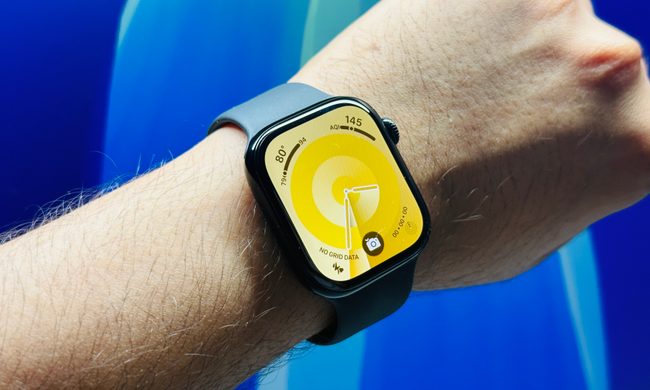
There is no denying the Apple Watch is an impressive feat of engineering. It’s waterproof, for instance, tracks your heart rate and location, and more. But if recent filings from the U.S. Patent and Trademark Office are any indication, the forthcoming version will be even more capable.
One patent describes “limb detection,” or a future Apple Watch’s ability to detect the appendage it is wrapped around — think a soccer-tracking app that measures each kick of your leg, for instance, or a fitness mode that records pull-ups. Apple proposes an algorithmic solution. Data from “position sensing devices” like accelerometers, gyroscopes, and magnetometers could be offloaded to a “processing device” — a phone, for example — that would suss out a wearer’s limb position and recognize the arm or leg wearing the watch.
A second patent, titled “Electronic device having display with curved edges,” describes an Apple Watch with a circular body. “Pixel arrays often have rectangular shapes,” Apple engineers noted in the patent. “However, rectangular pixel arrays will not fit efficiently within a device having a circular shape. Circular displays can have bottleneck regions in which signal lines become crowded, leading to bottleneck regions in which signal lines become crowded, leading to inefficient use of display area. It would therefore be desirable to be able to provide improved displays such as circular displays or displays with curved edges.”
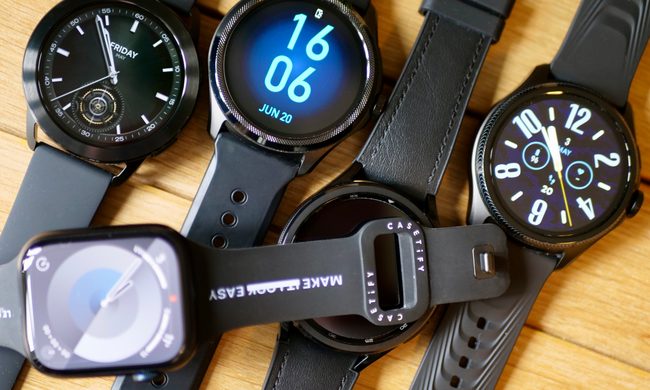
Apple would not be the first out of the gate with a circular smartwatch. Companies like LG, Motorola, Huawei, Samsung, and others have long since beaten the Cupertino, California-based company to the punch. But Apple describes a solution a bit different from what its competitors have adopted — a display that sits in a frame surrounded by an inactive border concealing circuitry, sensors, and other hardware. Pixels would be arranged in columns and rows of different lengths to accommodate the frame’s circular shape, and the electronic lines of the gate driver — the silicon component that powers the watch’s display — would overlap and criss-cross to save space.
Apple has been reluctant to adopt a circular design so far, citing usability concerns. “When a huge part of the function is lists, a circle just doesn’t make any sense,” company design guru Jony Ive famously told The New Yorker last year. But declining smartwatch sales may nudge it to reconsider. While Apple held a steady lead in the wearable market in 2016, competitors like Garmin, Samsung, and Lenovo encroached on its share. According to a report from research firm IDC, Apple shipped just 1.1 million of its Apple Watches in the second quarter of this year compared with 3.9 million a year earlier — a 72 percent decline.
Smartwatch shipments were down overall. Consumers bought 51.6 percent fewer wearable devices in the third quarter, or 2.7 million. Apple nabbed 41 percent of all sales, down from 41 percent in the third quarter of 2015.
Patents are not a great indicator of products to come, of course. But given that limb-tracking and circular wearables are well within the realm of possibility, they have a better chance than most.