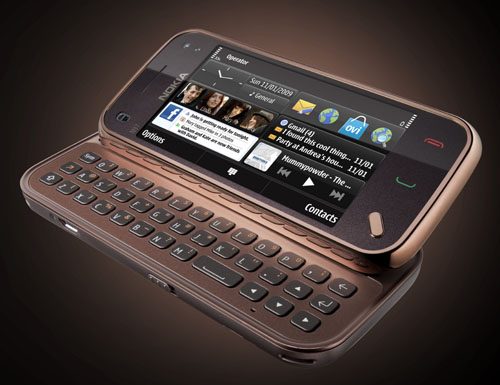
Phone maker Nokia kicked off its Nokia World 09 conference in Stuttgart, amping up its collection of social and lifestyle devices with the new N97 mini, a smaller version of its Internet-savvy smartphone that still packs a tilting 3.2-inch touch display, a QWERTY keyboard, and a fully personalizable homescreen. Noka sees the N97 mini as a companion to its existing N97, and the N97 mini will support “lifecasting,” a collection new utilities and features designed to make the N97 mini a premiere Internet- and location-aware social device by hooking up Nokia Ovi accounts to Facebook.
“People want to bring their physical and online worlds together via the internet,” said Nokia’s Nseries VP Jonas Geust, in a statement. “The Nokia N97 mini is designed for this new social Internet and to help navigate people and places. With lifecasting, the Nokia N97 mini and Ovi usher in the next chapter of personal and location-aware Internet.”
Users will be able to personalize the N97 mini with apps from the Ovi Store, and will offer a new version of Ovi Maps that offers premium content from Lonely Planet, Michelin, and Wcities; the N97 mini will also support interface enhancements like flick scrolling—come October, those will also make their way to the N97 via a software update. The N97 mini should go on sale in October for an estimated retail price of €450; no word on distribution in North America.
Nokia also took the wraps off two new new Comes with Music phones, the Nokia X6 and Nokia X3. The Nokia X6 will feature 32 GB of onboard memory, a 3.2-inch 16:9 touchscreen interface, and a battery life that pushes up to 35 hours of music—plus the phone can tap into Ovi Apps and (thereby) social networking services like Facebook. The Nokia X3 slider phone will be Nokia’s first Series40 device that can tap into the Ovi Store, and will feature a 3.2 megapixel camera and an FM Radio. Both phones should ship in Europe during the fourth quarter of 2009; the X6 will go for an estimated price of €450, while the X3 will run about €115.
Nokia has stated that it plans to bring its Comes with Music service to North America; the idea is that users get an all-you-can-download pass to millions of tracks for 18 months, with the royalty cost of the music built into the phone itself. The music is DRM protected, but users can keep the downloads forever; once the Comes With Music service expires, users have to get a new phone to tap back into it. Reports have Nokia delaying the launch of Comes with Music in the United States until 2010, perhaps in part because DRM restrictions on music available with the service will likely be a big turnoff to consumers who are now accustomed to being able to purchase DRM-free music.
Readers might remember that last week Nokia announced the Booklet 3G, the company’s first entry into the PC market. Industry watchers remain skeptical of Nokia’s efforts to get into the notoriously thin-margined PC market, particularly on the low end…but don’t see the company had a lot of choice considering that PC makers like Asus, Acer, and (of course) Apple are seriously encroaching on Nokia’s mobile market. Today Nokia revealed some specs and details on the Booklet 3G: like a netbook, it will sport a 1.6 GHz Intel Atom processor, and pack a 10.1-inch display, albeit with a native resolution of 1280 by 720 pixels. The system will pack 1 GB of RAM and a 120 GB hard drive, feature HDMI output and offer an SD slot, in addition to its Wi-Fi, Bluetooth, GPRS/EDGE, and 3G connectivity. As anticipated, the system will run Windows 7, but here’s the kicker: Nokia expects to sell the Booklet 3G for €575—that’s currently about $820 USD.