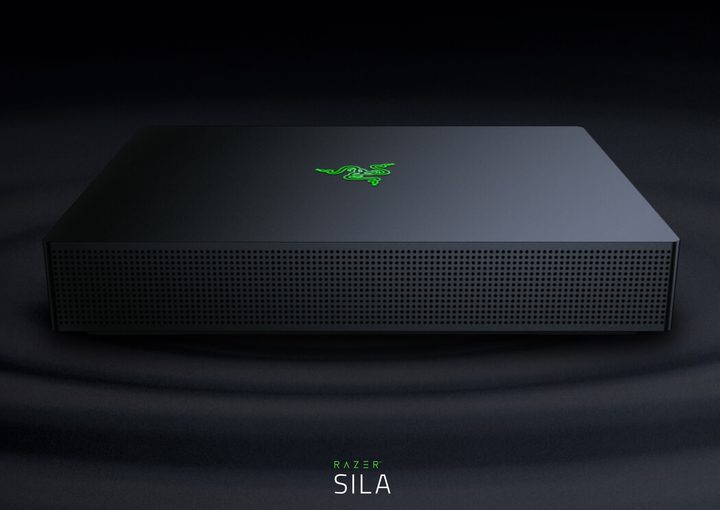
Although Razer made its start in the gaming space by building sleek laptops, mice, and keyboard accessories, the company seemingly wants to own more of the gaming ecosystem. Newer product categories include a gaming phone and speakers, and today, October 3, Razer is entering the wireless router market. The Razer Sila is a tri-band (802.11 a/b/g/n/ac) router that promises to deliver lag-free gaming connections for $250, or 300 euros, starting today.
“Meet Razer Sila — our first gaming router that isn’t just built to deliver unhindered speed, but lets you prioritize your applications for smooth wireless gaming performance,” Razer said on its website. “Say goodbye to congested Wi-Fi networks and experience reliable throughput anytime and anywhere at home.”
As a router, the Sila shares a similar design language with Razer’s recent phone and Blade 15 gaming laptop. Unlike some other offerings in the space, it doesn’t come with a bunch of protruding antennas, and Razer applied its minimalist design philosophy by housing the router’s nine antennas internally in a slim black box.
To give gamers the connection speeds they crave, the Sila relies on Razer’s FasTrack QoS engine to prioritize bandwidth for gaming applications and manage traffic when there are too many devices in use. “By using deep packet inspection and adaptive learning technology, Razer FasTrack allows users to prioritize traffic based on application and device types, from mobile phones and smart TVs through to laptops, PCs or consoles,” Razer said in a statement. “With built-in detection for PlayStation, Xbox, and Switch consoles, users can easily fine tune their networks for the smoothest gaming or streaming experiences. Razer FasTrack also features a one-touch gaming mode, to automatically reserve bandwidth for online gaming.”
The Sila is an 802.11ac wireless router that also adds support for wireless mesh networking. By linking multiple Sila routers together, users can blanket a larger home or space with fast Wi-Fi coverage. It supports multi-user MIMO and beam-forming technology to improve coverage. And like most modern mesh networking devices, Sila comes with its own companion app, available as a free download on iOS and Android devices, that allows users to quickly setup their routers, manage guest networks, and configure parental controls.
If you prefer to use a wired connection instead, the Sila also comes with four Gigabit Ethernet ports. It has two USB ports, one of which is a slower USB 2.0 port, for connecting devices like a printer or external storage drive.
Though not entirely new to the router market, Razer is heavily promoting its Multi-Channel ZeroWait DFS technology on the Sila. This allows the router to scan and automatically switch you to the best channel to avoid congestion. Razer claims that it “utilizes radar-sensing hardware that grants you exclusive access into normally restricted bandwidth frequencies.” We’ll have to test Sila to see how it performs compared to its peers.