  1. Home
  2. Trash
  3. News

Hubble solves the mystery of the bizarre disappearing exoplanet

Add as a preferred source on Google

One of the interesting things about science is that knowledge is constantly being updated. This week, for example, images from the Hubble Space Telescope have led astronomers to question the nature of what was thought to be one of the first exoplanets ever imaged, Fomalhaut b.

First announced in 2008, Fomalhaut b was assumed to be an exoplanet because it was seen to be moving in Hubble images taken between 2004 and 2006. However, there were some oddities about it. It was bright in the visible light spectrum, but it didn’t have an infrared heat signature. And it seemed to be moving along a strange orbit.

Now, in the latest Hubble observations, Fomalhaut b has apparently disappeared.

This makes astronomers think that the object is not in fact a planet, but is actually a cloud of dust particles caused by a tremendous collision of two icy asteroids orbiting the star Fomalhaut. This is even more exciting than an exoplanet, as such collisions are not often observed. The scientists estimate that such an event only occurs in the Fomalhaut system once every 200,000 years.
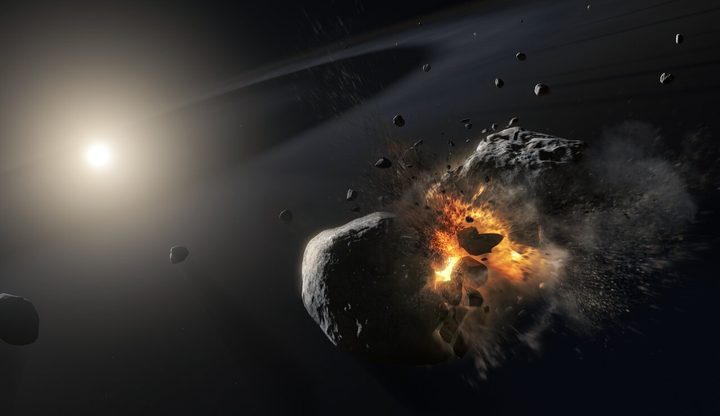
Visualisation of Fomalhaut and Fomalhaut b
Data from the NASA/ESA Hubble Space Telescope have revealed an expanding cloud of dust produced in a collision between two large bodies orbiting the bright nearby star Fomalhaut. This is the first time such a catastrophic event around another star has been imaged. ESA/NASA, M. Kornmesser

“These collisions are exceedingly rare and so this is a big deal that we actually get to see one,” András Gáspár of the University of Arizona said in a statement. “We believe that we were at the right place at the right time to have witnessed such an unlikely event with the Hubble Space Telescope.”

“Our study, which analyzed all available archival Hubble data on Fomalhaut b, including the most recent images taken by Hubble, revealed several characteristics that together paint a picture that the planet-sized object may never have existed in the first place,” he continued.

Researchers believe that the collision must have occurred only shortly before the first observations were taken in 2004. When it happened, a cloud of dust was thrown out which looked like a planet. By the time of the latest observations, the dust had dispersed enough to no longer be visible.

To learn more about this system, astronomers plan to study it with the upcoming James Webb Space Telescope, set to launch next year.

Georgina Torbet
Georgina has been the space writer at Digital Trends space writer for six years, covering human space exploration, planetary…
The Digital Trends App Bundle is yours to try for a whole week, free
Digital Trends App Bundle

Recently, we've entered an exciting collaboration with Maple Media, creating a bundle of 17 apps worth having on your phone. From relaxed fun to serious productivity boosts, these apps cover all your bases and provide a fun boost to your phone. Normally, the bundle is $9.99 per month (far lower than the cost of using the apps individually), but for your first 7 days you can get access to the bundle for free. View the full Digital Trends App Bundle for a complete list of the apps, or read on for a summarized take.

Start your free trial

Read more
The Galaxy S26 Ultra might not see much of a battery upgrade after all
It looks like it will stay the same as the last five years.
The back of the Samsung Galaxy S25 Ultra.

What's happened? This week, China's Quality Certification Center released information about a battery (EB-BS04898ABY) with a maximum capacity of 4,855mAh. That's the same capacity as was previously seen in the Samsung Galaxy S25 Ultra, and fans have taken this certification to mean the Galaxy S26 Ultra will not see a capacity increase after all.

The Samsung Galaxy Ultra models have had the same battery capacity for the last five years.

Read more
The Galaxy Tab S10 Lite is official, and it’ll be here sooner than you think
Galaxy Tab S10 Lite

What's happened? Samsung has officially announced the Galaxy Tab S10 Lite, a budget-friendly alternative to the Galaxy Tab S10. The device has been rumored for months, but this is the first time Samsung has officially acknowledged its existence.

The Galaxy Tab S10 Lite will have a 10.9-inch display and a peak brightness of 600 nits — a bit on the lower side, versus the iPad Pro's maximum brightness of 1,600 nits.

Read more