
NASA’s InSight lander has been struggling to breach the martian surface with its self-hammering heat probe, called the mole, for over a year now. But progress has been made, and NASA recently announced that techniques the engineers have been trying in order to fix the problem seem to have succeeded, and the mole is now underground.
“After several assists from my robotic arm, the mole appears to be underground,” the NASA InSight twitter account announced. “It’s been a real challenge troubleshooting from millions of miles away. We still need to see if the mole can dig on its own.”
After several assists from my robotic arm, the mole appears to be underground. It’s been a real challenge troubleshooting from millions of miles away. We still need to see if the mole can dig on its own. More from our @DLR_en partners: https://t.co/7YjJIF6Asx #SaveTheMole pic.twitter.com/qHtaypoxPp
— NASA InSight (@NASAInSight) June 3, 2020
The problems with InSight began in March last year, when it was first thought that the mole had hit a rock. Since then, the researchers have worked to figure out what might have happened and how to correct for it. The problem seems to be with the soil that InSight has encountered, as it generates less friction than was expected. This means that the mole can’t get a grip on the soil so when it pushes in, it pops back out again.
The engineers tried to fix this issue first through a technique called pinning, in which the weight of the lander was used to push the mole against the wall of its hole. Then they used the scoop on the end of the lander’s arm to push the end of the mole, called the back cap, into the ground.
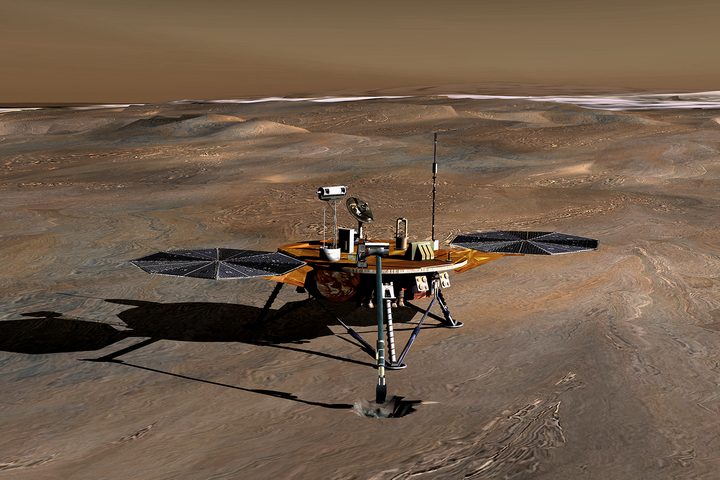
This latest technique seems to have been successful. A blog post by the leader of the InSight’s Heat Flow and Physical Properties Package (HP3) instrument at the German Aerospace Center, Tilman Spohn, gave more details about how scientists have been working to free the mole.
“The team proceeded very carefully,” Spohn wrote. “After each placement, the situation was checked through imaging and recordings of arm motor current data before a number of hammer strokes were commanded. We started the procedure with only a few (25) hammer strokes. Only after the team had gained some confidence in its ability to carefully place the scoop and in the rate of progress of the Mole did we increase the number of hammer strokes per session to, in the end, 150 strokes per session.”
This process took around three months, in which the mole moved from being stuck outside of the soil down to being beneath the soil. “We started about seven centimeters above the surface on Sol 458 (11 March) and we are now at the surface with the scoop on Sol 536 (30 May 30), after six cycles of hammering over 11 weeks,” Spohn wrote.
The team will now continue with more hammering on the back cap before seeing if the mole can dig on its own.



