1. Home
  2. Space
  3. News

See how beautiful the universe looks in the X-ray wavelength

Add as a preferred source on Google

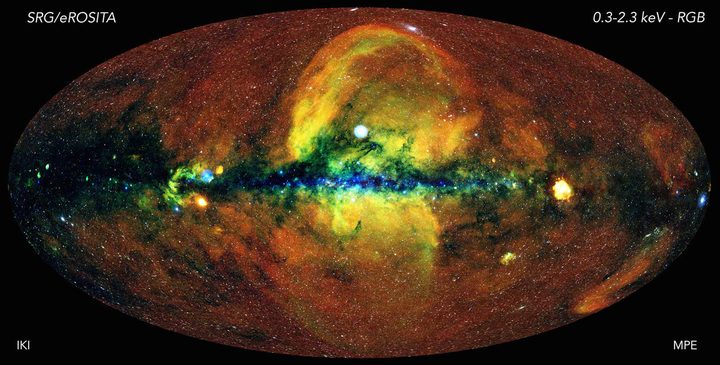
Using the new eROSITA X-ray telescope, scientists have created the deepest-sever view of the sky as seen in the X-ray wavelength.

The image was created over a period of six months, during which the space-based telescope constantly rotated to image most of the sky. Each part of the sky had an exposure of 150 to 200 seconds, allowing an accuracy of measurement of photons of between 2% and 6%. The data was turned into a color-coded image to show the different energies of incoming photons.
The energetic universe
The energetic universe: To generate this image, in which the whole sky is projected onto an ellipse (so-called Aitoff projection) with the center of the Milky Way in the middle and the body of the galaxy running horizontally, photons have been color-coded according to their energy (red for energies 0.3-0.6 keV, green for 0.6-1 keV, blue for 1-2.3 keV). Jeremy Sanders, Hermann Brunner und das eSASS-Team (MPE); Eugene Churazov, Marat Gilfanov (im Namen von IKI)

The eROSITA telescope was launched last year, along with another X-ray telescope, ART-XC. ART-XC looks at high energy X-rays, while eROSITA looks at lower energy X-rays and is able to scan a huge area of the sky. That’s what allowed it to produce this extraordinary image.

Recommended Videos

“This all-sky image completely changes the way we look at the energetic universe,” Peter Predehl, the Principal Investigator of eROSITA at the Max Planck Institute for Extraterrestrial Physics (MPE), said in a statement. “We see such a wealth of detail — the beauty of the images is really stunning.”

The data for the image totaled more than 165 GB collected from seven cameras, which was put together to create this all-sky map. It pinpoints many new sources of X-rays, with a total of around one million objects, including objects such as supernova remnants, binary stars containing neutron stars, and black holes.

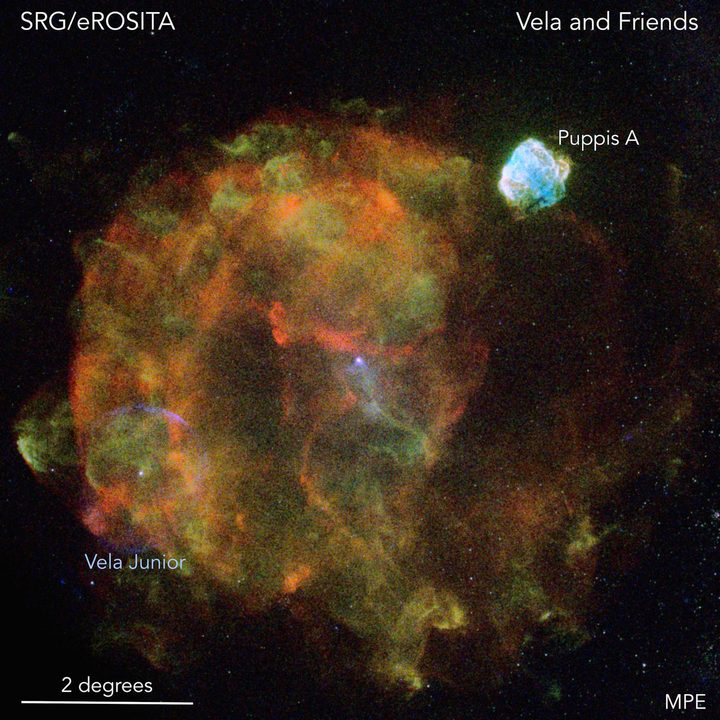
One such object which is close to Earth in relative terms and therefore a very bright source of X-rays is the beautiful Vela supernova remnant, a cloud of dust and gas left over from the explosion of a star 800 light-years away approximately 12,000 years ago.
Vela supernova remnant
Due to its size and close distance to Earth, the “Vela supernova remnant” which is shown in this picture is one of the most prominent objects in the X-ray sky. The objects marked Vela Junior and Puppis A are other, smaller supernova remnants. Peter Predehl, Werner Becker (MPE), Davide Mella

The value of the data isn’t just for its own sake though. It can only be combined with data from other sources in other wavelengths such as visible light or infrared to help scientists see more of the sky.

“We were all eagerly awaiting the first all-sky map from eROSITA,” said Mara Salvato, one of the scientists who worked on combining the eROSITA observations with data from other telescopes. “Large sky areas have already been covered at many other wavelengths, and now we have the X-ray data to match. We need these other surveys to identify the X-ray sources and understand their nature.”


Georgina Torbet
Georgina has been the space writer at Digital Trends space writer for six years, covering human space exploration, planetary…
Space is becoming Bezos and Musk’s next data center site, and we have every reason to worry
The AI boom is coming for the night sky
How Vast's space station will look in orbit.

AI data centers already consume vast amounts of electricity and water on Earth, so Silicon Valley has begun looking somewhere considerably more spacious... literally.

Elon Musk's SpaceX and Jeff Bezos' Blue Origin, along with several other companies, have proposed enormous constellations of satellites designed to operate as orbital data centers. However, environmental groups and former space officials are now warning that putting them into orbit at the proposed scale could have severe consequences for Earth's atmosphere and the night sky.

Read more
The first possible exomoon is here, and it makes our Moon look hilariously tiny
Scientists may have found the first exomoon, except this one is the size of Jupiter
This artist’s concept depicts a potential volcanic moon between the exoplanet WASP-49 b, left, and its parent star. New evidence indicating that a massive sodium cloud observed near WASP-49 b is produced by neither the planet nor the star has prompted researchers to ask if its origin could be an exomoon.

We have already discovered more than 6,000 planets outside of our immediate neighborhood. Yet, finding a moon orbiting one of those distant worlds has proved considerably harder. Astronomers may finally have something close to the real deal, but this particular object stretches the word “moon” almost beyond recognition.

Using the European Southern Observatory’s Very Large Telescope in Chile, researchers detected strong evidence for a moon-like object in the CD-35 2722 system. Further observations are still necessary to confirm the discovery, but it could become the first confidently detected natural satellite outside our solar system. There is still one tiny complication though. This moon is apparently massive.

Read more
China’s answer to SpaceX’s reusable rockets literally catches boosters in a net
SpaceX catches boosters on legs. China just used a net.
Ammunition, Missile, Weapon

SpaceX's playbook for recovering a rocket booster generally involves legs, a precisely controlled vertical landing, and either a concrete pad or a drone ship. 

China just managed to pull off something similar, but in a slightly different way, and on July 10, it tested the method as well.

Read more