NASA astronaut Chris Cassidy on Saturday tweeted a cool shot showing SpaceX’s Crew Dragon spacecraft docked with the International Space Station (ISS). The capsule, seen to the right of the picture, looks tiny alongside the enormous space station, but its interior is actually large enough for a human to perform something close to a somersault.
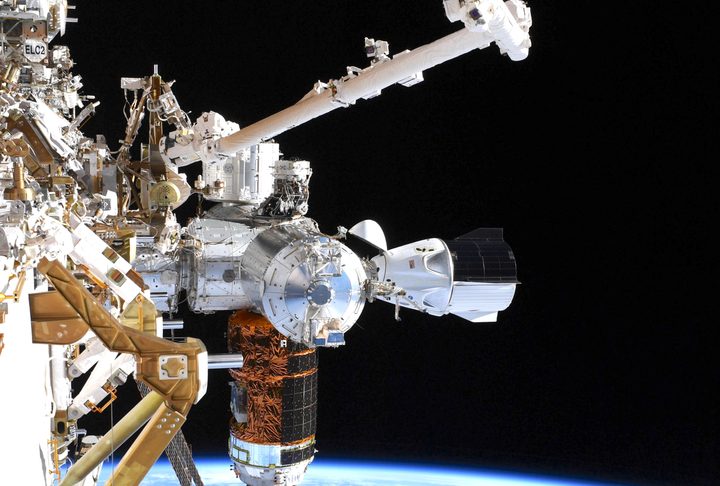
Cassidy captured the image during Friday’s spacewalk with fellow astronaut Bob Behnken. The outing involved ongoing work to upgrade power systems on the space station, swapping old nickel-hydrogen batteries for new lithium-ion batteries. The batteries store power gathered from the station’s main solar arrays and the new ones will provide an improved and more efficient power capacity for the orbiting outpost.
Cassidy later tweeted a couple of other shots from the spacewalk, one a “space selfie” and another taken shortly after the pair returned to the inside of the ISS.
Astronauts cherish every opportunity to be part of a #spacewalk, and yesterday was no different. @AstroBehnken and I completed the first step in updating the external batteries which are connected to the outboard starboard solar arrays on @Space_Station. pic.twitter.com/hsE0bJld5t
— Chris Cassidy (@Astro_SEAL) June 27, 2020
NASA declared the six-hour spacewalk a success and is now preparing another one for Wednesday, July 1, which will see the completion of the work.
Crew Dragon
SpaceX’s capsule made its first-ever crewed launch on May 30, transporting Bob Behnken and Doug Hurley to the ISS as part of the Demo-2 mission.
NASA said last week it’s currently targeting no earlier than August 2 for the return of the Crew Dragon, along with Behnken and Hurley. The trip home will follow the completion of further testing of the spacecraft during its time docked at the space station.
This includes a habitability test scheduled for July 4. It will involve four of the space station’s astronauts entering the capsule and carrying out everyday activities, as well as emergency procedures, to learn more about how it might perform during future crewed missions with more astronauts aboard. While future NASA missions using the Crew Dragon are likely to involve up to four astronauts, upcoming space tourism trips could see as many as seven people heading to space.
Steve Stich, NASA’s Commercial Crew Program manager, said last week, “We’re learning a lot about the vehicle, [such as] how to manage the systems, heaters, and thermal performance as we go through the changes in the orbit,” adding, “The vehicle’s doing extremely well as we put it through its paces.”