  1. Home
  2. Space
  3. News

Betelgeuse is going dim because it’s covered in star spots, research finds

Add as a preferred source on Google

Betelgeuse is normally one of the brightest stars in the night sky, but late last year something strange began happening to it: The star was becoming much less bright than it used to be. In December, astronomers announced that Betelgeuse was dimming dramatically, leading some to think that it could soon explode in an epic supernova.

Although it’s typical for red giant stars like Betelgeuse to vary in brightness over time, in this case, the star’s output dropped so dramatically that scientists figured something unusual must be going on.

Recommended Videos

Further study of the star in February this year showed that it had dimmed by almost two thirds, going down to just 36% of its usual brightness. That difference was enough that it could be observed with the naked eye, even from 500 light-years away. At the time, researchers theorized that the variations could either be due to a dust cloud being ejected from the star and blocking its light, or that the irregular surface of the star could be creating the brightness variations.
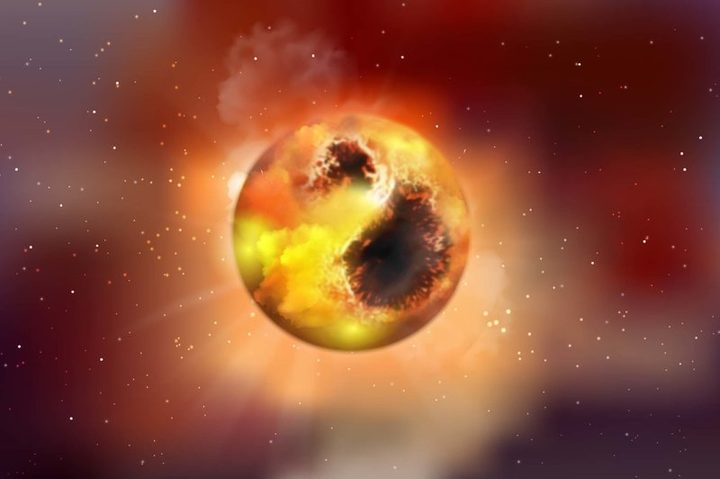
Red Supergiant Betelgeuse
An artist’s impression of the Red Supergiant Betelgeuse. Its surface is covered by large star spots, which reduce its brightness. During their pulsations, such stars regularly release gas into their surroundings, which condenses into dust. MPIA graphics department

New research suggests that this second theory is more likely, and that Betelgeuse’s unusual behavior is due to temperature variations in the lowest layer of the star’s atmosphere caused by star spots. Star spots are similar to sunspots, dark patches that temporarily appear on the surface of the sun due to magnetic fields and give rise to solar flares. These star spots cover between 50% and 70% of Betelgeuse’s entire surface.

“Towards the end of their lives, stars become red giants,” lead author Thavisha Dharmawardena of the Max Planck Institute for Astronomy explained in a statement. “As their fuel supply runs out, the processes change by which the stars release energy. As a result, they bloat, become unstable and pulsate with periods of hundreds or even thousands of days, which we see as a fluctuation in brightness.”

Elderly Betelgeuse has bloated to a size so large — 1,000 times the size of our sun, while only being 20 times the mass — that gravitational forces can easily pull off its outer layers. That leaves behind areas of cool dust and gas, with areas of varying temperatures across the surface that reduce the brightness of the star overall.

One open question is whether Betelgeuse will continue to dim or will rebound in brightness. We know that sunspots on our sun follow an 11-year cycle, but scientists aren’t yet sure if the same is true of star spots on giant stars.

“Observations in the coming years will tell us whether the sharp decrease in Betelgeuse’s brightness is related to a spot cycle,” Dharmawardena said. “In any case, Betelgeuse will remain an exciting object for future studies.”

The findings are published in the Astrophysical Journal Letters.

Georgina Torbet
Georgina has been the space writer at Digital Trends space writer for six years, covering human space exploration, planetary…
Space is becoming Bezos and Musk’s next data center site, and we have every reason to worry
The AI boom is coming for the night sky
How Vast's space station will look in orbit.

AI data centers already consume vast amounts of electricity and water on Earth, so Silicon Valley has begun looking somewhere considerably more spacious... literally.

Elon Musk's SpaceX and Jeff Bezos' Blue Origin, along with several other companies, have proposed enormous constellations of satellites designed to operate as orbital data centers. However, environmental groups and former space officials are now warning that putting them into orbit at the proposed scale could have severe consequences for Earth's atmosphere and the night sky.

Read more
The first possible exomoon is here, and it makes our Moon look hilariously tiny
Scientists may have found the first exomoon, except this one is the size of Jupiter
This artist’s concept depicts a potential volcanic moon between the exoplanet WASP-49 b, left, and its parent star. New evidence indicating that a massive sodium cloud observed near WASP-49 b is produced by neither the planet nor the star has prompted researchers to ask if its origin could be an exomoon.

We have already discovered more than 6,000 planets outside of our immediate neighborhood. Yet, finding a moon orbiting one of those distant worlds has proved considerably harder. Astronomers may finally have something close to the real deal, but this particular object stretches the word “moon” almost beyond recognition.

Using the European Southern Observatory’s Very Large Telescope in Chile, researchers detected strong evidence for a moon-like object in the CD-35 2722 system. Further observations are still necessary to confirm the discovery, but it could become the first confidently detected natural satellite outside our solar system. There is still one tiny complication though. This moon is apparently massive.

Read more
China’s answer to SpaceX’s reusable rockets literally catches boosters in a net
SpaceX catches boosters on legs. China just used a net.
Ammunition, Missile, Weapon

SpaceX's playbook for recovering a rocket booster generally involves legs, a precisely controlled vertical landing, and either a concrete pad or a drone ship. 

China just managed to pull off something similar, but in a slightly different way, and on July 10, it tested the method as well.

Read more

