1. Home
  2. Space
  3. News

Astronomers have found our Milky Way’s galactic twin

Add as a preferred source on Google

Astronomers have spotted an oddity from the ancient universe: An extremely distant young galaxy which looks unexpectedly similar to our Milky Way.

The galaxy, known by the not terribly pithy name of SPT0418-47, is located so far away that light from it takes more than 12 billion years to reach us. This means that observing it is like looking back in time to when the universe was very young, at just 1.4 billion years old. And surprisingly, the galaxy looks remarkably like our own, much older galaxy.

Recommended Videos

Scientists had previously believed that all galaxies which formed in the early universe were chaotic and unstable, unlike our relatively sedate galaxy. But this new finding challenges that belief.

“This result represents a breakthrough in the field of galaxy formation, showing that the structures that we observe in nearby spiral galaxies and in our Milky Way were already in place 12 billion years ago,” lead researcher Francesca Rizzo, Ph.D. student from the Max Planck Institute for Astrophysics in Germany, said in a statement.
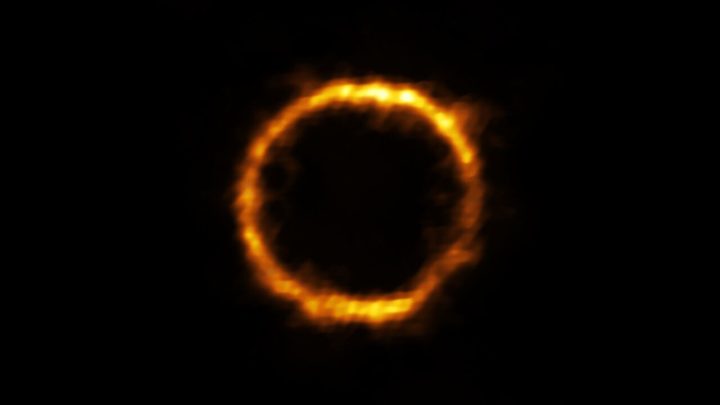
an extremely distant galaxy that looks surprisingly like our Milky Way
Astronomers using ALMA have revealed an extremely distant galaxy that looks surprisingly like our Milky Way. The galaxy, SPT0418-47, is gravitationally lensed by a nearby galaxy, appearing in the sky as a near-perfect ring of light. ALMA (ESO/NAOJ/NRAO), Rizzo et al.

The image of the galaxy shown above appears in a ring shape due to the way in which the data about it was collected. As the galaxy is so far away, it is impossible to see using typical methods. So the team collected data with the Atacama Large Millimeter/submillimeter Array (ALMA) by using a nearby galaxy as a magnifying glass, with a technique called gravitational lensing.

Then, to see the distant galaxy as it actually exists, they reconstructed a realistically shaped image from this ring using computer modeling.

“When I first saw the reconstructed image of SPT0418-47 I could not believe it,” Rizzo said. “A treasure chest was opening.”
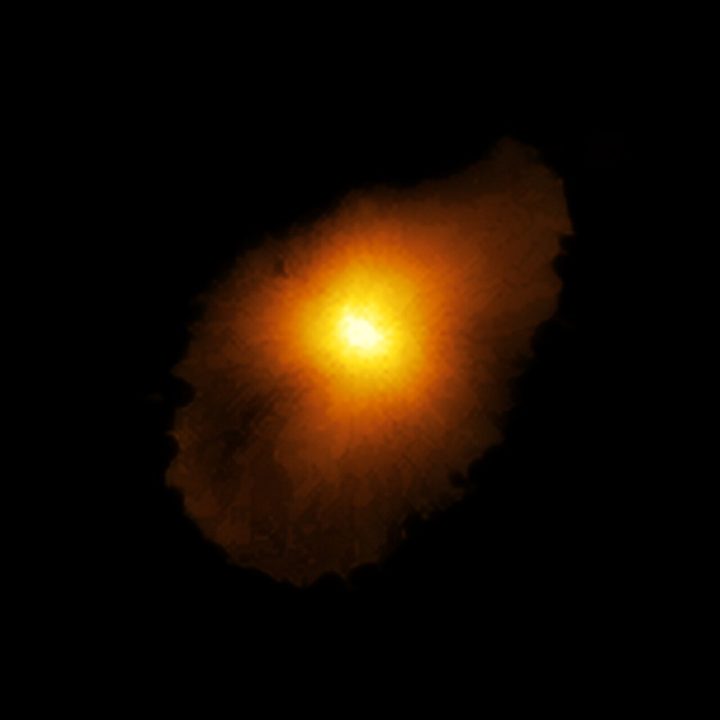
Reconstructed view of SPT0418-47
The research team reconstructed the distant galaxy’s true shape, shown here, and the motion of its gas from the ALMA data using a new computer modeling technique. ALMA (ESO/NAOJ/NRAO), Rizzo et al.

When looking at this reconstructed image, the researchers could tell that the galaxy was orderly and showed features similar to much older galaxies. “The big surprise was to find that this galaxy is actually quite similar to nearby galaxies, contrary to all expectations from the models and previous, less detailed, observations,” co-author Filippo Fraternali, from the Kapteyn Astronomical Institute, University of Groningen in the Netherlands said in the statement.

This raises questions as to how such an orderly galaxy was able to form in the chaos of the early universe, and indicates that our previous assumptions about galactic evolution may be incorrect.

“What we found was quite puzzling; despite forming stars at a high rate, and therefore being the site of highly energetic processes, SPT0418-47 is the most well-ordered galaxy disc ever observed in the early universe,” explained co-author Simona Vegetti, also from the Max Planck Institute for Astrophysics. “This result is quite unexpected and has important implications for how we think galaxies evolve.”

The findings are published in the journal Nature.

Georgina Torbet
Georgina has been the space writer at Digital Trends space writer for six years, covering human space exploration, planetary…
Amazon’s Starlink rival just crossed a major milestone, but don’t expect perfect internet just yet
Amazon finally showed up to the space internet party
Amazon Leo satellite layout across all launch vehicles

Amazon has taken a significant step toward launching its long-awaited satellite internet service. Following its latest rocket launch, the company now has 396 Project Kuiper satellites in low-Earth orbit, enough to begin offering continuous service across select regions. The milestone keeps Amazon on track for its previously announced goal of launching commercial service by mid-2026.

https://twitter.com/Weber44Chris/status/2072575499461963938?ref_src=twsrc%5Etfw%7Ctwcamp%5Etweetembed%7Ctwterm%5E2072575499461963938%7Ctwgr%5Ed727a1b853cbf519585e7bf2655943afb2f91bb8%7Ctwcon%5Es1_&ref_url=https%3A%2F%2Fwww.theverge.com%2Fscience%2F960563%2Famazon-leo-service-tipping-point

Read more
Amazon’s Starlink rival is set to launch satellite internet later this year
After launching nearly 400 satellites, Amazon says its Leo broadband service will go live later this year.
Atlas V launches 29 Amazon Leo satellites from Cape Canaveral, Florida

Amazon's long-awaited answer to SpaceX's Starlink is finally nearing liftoff. According to an exclusive report from Reuters, the company plans to begin offering its Leo satellite internet service later this year, after its latest rocket launch pushed the constellation to 394 satellites in orbit.

The pieces are finally falling into place for Project Kuiper

Read more
NASA is investing $590 million in private contractors to build humanity’s first Moon outpost
NASA is counting on private companies to land its Moon Base dream.
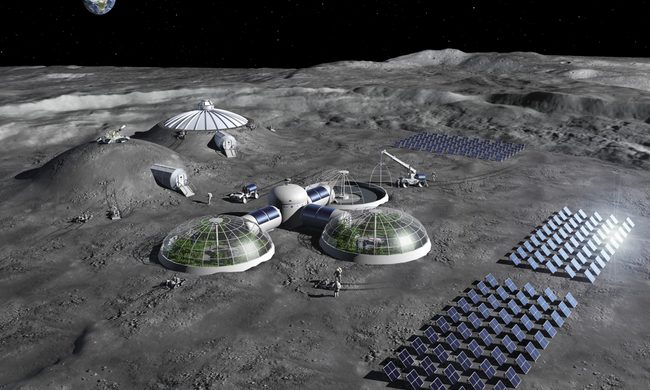
Artist impression of a Moon Base concept, with solar arrays for energy generation, greenhouses for food production, and habitats shielded with regolith.

Building a permanent base on the Moon sounds like science fiction, but NASA is making it feel a lot more real. The agency just handed $590 million in contracts to three private companies for four uncrewed lunar lander missions launching in late 2028.

These missions are part of Phase 1 of NASA's broader $30 billion Moon Base program, which needs to deliver landers, rovers, and scientific cargo up there before astronauts eventually move in. These efforts are closely tied NASA's Artemis program, which sent humans on a lunar flyby in April for the first time since the Apollo era.

Read more