
In an era of drastic climate change, we’re becoming more aware of the results of our actions on Earth’s environment. But one topic which doesn’t get so much consideration is the issue of light pollution. Not only does excessive light pollution interfere with astronomers observing the night sky, but it can also disrupt ecosystems and even have adverse effects on human health by affecting circadian rhythms.
Now, a new study from researchers in Germany, the U.S., and Ireland has looked at how much street lighting contributes to the problem of light pollution, and how smart city lighting could reduce it. The researchers focused on the city of Tucson in, Arizona, which has smart lighting technology, and they used the Suomi National Polar-orbiting Partnership (NPP) satellite to take images of the city on cloudless nights. Then they assessed how much light in the images came from the streetlights.
They found that only 20% of the light in the images of Tucson comes from streetlights. The city has a smart streetlight system, which adjusts illumination over time. Usually, When night falls in the city the streetlights start out at 90% illumination, dropping to 60% at midnight. But for the experiment, the lights were set at 100% brightness on some nights and 30% brightness on others.
“When sensors and control systems are installed throughout an entire city, it is possible to make a change in how the city works, and then measure the impact that change has on the environment, even from outer space,” lead author Dr. Christopher Kyba from the GFZ German Research Centre for Geosciences said in a statement.
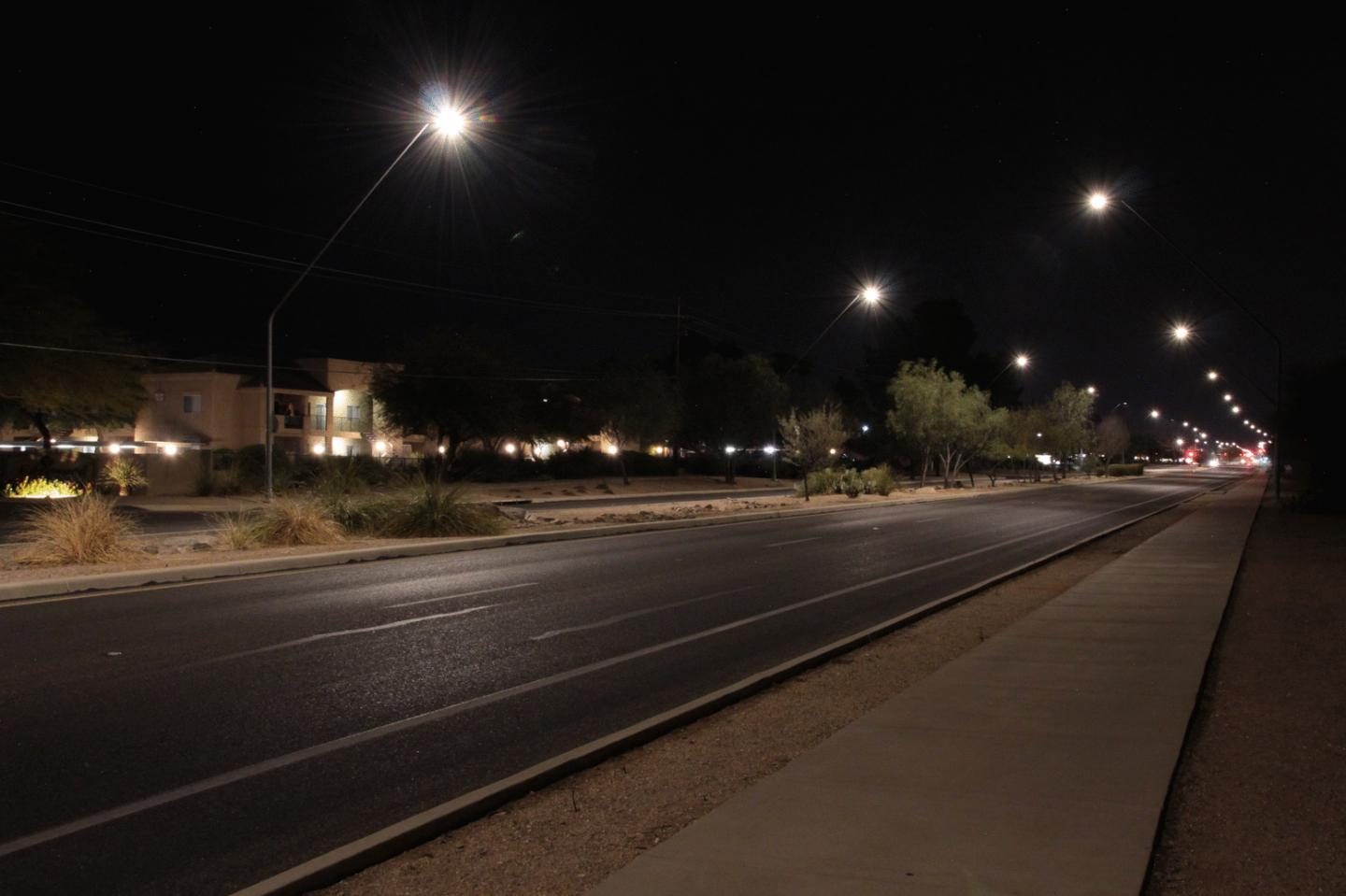
Another experiment during the same period took the opposite measurements: How much of the night sky could be seen from the ground. Once again, the researchers found that most of the sky brightness was from other sources, not the streetlights.
“Taken together, these studies show that in a city with well-designed streetlights, most of the light emissions and light pollution come from other lights,” co-author Dr. John Barentine from the International Dark-Sky Association explained. He and the other authors suggested that the city government should think about sources like lit signs and facades as well as street lighting when tackling light pollution.
The smart lighting technology allows for more experimentation and adjustments in the future as well. “Instead of dimming lights to the same level late each night, a city could instead dim to 45% on even days and 55% on odd days,” Kyba suggested. “City residents wouldn’t notice any difference, but that way we could measure how the contribution of different light types is changing over time.”



