Intel’s discrete Xe desktop graphics card may be getting closer to launch. The Xe discrete GPU was recently spotted in a leaked Geekbench benchmark test, revealing key specifications behind the entry-level desktop card. Though unannounced by Intel, the fact that the discrete Xe GPU is undergoing testing suggests that it could soon debut, and a potential launch could happen at CES in January 2021.
According to the Geekbench database, the card was spotted with 128 compute units, 1,024 cores, 3GB of video RAM, and a clock speed of 1.4 GHz. The benchmark was spotted by Twitter user @TUM_APISAK, and the benchmark revealed that the card was paired with Intel’s 9th-Gen processor for testing. Specifically, it was used with an Intel Core i5-9600K silicon with 16GB of system memory.
The card’s specifications from the Geekbench test matches what was spotted previously on the SiSoftware database, which listed Intel’s Gen12 desktop graphics with the same clock speed and the same number of compute units. They could debut as the DG2.
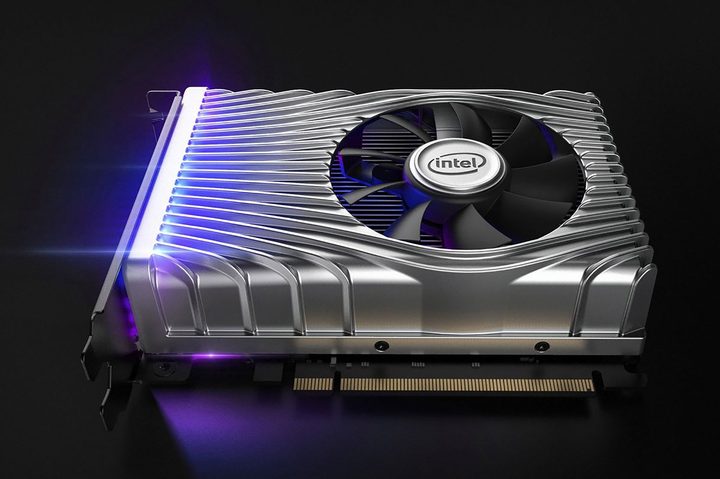
It’s unclear how the final card — with proper drivers and software support — will perform, but the leaked Geekbench score of 9,311 is below the 15,000-point performance of the Intel Iris Xe Max discrete laptop GPU in the same test. We would expect the desktop part to perform better than the laptop part when released, especially since the Iris Xe Max ships with just 96 execution units and 768 cores.
The new desktop part will likely not be based on the same Xe-LP architecture that the Iris Xe Max is based upon, since the LP design maxes out with 96 cores. Instead, this card could likely be an early version of either Intel’s upcoming Xe-HP or Xe-HPG architecture, according to a report on Wccftech. The Xe-HPG is likely to be designed for mainstream computing and high-end gaming, and it tops out with 512 execution units and comes with GDDR6 memory. The VRAM should make the GPU competitive against recent offerings from Nvidia and AMD, like the former’s GeForce RTX 3070. More premium GPUs from Nvidia, like the RTX 3080, utilize a faster GDDR6X memory standard.
It’s expected that the Intel Xe-HPG will be part of Intel’s second generation of discrete graphics card, known as the DG2. The Intel Xe-LP on Tiger Lake notebooks is part of the DG1 family. With just a few weeks to go until CES starts in early 2021, we won’t have much longer to wait to see if Intel will choose that venue to unveil its DG2 card. Given recent GPU launches from AMD and Nvidia, and Apple’s transition to its own M1 processors on the Mac, strong performance by the DG2 will allow Intel to stay competitive in the space.