1. Home
  2. Space
  3. News

There’s an asteroid the size of a small planet lurking in our solar system

Add as a preferred source on Google

Scientists studying a shard of meteorite have found evidence that it comes from a previously unknown asteroid that could be as large as the dwarf planet Ceres. The meteorite, Almahata Sitta (AhS), fell to Earth in 2008, and the researchers studied its composition to learn about the asteroid from which it came.

A meteorite is the name for a piece of debris that falls to Earth, and this particular one comes from an asteroid, which is a small object which orbits the sun. Asteroids are typically much smaller than planets and are most commonly clustered in the asteroid belt between Jupiter and Mars. Within this asteroid belt, the largest known object is a dwarf planet called Ceres.

Recommended Videos

Now, the new evidence suggests another asteroid as big as Ceres may exist somewhere else out in the solar system.

SwRI scientists studied the composition of a small shard of a meteoroid to determine that it likely originated from a previously unknown parent asteroid. This false-color micrograph of the meteoroid sample shows the unexpected amphibole crystals identified in orange.
SwRI scientists studied the composition of a small shard of a meteoroid to determine that it likely originated from a previously unknown parent asteroid. This false-color micrograph of the meteoroid sample shows the unexpected amphibole crystals identified in orange. Courtesy of NASA/USRA/Lunar and Planetary Institute

The researchers from the Southwest Research Institute (SwRI) looked at a tiny sample of meteorite AhS to learn about the body it came from. “We were allocated a 50-milligram sample of AhS to study,” Dr. Vicky Hamilton, first author of the paper, explained in a statement. “We mounted and polished the tiny shard and used an infrared microscope to examine its composition. Spectral analysis identified a range of hydrated minerals, in particular amphibole, which points to intermediate temperatures and pressures and a prolonged period of aqueous alteration on a parent asteroid at least 400, and up to 1,100, miles in diameter.”

This means that the asteroid the sample came from must have been large and that it formed in the presence of water. It’s rare to find the mineral amphibole in this kind of meteorite, called a carbonaceous chondrite (CC) meteorite, making AhS an unusual specimen and one which is particularly useful for learning about the early solar system.

We may well learn more about the early solar system from the study of two recently visited asteroids, Ryugu and Bennu. Ryugu was visited by Japan’s Hayabusa 2, which recently returned a sample to Earth, and Bennu has been visited by NASA’s OSIRIS-REx, which should return a sample in 2023.

These samples, which are collected from asteroids directly, may differ from those like AhS which have fallen to Earth and been affected by their journey through the atmosphere.

“If the compositions of the Hayabusa2 and OSIRIS-REx samples differ from what we have in our collections of meteorites, it could mean that their physical properties cause them to fail to survive the processes of ejection, transit and entry through Earth’s atmosphere, at least in their original geologic context,” said Hamilton. “However, we think that there are more carbonaceous chondrite materials in the solar system than are represented by our collections of meteorites.”

The findings are published in the journal Nature.

Georgina Torbet
Georgina has been the space writer at Digital Trends space writer for six years, covering human space exploration, planetary…
Amazon’s Starlink rival just crossed a major milestone, but don’t expect perfect internet just yet
Amazon finally showed up to the space internet party
Amazon Leo satellite layout across all launch vehicles

Amazon has taken a significant step toward launching its long-awaited satellite internet service. Following its latest rocket launch, the company now has 396 Project Kuiper satellites in low-Earth orbit, enough to begin offering continuous service across select regions. The milestone keeps Amazon on track for its previously announced goal of launching commercial service by mid-2026.

https://twitter.com/Weber44Chris/status/2072575499461963938?ref_src=twsrc%5Etfw%7Ctwcamp%5Etweetembed%7Ctwterm%5E2072575499461963938%7Ctwgr%5Ed727a1b853cbf519585e7bf2655943afb2f91bb8%7Ctwcon%5Es1_&ref_url=https%3A%2F%2Fwww.theverge.com%2Fscience%2F960563%2Famazon-leo-service-tipping-point

Read more
Amazon’s Starlink rival is set to launch satellite internet later this year
After launching nearly 400 satellites, Amazon says its Leo broadband service will go live later this year.
Atlas V launches 29 Amazon Leo satellites from Cape Canaveral, Florida

Amazon's long-awaited answer to SpaceX's Starlink is finally nearing liftoff. According to an exclusive report from Reuters, the company plans to begin offering its Leo satellite internet service later this year, after its latest rocket launch pushed the constellation to 394 satellites in orbit.

The pieces are finally falling into place for Project Kuiper

Read more
NASA is investing $590 million in private contractors to build humanity’s first Moon outpost
NASA is counting on private companies to land its Moon Base dream.
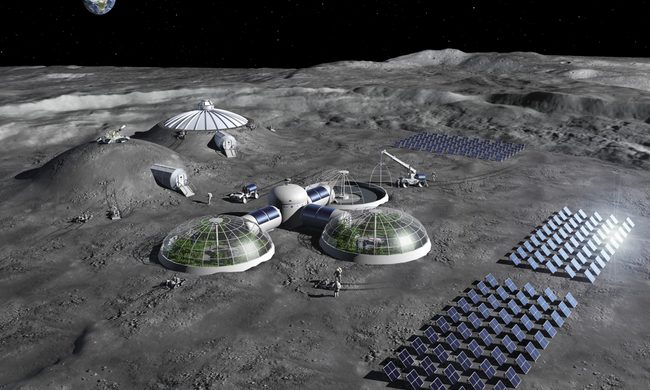
Artist impression of a Moon Base concept, with solar arrays for energy generation, greenhouses for food production, and habitats shielded with regolith.

Building a permanent base on the Moon sounds like science fiction, but NASA is making it feel a lot more real. The agency just handed $590 million in contracts to three private companies for four uncrewed lunar lander missions launching in late 2028.

These missions are part of Phase 1 of NASA's broader $30 billion Moon Base program, which needs to deliver landers, rovers, and scientific cargo up there before astronauts eventually move in. These efforts are closely tied NASA's Artemis program, which sent humans on a lunar flyby in April for the first time since the Apollo era.

Read more