Verizon Communications Inc., the largest wireless carrier in the country, is finding there’s an end to the number of people who will sign two-year contracts for cell phone service.
Verizon said Thursday that it gained a net of just 423,000 wireless customers under contract in the first three months of the year. That was the lowest number in nearly a decade, and below analyst expectations.
Its chief competitor, AT&T Inc., also reported a relatively low number of contract customers for the first quarter when it reported first-quarter results Wednesday. But AT&T did somewhat better, signing up 512,000 with help from the iPhone.
Verizon said it does not appear to be losing market share to other carriers. Rather, the results demonstrate that the engine that has kept the wireless industry booming for more than a decade is now running out of steam. Nearly everyone already has a cell phone.
Verizon’s chief financial officer, John Killian, also signaled that the company may stepping up the pace of layoffs in its shrinking wireline business.
“In the last couple of years we’ve reduced our wireline work force by about 13,000 per year and I said we’d do the same this year. I now actually think we have the ability to do more this year,” Killian said. Verizon ended the quarter with 217,100 employees.
Late Wednesday, Verizon reached an agreement with its two largest unions that would allow it to make enhanced buyout offers, getting around some previous limitations on layoffs in its labor contracts.
Like AT&T, Verizon hopes to keep revenue growth in wireless going by signing up more people for smart phones, which require people to pay extra every month for data service. Verizon aggressively marketed phones based on Google Inc.’s Android software late last year, and that has been paying off, Killian said. However, Verizon didn’t release any significant new devices in the first quarter, which partly explained the low number of new contracts, he said.
About 30 percent of Verizon subscribers have a smart phone or multimedia phone capable of “3G,” or broadband, data speeds. The corresponding figure at AT&T is about 50 percent.
That meant that while Verizon’s wireless service revenue grew 5.9 percent from a year ago, to $13.8 billion, AT&T managed to grow its corresponding figure by 10.3 percent.
To keep revenue growing, the carriers are looking at other avenues. One is prepaid service, which is usually cheaper than contract plans and available to consumers without credit. Verizon lost 139,000 prepaid customers under its own brand in the quarter, but added 1.3 million through resellers.
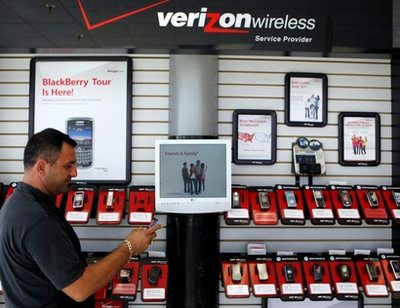 In total, Verizon added 1.55 million wireless customers in the quarter, comparable to the 1.3 million it added in the same quarter last year. But since far fewer signed contracts, they’re worth much less to Verizon. It ended the quarter with 92.8 million subscribers. AT&T had 87 million.
Verizon also revealed for the first time that it serves 7.3 million non-phone devices like vehicle trackers and industrial sensors. That’s an area that’s expected to grow quickly, and one where AT&T competes as well.
Overall, Verizon said its earnings fell by three-quarters in the first three months of the year, brought down in large part by the one-time tax effect of the health care reform bill.
The New York company earned $409 million, or 14 cents per share, in the quarter, down from $1.6 billion, or 58 cents per share, a year ago.
The results included a previously announced a charge of 34 cents per share, to reflect a change in the health care reform package regarding the tax treatment of benefits.
Excluding that and other one-time items, Verizon said it earned 56 cents per share, matching the average analyst estimate as polled by Thomson Reuters.
Revenue rose 1.2 percent to $26.9 billion, matching analyst expectations.
Verizon shares fell 49 cents, or 1.7 percent, to $29.05 in midday trading.
Some analysts have questioned whether Verizon can maintain its quarterly dividend of 47.5 cents per share, given that nearly all of its cash flow comes from Verizon Wireless, which is 45 percent owned by Vodafone Group PLC.
Killian dismissed that line of thinking.
“We have the ability to pay the dividend. I’m surprised that becomes as big of a question as it does become, given all of the levers and all of the cash flow that we have,” Killian said.
He repeated that Verizon has a longstanding desire to buy out Vodafone’s stake at the right price, but didn’t supply any support for another rumored option: that Vodafone would buy Verizon outright.
“We’re not convinced there’s industrial logic behind putting the two companies together,” he said. “Cross-border mergers have not historically been very successful.”