  1. Home
  2. Space
  3. News

Enormous sky survey creates the most accurate map yet of universe’s dark matter

Add as a preferred source on Google

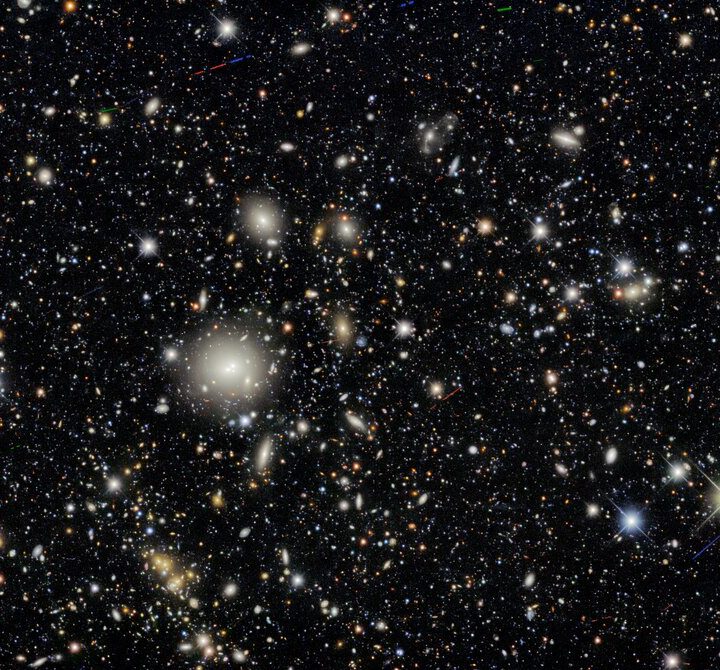
Ten areas in the sky were selected as “deep fields” that the Dark Energy Camera imaged several times during the survey, providing a glimpse of distant galaxies and helping determine their 3D distribution in the cosmos. The image is teeming with galaxies — in fact, nearly every single object in this image is a galaxy. Some exceptions include a couple of dozen asteroids as well as a few handfuls of foreground stars in our own Milky Way.
Ten areas in the sky were selected as “deep fields” that the Dark Energy Camera imaged several times during the survey, providing a glimpse of distant galaxies and helping determine their 3D distribution in the cosmos. The image is teeming with galaxies — in fact, nearly every single object in this image is a galaxy. Some exceptions include a couple of dozen asteroids as well as a few handfuls of foreground stars in our own Milky Way. Dark Energy Survey/DOE/FNAL/DECam/CTIO/NOIRLab/NSF/AURA Acknowledgments: T.A. Rector (University of Alaska Anchorage/NSF’s NOIRLab), M. Zamani (NSF’s NOIRLab) & D. de Martin (NSF’s NOIRLab)

We can’t see it, but we know it’s there: The mystery of dark matter has been puzzling astronomers since the 1930s. We know that ordinary matter makes up just 5% of all that exists in the universe, with the remaining 68% being made up of dark energy and 27% of dark matter. But the exact nature of this matter and energy remains a subject of debate.

Recommended Videos

To learn more, a project called the Dark Energy Survey (DES) has observed more than 226 million galaxies covering one-eighth of the sky, collecting data that can provide the most precise measurements yet of what the universe is made of and how it is expanding. The data from the project’s first three years is now being released in 29 new scientific papers.

“Most of the matter in the Universe is dark matter,” explained co-lead author of one of the studies Niall Jeffrey, of École Normale Supérieure and University College London. “It is a real wonder to get a glimpse of these vast, hidden structures across a large portion of the night sky. These structures are revealed using the distorted shapes of hundreds of millions of distant galaxies with photographs from the Dark Energy Camera in Chile.”

Jeffrey’s group analyzed the DES data using artificial intelligence methods to create a map of dark matter as seen from the southern hemisphere. The final map covers around a quarter of the sky seen from this hemisphere:
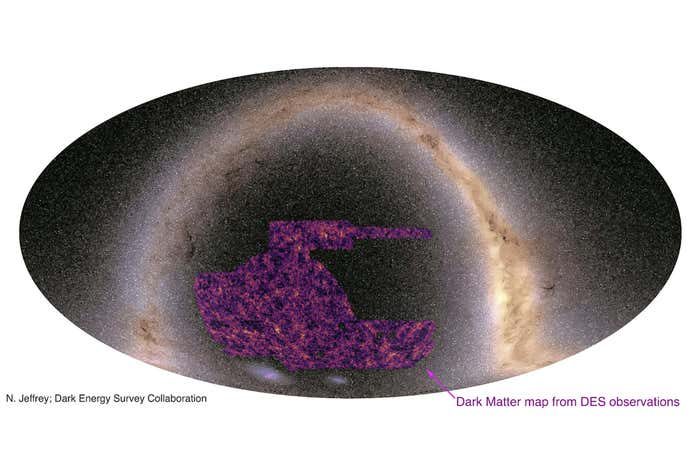
A map of the southern hemisphere sky, with the region of dark matter mapped by DES shown in pink.
A map of the southern hemisphere sky, with the region of dark matter mapped by DES shown in pink. N. Jeffrey/Dark Energy Survey collaboration

“In our map, which mainly shows dark matter, we see a similar pattern as we do with visible matter only– a web-like structure with dense clumps of matter separated by large empty voids,” Jeffrey explained. “Observing these cosmic-scale structures can help us to answer fundamental questions about the Universe.”

The researchers were able to map the dark matter by seeing the way that its gravity distorts light, in a technique called gravitational lensing. From these distortions, they could estimate how much dark matter must be present in a particular region. This work flattens the 3D universe into a 2D map and so for the next phase of investigation, the researchers want to build up a 3D view of the dark matter.

The data gathered by DES can also tell us about the big questions in cosmology, like how the universe grew after the Big Bang and how “smooth” the universe is — meaning how much matter clumps together. In fact, the smoothness calculated by the project seems to be a little off from what current models would have predicted. Researchers in the project say they want to collect more data to understand whether there is a difference in smoothness found between the DES survey and analysis of the leftover radiation from the Big Bang, called the cosmic microwave background (CMB).

“It would be very exciting to find contradictions between galaxy surveys like DES and analyses of the CMB, as they would provide hints of new physics,” said Pablo Lemos, co-author of another paper. “This observed difference in the clustering of matter could be one such contradiction, but we will need more data to confirm it.”

Georgina Torbet
Georgina has been the space writer at Digital Trends space writer for six years, covering human space exploration, planetary…
Scientists warn Elon Musk’s orbital data centers could blind Earth’s biggest telescopes
A new ESO study suggests millions of satellites could make parts of the night sky effectively unusable for astronomy.
One hour of satellites over the northern Atacama Desert in Chile (October 2025)

The race to blanket Earth with satellite internet has unlocked faster connectivity for millions. But according to the European Southern Observatory (ESO), it could also make one of humanity's oldest hobbies, and one of its most important sciences, a whole lot harder. The organization warns that the rapid growth of satellite mega-constellations could severely disrupt observations made by some of the world's most powerful telescopes.

Astronomers say the night sky is reaching its limit

Read more
Amazon’s Starlink rival just crossed a major milestone, but don’t expect perfect internet just yet
Amazon finally showed up to the space internet party
Amazon Leo satellite layout across all launch vehicles

Amazon has taken a significant step toward launching its long-awaited satellite internet service. Following its latest rocket launch, the company now has 396 Project Kuiper satellites in low-Earth orbit, enough to begin offering continuous service across select regions. The milestone keeps Amazon on track for its previously announced goal of launching commercial service by mid-2026.

https://twitter.com/Weber44Chris/status/2072575499461963938?ref_src=twsrc%5Etfw%7Ctwcamp%5Etweetembed%7Ctwterm%5E2072575499461963938%7Ctwgr%5Ed727a1b853cbf519585e7bf2655943afb2f91bb8%7Ctwcon%5Es1_&ref_url=https%3A%2F%2Fwww.theverge.com%2Fscience%2F960563%2Famazon-leo-service-tipping-point

Read more
Amazon’s Starlink rival is set to launch satellite internet later this year
After launching nearly 400 satellites, Amazon says its Leo broadband service will go live later this year.
Atlas V launches 29 Amazon Leo satellites from Cape Canaveral, Florida

Amazon's long-awaited answer to SpaceX's Starlink is finally nearing liftoff. According to an exclusive report from Reuters, the company plans to begin offering its Leo satellite internet service later this year, after its latest rocket launch pushed the constellation to 394 satellites in orbit.

The pieces are finally falling into place for Project Kuiper

Read more