  1. Home
  2. Trash
  3. News

NASA is designing a space telescope to protect Earth from asteroid impacts

Add as a preferred source on Google

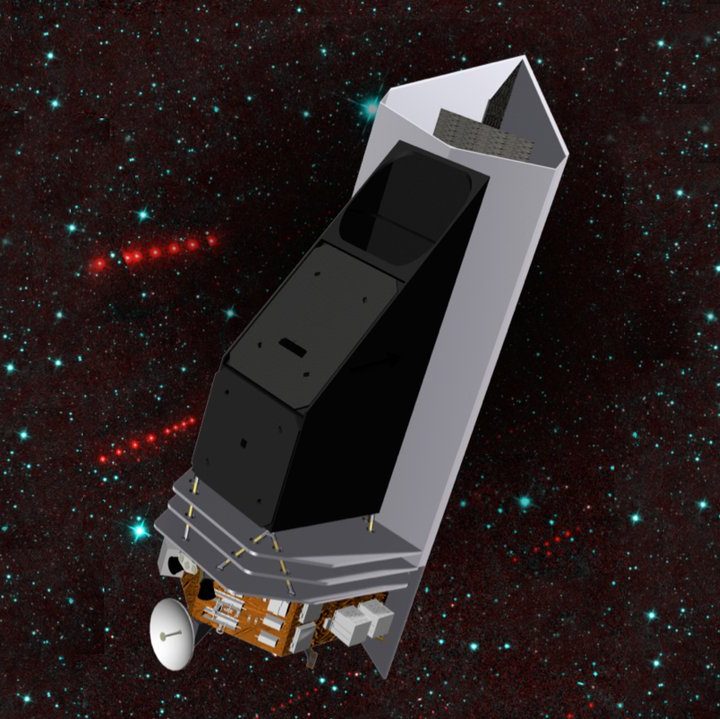
NEO Surveyor is a new mission proposal designed to discover and characterize most of the potentially hazardous asteroids that are near the Earth.
The NEO Surveyor, a proposed space telescope designed to discover and characterize most of the potentially hazardous asteroids and comets that come within 30 million miles of Earth. NASA/JPL-Caltech

NASA is planning a new telescope to detect potentially dangerous asteroids and comets that could threaten the planet. The space telescope, called the Near-Earth Object Surveyor, or NEO Surveyor, is part of an increasing interest in planetary defense, an effort that aims to discover objects that could come dangerously close to Earth. Asteroids and comets that come within 30 million miles are known as near-Earth objects, or NEOs.

“We think there are about 25,000 NEOs large enough to wipe out an area like Southern California,” said project leader Amy Mainzer of the University of Arizona. “Once they get bigger than about 450 feet in diameter, they can cause severe regional damage. We want to find these, and as many smaller ones as possible.”

The NEO Surveyor would be equipped with heat-sensitive cameras capable of taking more sensitive readings than those possible from telescopes on Earth. By looking at infrared data, the space telescope would be able to detect objects, track their positions, and calculate their sizes.

“Earth-approaching asteroids and comets are warmed by the sun, and they give off heat that the NEO Surveyor mission will be able to pick up,” Mainzer said. “Even asteroids as dark as a chunk of coal won’t be able to hide from our infrared eyes.”

NASA has approved the NEO Surveyor for the next phase of development, moving the space telescope from the concept stage to the design stage, where details of its design and hardware will be worked out. If all goes according to plan, the telescope would be launched in the first half of 2026.

The telescope should be able to start protecting Earth within its first 10 years in space, according to Michael Kelley, NEO Surveyor program scientist at NASA headquarters. “NEO Surveyor will have the capability to rapidly accelerate the rate at which NASA is able to discover asteroids and comets that could pose a hazard to the Earth, and it is being designed to discover 90 percent of asteroids 140 meters in size or larger within a decade of being launched,” Kelley said.

Georgina Torbet
Georgina has been the space writer at Digital Trends space writer for six years, covering human space exploration, planetary…
The Digital Trends App Bundle is yours to try for a whole week, free
Digital Trends App Bundle

Recently, we've entered an exciting collaboration with Maple Media, creating a bundle of 17 apps worth having on your phone. From relaxed fun to serious productivity boosts, these apps cover all your bases and provide a fun boost to your phone. Normally, the bundle is $9.99 per month (far lower than the cost of using the apps individually), but for your first 7 days you can get access to the bundle for free. View the full Digital Trends App Bundle for a complete list of the apps, or read on for a summarized take.

Start your free trial

Read more
The Galaxy S26 Ultra might not see much of a battery upgrade after all
It looks like it will stay the same as the last five years.
The back of the Samsung Galaxy S25 Ultra.

What's happened? This week, China's Quality Certification Center released information about a battery (EB-BS04898ABY) with a maximum capacity of 4,855mAh. That's the same capacity as was previously seen in the Samsung Galaxy S25 Ultra, and fans have taken this certification to mean the Galaxy S26 Ultra will not see a capacity increase after all.

The Samsung Galaxy Ultra models have had the same battery capacity for the last five years.

Read more
The Galaxy Tab S10 Lite is official, and it’ll be here sooner than you think
Galaxy Tab S10 Lite

What's happened? Samsung has officially announced the Galaxy Tab S10 Lite, a budget-friendly alternative to the Galaxy Tab S10. The device has been rumored for months, but this is the first time Samsung has officially acknowledged its existence.

The Galaxy Tab S10 Lite will have a 10.9-inch display and a peak brightness of 600 nits — a bit on the lower side, versus the iPad Pro's maximum brightness of 1,600 nits.

Read more