  1. Home
  2. Space
  3. News

China’s Zhurong rover visits its parachute and backshell on Mars

Add as a preferred source on Google

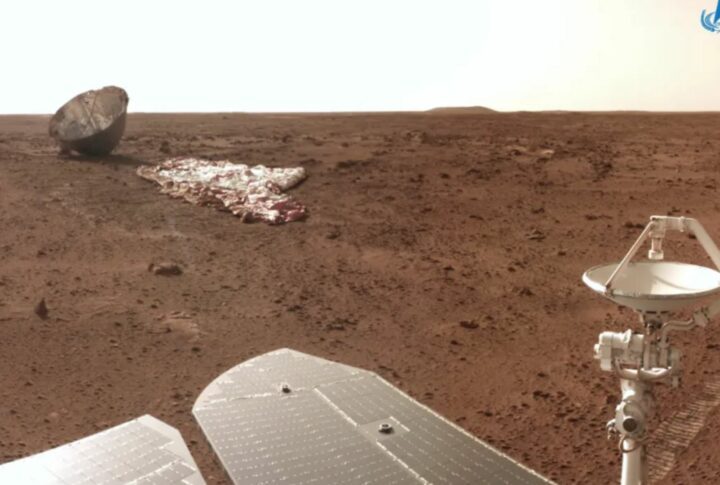
China's Zhurong rover visits its parachute and backshell.
China’s Zhurong rover visits its parachute and backshell on July 12. CNSA/PEC

China’s Zhurong rover is exploring the surface of Mars and recently stopped by the site of its parachute and backshell. It snapped the picture above, which was shared by China’s space agency, the China National Space Administration.

Recommended Videos

The rover visited the site where its backshell and parachute fell during its landing process on May 14. The backshell is the curved piece that protects the rover from the heat generated during landing, and the parachute helps to slow the lander as it passes through the thin atmosphere. Once the lander has slowed and begun to use its retro-propulsors to touch down slowly on the ground, the shell and parachute are no longer necessary. They are jettisoned so that the lander and the rover don’t get tangled in them when the rover is deployed.

According to CNSA, the image was snapped about 30 meters away from the backshell, which is around 350 meters away from the rover’s landing site. Zhurong used its navigation terrain camera to capture the image as it was passing by during its exploration to the south of its landing place.

As well as visiting the parachute, Zhurong has been busy exploring the Utopia Planitia area. By July 18, the rover had traveled a total of 509 meters, according to the Chinese state media website Xinhua. It is currently heading toward a second sand dune that it will survey, as well as surveying the surrounding area.

The rover continues to operate well and has now been on the surface of Mars for 63 Martian days (or sols). A Martian day is just a little bit longer than an Earth day. The aim is for the rover to complete a mission lasting 90 Martian days in total.

Zhurong is just one part of the Chinese Mars mission, however. It traveled to the red planet along with the Tianwen-1 orbiter, which is observing the planet from orbit. The orbiter has been in orbit for 359 days, during which time it deployed a small satellite with two cameras called the Tianwen-1 Deployable Camera (TDC). The orbiter is also collecting science data with its Mars Energetic Particle Analyzer instrument.

Georgina Torbet
Georgina has been the space writer at Digital Trends space writer for six years, covering human space exploration, planetary…
Amazon’s Starlink rival just crossed a major milestone, but don’t expect perfect internet just yet
Amazon finally showed up to the space internet party
Amazon Leo satellite layout across all launch vehicles

Amazon has taken a significant step toward launching its long-awaited satellite internet service. Following its latest rocket launch, the company now has 396 Project Kuiper satellites in low-Earth orbit, enough to begin offering continuous service across select regions. The milestone keeps Amazon on track for its previously announced goal of launching commercial service by mid-2026.

https://twitter.com/Weber44Chris/status/2072575499461963938?ref_src=twsrc%5Etfw%7Ctwcamp%5Etweetembed%7Ctwterm%5E2072575499461963938%7Ctwgr%5Ed727a1b853cbf519585e7bf2655943afb2f91bb8%7Ctwcon%5Es1_&ref_url=https%3A%2F%2Fwww.theverge.com%2Fscience%2F960563%2Famazon-leo-service-tipping-point

Read more
Amazon’s Starlink rival is set to launch satellite internet later this year
After launching nearly 400 satellites, Amazon says its Leo broadband service will go live later this year.
Atlas V launches 29 Amazon Leo satellites from Cape Canaveral, Florida

Amazon's long-awaited answer to SpaceX's Starlink is finally nearing liftoff. According to an exclusive report from Reuters, the company plans to begin offering its Leo satellite internet service later this year, after its latest rocket launch pushed the constellation to 394 satellites in orbit.

The pieces are finally falling into place for Project Kuiper

Read more
NASA is investing $590 million in private contractors to build humanity’s first Moon outpost
NASA is counting on private companies to land its Moon Base dream.
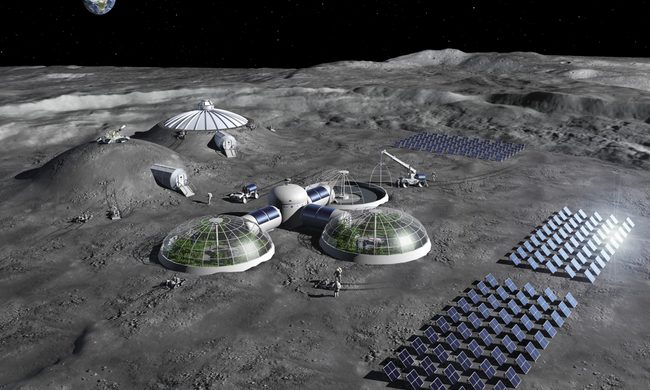
Artist impression of a Moon Base concept, with solar arrays for energy generation, greenhouses for food production, and habitats shielded with regolith.

Building a permanent base on the Moon sounds like science fiction, but NASA is making it feel a lot more real. The agency just handed $590 million in contracts to three private companies for four uncrewed lunar lander missions launching in late 2028.

These missions are part of Phase 1 of NASA's broader $30 billion Moon Base program, which needs to deliver landers, rovers, and scientific cargo up there before astronauts eventually move in. These efforts are closely tied NASA's Artemis program, which sent humans on a lunar flyby in April for the first time since the Apollo era.

Read more