  1. Home
  2. Space
  3. News

Space Station astronauts use AR headset to upgrade particle physics hardware

Add as a preferred source on Google

Mixed Reality headsets aren’t only for playing VR games on Earth: The astronauts aboard the International Space Station are making use of an Augmented Reality (AR) system based on commercial Microsoft HoloLens hardware with custom-designed software. Recently, NASA astronaut Megan McArthur used a HoloLens headset to perform a hardware replacement on a highly complex piece of equipment: The station’s Cold Atom Lab.

Mixed Reality Meets Quantum Science on the International Space Station

The ISS’s Cold Atom Lab is a particle physics instrument that chills atoms down to almost absolute zero, or minus 459 degrees Fahrenheit (minus 273 degrees Celsius), at which temperature atoms move much more slowly than usual and can be studied in greater detail.
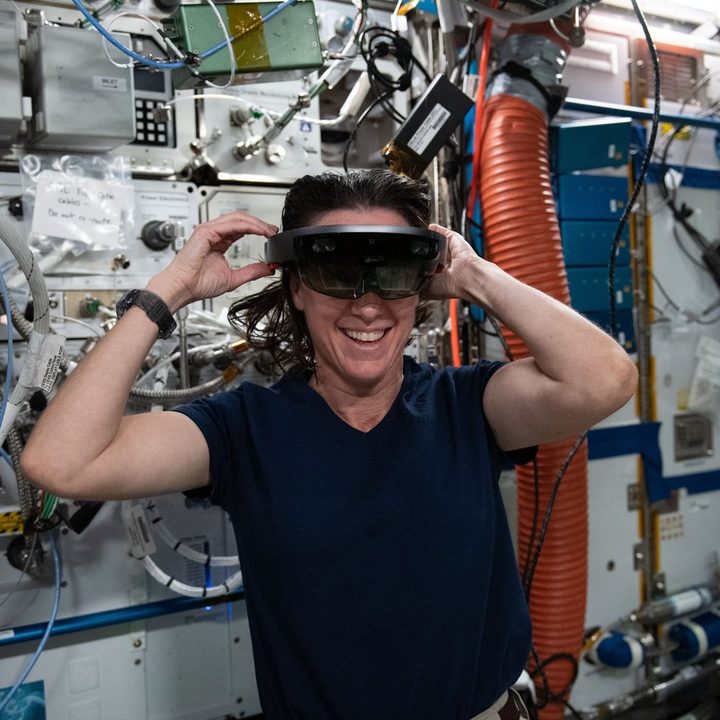
NASA Astronaut Megan McArthur dons a Microsoft HoloLens, a mixed reality (or augmented reality) headset, which allows her to see both the spacearound her as well as digital displays in her field of view.
NASA Astronaut Megan McArthur dons a Microsoft HoloLens, a mixed reality (or augmented reality) headset, which allows her to see both the space around her as well as digital displays in her field of view. NASA

This technology is complex, and so maintaining the instrument or replacing parts requires careful instructions sent to the ISS crew from Earth. With the mixed reality headset, astronaut Megan McArthur could see an overlay of text and information when she looked at hardware like cables. And the team on Earth could even use an arrow in her vision to point to particular cables she needed to unplug.

Recommended Videos

“Cold Atom Lab is investing in the use of this technology on the space station not just because it’s intriguing, but because it could provide additional capabilities for these complex tasks that we rely on astronauts to perform,” said Kamal Oudrhiri, Cold Atom Lab’s project manager at NASA’s Jet Propulsion Laboratory, in a statement. “This activity was a perfect demonstration of how Cold Atom Lab and quantum science can take advantage of mixed reality technology.”

With the replacement hardware, the instrument now has a new capability: Producing ultracold potassium atoms. The Cold Atom Lab team on the ground says this means it can be used in a whole variety of new particle physics experiments.

“This repair activity allows potassium gases to also be studied in Cold Atom Lab, which will enable scientists to perform dozens of new experiments in quantum chemistry and fundamental physics using multi-species gases where the atoms interact with each other in interesting ways at the ultra-low temperatures only achievable in microgravity,” said Jason Williams, Cold Atom Lab’s project scientist.

“Our goal is for Cold Atom Lab to become an evolving science facility so we can quickly build on our research and work with the astronauts to add new hardware capabilities without the need to build and launch new facilities each step of the way.”

Georgina Torbet
Georgina has been the space writer at Digital Trends space writer for six years, covering human space exploration, planetary…
You can now walk through space and gaze into a black hole at this VR exhibit
Smithsonian Starstruck lets you drift past dying stars and see the origin point of the universe for as little as $18 a person.
Smithsonian Starstruck featured

Most planetarium shows ask you to sit still and look up. The Smithsonian's new VR exhibit takes a different approach, letting visitors walk through the vast expanse of the universe, drifting past stars, planets, and a black hole to get a physical sense of its true scale.

A $29 ticket to the edge of the galaxy

Read more
Scientists warn Elon Musk’s orbital data centers could blind Earth’s biggest telescopes
A new ESO study suggests millions of satellites could make parts of the night sky effectively unusable for astronomy.
One hour of satellites over the northern Atacama Desert in Chile (October 2025)

The race to blanket Earth with satellite internet has unlocked faster connectivity for millions. But according to the European Southern Observatory (ESO), it could also make one of humanity's oldest hobbies, and one of its most important sciences, a whole lot harder. The organization warns that the rapid growth of satellite mega-constellations could severely disrupt observations made by some of the world's most powerful telescopes.

Astronomers say the night sky is reaching its limit

Read more
Amazon’s Starlink rival just crossed a major milestone, but don’t expect perfect internet just yet
Amazon finally showed up to the space internet party
Amazon Leo satellite layout across all launch vehicles

Amazon has taken a significant step toward launching its long-awaited satellite internet service. Following its latest rocket launch, the company now has 396 Project Kuiper satellites in low-Earth orbit, enough to begin offering continuous service across select regions. The milestone keeps Amazon on track for its previously announced goal of launching commercial service by mid-2026.

https://twitter.com/Weber44Chris/status/2072575499461963938?ref_src=twsrc%5Etfw%7Ctwcamp%5Etweetembed%7Ctwterm%5E2072575499461963938%7Ctwgr%5Ed727a1b853cbf519585e7bf2655943afb2f91bb8%7Ctwcon%5Es1_&ref_url=https%3A%2F%2Fwww.theverge.com%2Fscience%2F960563%2Famazon-leo-service-tipping-point

Read more