1. Home
  2. Space
  3. News

Telescopes turn on Parker Solar Probe’s latest approach to the sun

Add as a preferred source on Google

NASA’s Parker Solar Probe, a sun-investigating spacecraft that made history last year when it flew through the sun’s corona, has made another swing around the sun. And this time it was watched by both other spacecraft and by ground-based telescopes.

Missions like Parker get close to the sun by performing a series of flybys of other planets. This spacecraft makes passes around Venus, and it uses the planet’s gravity to adjust its trajectory as it moves back toward the sun. Over the course of seven Venus flybys, it will get closer and closer to the sun until it moves into its final altitude, coming within 4 million miles of the sun’s surface in December 2024.
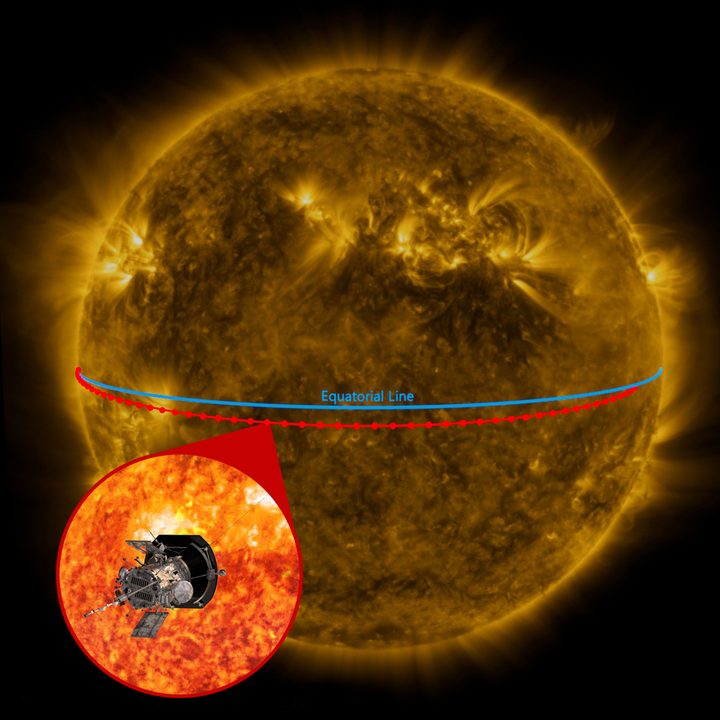
A red line indicates path of NASA’s Parker Solar Probe across the face of the Sun, as seen from Earth. The red dots indicate an hour along the trajectory.
The view from Earth: The red line indicates the path of NASA’s Parker Solar Probe across the face of the Sun, as seen from Earth, from Feb. 24-27, 2022. The red dots indicate an hour along the trajectory, and the appearance of the path heading into the Sun at right accounts for Earth’s own movement around our star. The image of the Sun was captured by NASA’s Solar Dynamics Observatory. NASA/Johns Hopkins APL/Steve Gribben/SDO

Parker’s most recent close approach to the sun was on February 25 and was its 11th close approach out of a planned 24. But this particular approach is special because it is visible from Earth. “Most of these passes occur while the sun is between the spacecraft and Earth, blocking any direct lines of sight from home,” NASA explained in a blog post. “But every few orbits, the dynamics work out to put the spacecraft in Earth’s view – and the Parker mission team seizes these opportunities to organize broad observation campaigns that not only include telescopes on Earth but several spacecraft as well.”

Recommended Videos

This approach was observed by more than 40 different observatories, including the brand-new Daniel K. Inouye Solar Telescope in Hawaii. Other observatories tuned in as well, observing in the visible light, infrared, and radio wavelengths. These were backed up by observations from several spacecraft including NASA’s Solar Dynamics Observatory and the NASA/ESA Solar Orbiter.

These observers won’t actually be able to see Parker, which is too small to detect. But they will be able to get a big-picture view, to see how the fluctuations of the sun which Parker sees up close ripple out to have effects on the rest of the solar system. Once Parker sends back its data, this can be compared to data collected by the other observatories to see how solar winds propagate on a larger scale.

Parker also observed another big event up close recently, when it captured data from a large solar prominence on February 15. “The shock from the event hit Parker Solar Probe head-on, but the spacecraft was built to withstand activity just like this – to get data in the most extreme conditions,” said Project Scientist Nour Raouafi of the Space Exploration Sector. “And with the sun getting more and more active, we can’t wait to see the data that Parker Solar Probe gathers as it gets closer and closer.”

Georgina Torbet
Georgina has been the space writer at Digital Trends space writer for six years, covering human space exploration, planetary…
Amazon’s Starlink rival is set to launch satellite internet later this year
After launching nearly 400 satellites, Amazon says its Leo broadband service will go live later this year.
Atlas V launches 29 Amazon Leo satellites from Cape Canaveral, Florida

Amazon's long-awaited answer to SpaceX's Starlink is finally nearing liftoff. According to an exclusive report from Reuters, the company plans to begin offering its Leo satellite internet service later this year, after its latest rocket launch pushed the constellation to 394 satellites in orbit.

The pieces are finally falling into place for Project Kuiper

Read more
NASA is investing $590 million in private contractors to build humanity’s first Moon outpost
NASA is counting on private companies to land its Moon Base dream.
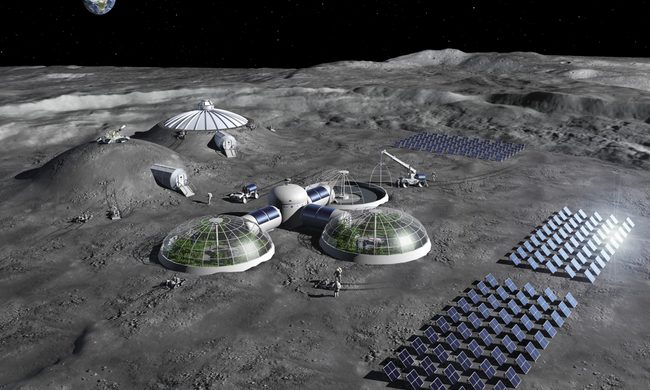
Artist impression of a Moon Base concept, with solar arrays for energy generation, greenhouses for food production, and habitats shielded with regolith.

Building a permanent base on the Moon sounds like science fiction, but NASA is making it feel a lot more real. The agency just handed $590 million in contracts to three private companies for four uncrewed lunar lander missions launching in late 2028.

These missions are part of Phase 1 of NASA's broader $30 billion Moon Base program, which needs to deliver landers, rovers, and scientific cargo up there before astronauts eventually move in. These efforts are closely tied NASA's Artemis program, which sent humans on a lunar flyby in April for the first time since the Apollo era.

Read more
Getting to Mars may require a pit stop in orbit, and NASA just tested the nozzle to make that happen
A gas pump nozzle for spacecraft sounds simple. It is not, and that's what makes this test worth paying attention to.
Architecture, Building, Factory

Getting a spacecraft to Mars or beyond requires an enormous amount of fuel, most of which has to be hauled from Earth, adding to the overall cost and weight of the spacecraft. NASA has been working on a different approach, one that could be more efficient and effective.

It wants to refuel a spacecraft in orbit before heading out for the mission. What’s even more interesting is that the space agency just finished testing a component that could make that possible: a cryocoupler.

Read more