  1. Home
  2. Trash
  3. News

Going green with an algae-powered microprocessor computer

Add as a preferred source on Google

Researchers from the University of Cambridge, U.K., have created a computer system that is powered by algae that harvests energy from the sun. About the size of a AA battery, the cell uses the microscopic organism Synechocystis which photosynthesizes sunlight to generate electrical current. Although the current generated is very small, it is enough to power a microprocessor, and the system had been running continuously for a year.
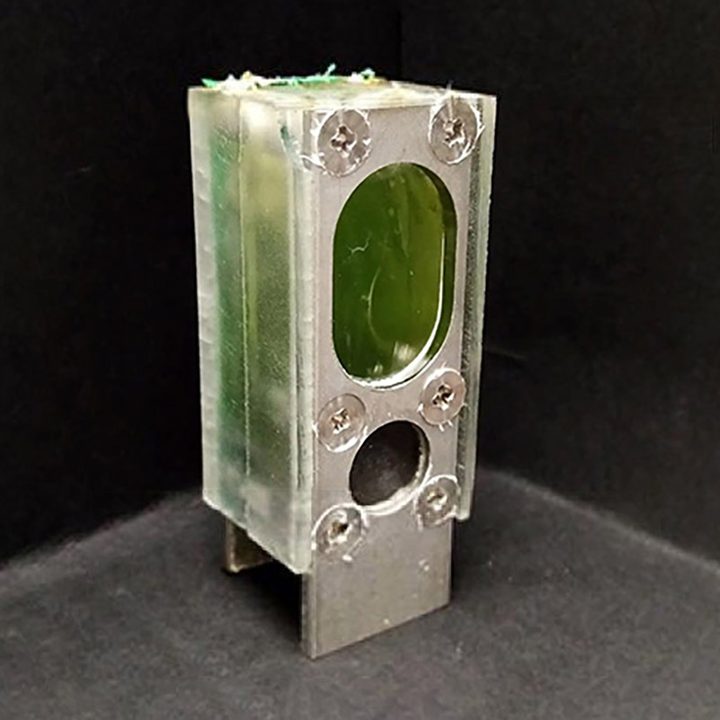
The biological photovoltaic cell uses Synechocystis algae to harvest energy from the sun.
The biological photovoltaic cell uses Synechocystis algae to harvest energy from the sun. Paolo Bombelli

The system would be most useful for powering small devices in remote locations, according to the researchers. “The growing Internet of Things needs an increasing amount of power, and we think this will have to come from systems that can generate energy, rather than simply store it like batteries,” said one of the lead researchers, Christopher Howe, in a statement. “Our photosynthetic device doesn’t run down the way a battery does because it’s continually using light as the energy source.”

The algae used in the system doesn’t need any additional food other than sunlight, and it even continues to produce power at night because it continues the process of photosynthesis for a time even when there isn’t light present. The electrical current generated by the algae is sent to an aluminum electrode from where it can be sent to the processor.

To test the system, the researchers hooked up the device to an Arm Cortex M0+ microprocessor, a highly efficient processor which is typically used in Internet of Things devices. It was left in semi-outdoor conditions with typical variations in temperature and sunlight, and it performed even better than the researchers expected.

“We were impressed by how consistently the system worked over a long period of time — we thought it might stop after a few weeks but it just kept going,” said lead author Paolo Bombelli.

The researchers hope that systems like this one, which is made from cheap and widely available materials, could help replace expensive lithium-ion batteries or traditional photovoltaic systems which use environmentally hazardous materials, especially with the predicted growth of Internet of Things devices.

The research is published in the journal Energy & Environmental Science.

Georgina Torbet
Georgina has been the space writer at Digital Trends space writer for six years, covering human space exploration, planetary…
The Digital Trends App Bundle is yours to try for a whole week, free
Digital Trends App Bundle

Recently, we've entered an exciting collaboration with Maple Media, creating a bundle of 17 apps worth having on your phone. From relaxed fun to serious productivity boosts, these apps cover all your bases and provide a fun boost to your phone. Normally, the bundle is $9.99 per month (far lower than the cost of using the apps individually), but for your first 7 days you can get access to the bundle for free. View the full Digital Trends App Bundle for a complete list of the apps, or read on for a summarized take.

Start your free trial

Read more
The Galaxy S26 Ultra might not see much of a battery upgrade after all
It looks like it will stay the same as the last five years.
The back of the Samsung Galaxy S25 Ultra.

What's happened? This week, China's Quality Certification Center released information about a battery (EB-BS04898ABY) with a maximum capacity of 4,855mAh. That's the same capacity as was previously seen in the Samsung Galaxy S25 Ultra, and fans have taken this certification to mean the Galaxy S26 Ultra will not see a capacity increase after all.

The Samsung Galaxy Ultra models have had the same battery capacity for the last five years.

Read more
The Galaxy Tab S10 Lite is official, and it’ll be here sooner than you think
Galaxy Tab S10 Lite

What's happened? Samsung has officially announced the Galaxy Tab S10 Lite, a budget-friendly alternative to the Galaxy Tab S10. The device has been rumored for months, but this is the first time Samsung has officially acknowledged its existence.

The Galaxy Tab S10 Lite will have a 10.9-inch display and a peak brightness of 600 nits — a bit on the lower side, versus the iPad Pro's maximum brightness of 1,600 nits.

Read more