1. Home
  2. Space
  3. News

NASA confirms date for final test of its mega moon rocket

Add as a preferred source on Google

NASA officials have confirmed Monday, June 20, as the date for the final pre-flight test of its next-generation Space Launch System (SLS) rocket and Orion spacecraft.

The so-called “wet dress rehearsal” will take place on a launchpad at the Kennedy Space Center and involve engineers filling the boosters with fuel and performing a mock countdown, NASA confirmed in a call with reporters on Wednesday.

Recommended Videos

The upcoming test is particularly crucial as it follows a failed effort in April when the rehearsal surfaced a number of technical issues that had to be fixed.

Despite the rocket’s development being years behind schedule, and with billions of dollars already spent on the project, NASA chief Bill Nelson is adamant that his team won’t be sending the SLS skyward until it’s absolutely confident of its readiness for flight.

“We are not going to fly until it’s safe,” Nelson said recently. “You can just nail that down. That’s on all spacecraft. That’s why we’ve had delays that we’ve had.”

If no anomalies occur with next week’s rehearsal, NASA will be clear to launch the SLS on its first test mission, called Artemis I, possibly as early as August. The uncrewed flight will involve the SLS rocket powering the Orion capsule toward the moon, where it will perform a flyby of our nearest neighbor before returning home.

This is just the beginning 🚀🌕 pic.twitter.com/UZFCHLROnY

— NASA's Kennedy Space Center (@NASAKennedy) June 15, 2022

A successful Artemis I mission will pave the way for the crewed Artemis II flight in which the Orion will follow the same route around the moon.

Following that, the highly anticipated Artemis III mission will endeavor to land the first woman and first person of color on the lunar surface in what will also be the first moon landing since the Apollo 17 mission in 1972. NASA isn’t yet in a position to offer a firm date for the launch of Artemis III, though it’s currently eyeing no earlier than 2025.

The Artemis program heralds a new era in human exploration of the moon, and part of the goal is to build a permanent lunar base for extended stays. The effort is seen as a stepping stone to the first astronaut mission to Mars, which the space agency suggests could take place in the late 2030s.

Trevor Mogg
Contributing Editor
Not so many moons ago, Trevor moved from one tea-loving island nation that drives on the left (Britain) to another (Japan)…
Amazon’s Starlink rival is set to launch satellite internet later this year
After launching nearly 400 satellites, Amazon says its Leo broadband service will go live later this year.
Atlas V launches 29 Amazon Leo satellites from Cape Canaveral, Florida

Amazon's long-awaited answer to SpaceX's Starlink is finally nearing liftoff. According to an exclusive report from Reuters, the company plans to begin offering its Leo satellite internet service later this year, after its latest rocket launch pushed the constellation to 394 satellites in orbit.

The pieces are finally falling into place for Project Kuiper

Read more
NASA is investing $590 million in private contractors to build humanity’s first Moon outpost
NASA is counting on private companies to land its Moon Base dream.
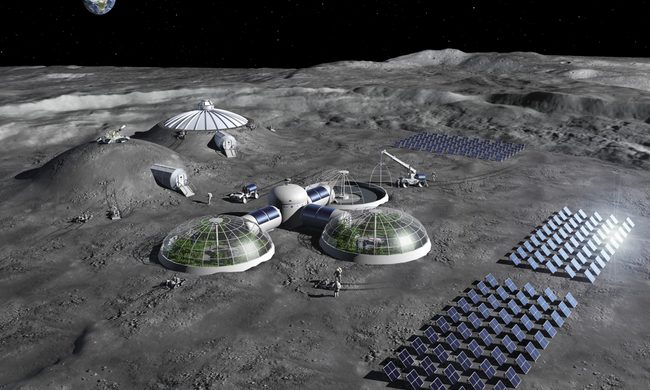
Artist impression of a Moon Base concept, with solar arrays for energy generation, greenhouses for food production, and habitats shielded with regolith.

Building a permanent base on the Moon sounds like science fiction, but NASA is making it feel a lot more real. The agency just handed $590 million in contracts to three private companies for four uncrewed lunar lander missions launching in late 2028.

These missions are part of Phase 1 of NASA's broader $30 billion Moon Base program, which needs to deliver landers, rovers, and scientific cargo up there before astronauts eventually move in. These efforts are closely tied NASA's Artemis program, which sent humans on a lunar flyby in April for the first time since the Apollo era.

Read more
Getting to Mars may require a pit stop in orbit, and NASA just tested the nozzle to make that happen
A gas pump nozzle for spacecraft sounds simple. It is not, and that's what makes this test worth paying attention to.
Architecture, Building, Factory

Getting a spacecraft to Mars or beyond requires an enormous amount of fuel, most of which has to be hauled from Earth, adding to the overall cost and weight of the spacecraft. NASA has been working on a different approach, one that could be more efficient and effective.

It wants to refuel a spacecraft in orbit before heading out for the mission. What’s even more interesting is that the space agency just finished testing a component that could make that possible: a cryocoupler.

Read more