  1. Home
  2. Space
  3. News

NASA takes a closer look at DART’s final images before asteroid crash

Add as a preferred source on Google

NASA’s Double Asteroid Redirection Test (DART) spacecraft crashed into a distant asteroid on Monday in a mission designed to see if the force of such an impact can shift a space rock’s direction of travel.

If it worked — and we may not find out for a couple of months — then we will have a way of deflecting hazardous asteroids spotted heading toward Earth. And when you consider what happened to the dinosaurs, that would be very good news indeed.

Recommended Videos

Thanks to the marvels of modern technology, earthlings were able to tune into NASA’s online stream on Monday to watch the spacecraft smash into the asteroid in near real time. Incredible stuff considering the event was happening around 7 million miles from Earth.

DART’s Didymos Reconnaissance and Asteroid Camera for Optical navigation (DRACO) provided the feed. Traveling toward the asteroid at a relative speed of 14,000 mph, the 525-feet-wide (160 meters) Dimorphos asteroid for a long time appeared as a tiny dot in the video, but then rapidly became larger in the frame in the seconds prior to impact. When the feed cut out and the screen turned black, everyone at Mission Control broke into applause and cheers — surely a first for a video link suddenly cutting out like that.

Aware that some folks might be interested in those final images before impact, NASA shared a post on Tuesday telling us more about them.

In the first one we see the asteroid Didymos (bottom left) and its moonlet, Dimorphos, about 2.5 minutes prior to impact. The image was taken by DRACO from a distance of about 570 miles (920 kilometers).
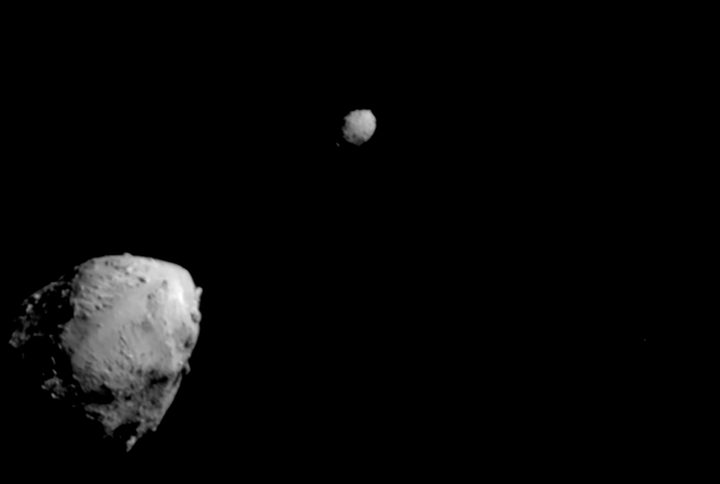
The Dimorphos asteroid as seen from NASA's DART spacecraft.
NASA/Johns Hopkins APL

The next image shows DART having made good progress toward the asteroid, with astonishing details now becoming visible. NASA notes how Dimorphos is “full of boulders of various sizes,” adding that the asteroid appears to lack “the fine-grained regolith, or loose, dust-rich outer material, that is seen on Earth’s moon and on other asteroids.”
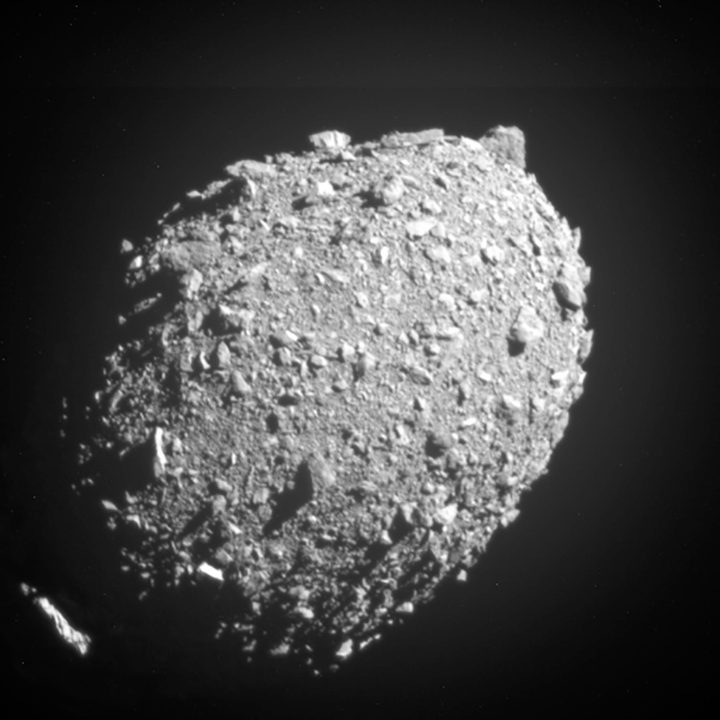
The Dimorphos asteroid as seen from NASA's DART spacecraft.

Below is the last complete image of Dimorphos, captured from a distance of about 7 miles (12 kilometers) just 2 seconds before impact. According to NASA, the image shows a patch of the asteroid 100 feet (31 meters) across.
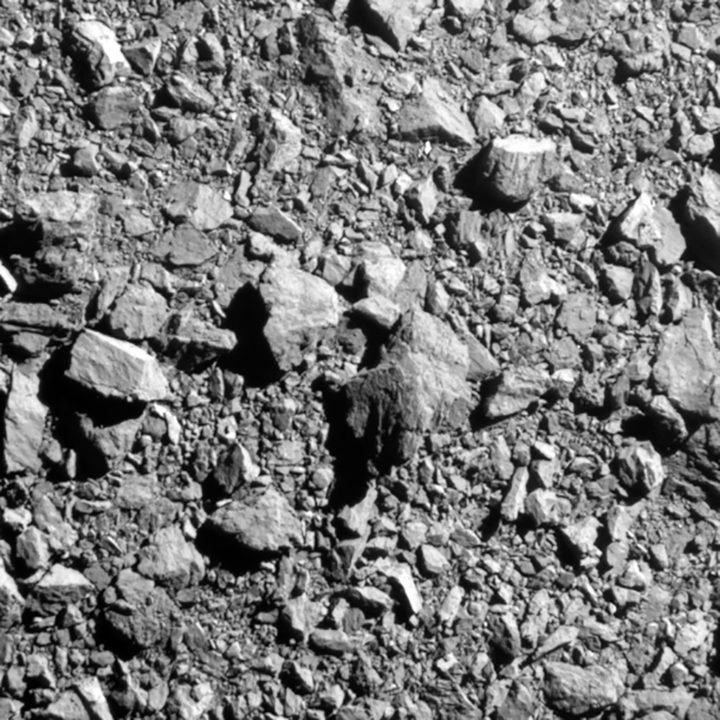
The Dimorphos asteroid as seen from NASA's DART spacecraft.
NASA/Johns Hopkins APL

Below is DRACO’s final glimpse of Dimorphos before the DART spacecraft slams into the rock at high speed. The image was captured at up to 4 miles (6 kilometers) from the asteroid’s surface and just 1 second before impact.

“DART’s impact occurred during transmission of the image to Earth, resulting in a partial picture,” NASA said, adding that it shows a patch of the asteroid that’s 51 feet (16 meters) across.

The Dimorphos asteroid as seen from NASA's DART spacecraft.
NASA/Johns Hopkins APL

DART’s mission team is now gathering data from ground-based observatories in an effort to see if the impact had any effect on the asteroid’s trajectory, and if so, to what extent. We’ll be sure to report any developments just as soon as they come in.


Trevor Mogg
Contributing Editor
Not so many moons ago, Trevor moved from one tea-loving island nation that drives on the left (Britain) to another (Japan)…
Space is becoming Bezos and Musk’s next data center site, and we have every reason to worry
The AI boom is coming for the night sky
How Vast's space station will look in orbit.

AI data centers already consume vast amounts of electricity and water on Earth, so Silicon Valley has begun looking somewhere considerably more spacious... literally.

Elon Musk's SpaceX and Jeff Bezos' Blue Origin, along with several other companies, have proposed enormous constellations of satellites designed to operate as orbital data centers. However, environmental groups and former space officials are now warning that putting them into orbit at the proposed scale could have severe consequences for Earth's atmosphere and the night sky.

Read more
The first possible exomoon is here, and it makes our Moon look hilariously tiny
Scientists may have found the first exomoon, except this one is the size of Jupiter
This artist’s concept depicts a potential volcanic moon between the exoplanet WASP-49 b, left, and its parent star. New evidence indicating that a massive sodium cloud observed near WASP-49 b is produced by neither the planet nor the star has prompted researchers to ask if its origin could be an exomoon.

We have already discovered more than 6,000 planets outside of our immediate neighborhood. Yet, finding a moon orbiting one of those distant worlds has proved considerably harder. Astronomers may finally have something close to the real deal, but this particular object stretches the word “moon” almost beyond recognition.

Using the European Southern Observatory’s Very Large Telescope in Chile, researchers detected strong evidence for a moon-like object in the CD-35 2722 system. Further observations are still necessary to confirm the discovery, but it could become the first confidently detected natural satellite outside our solar system. There is still one tiny complication though. This moon is apparently massive.

Read more
China’s answer to SpaceX’s reusable rockets literally catches boosters in a net
SpaceX catches boosters on legs. China just used a net.
Ammunition, Missile, Weapon

SpaceX's playbook for recovering a rocket booster generally involves legs, a precisely controlled vertical landing, and either a concrete pad or a drone ship. 

China just managed to pull off something similar, but in a slightly different way, and on July 10, it tested the method as well.

Read more
