1. Home
  2. Space
  3. News

Astronomers develop ‘early warning system’ for stars about to go supernova

Add as a preferred source on Google

One of the most dramatic cosmic events is a supernova, when a massive star runs out of fuel. The star explodes in an enormous burst of energy that can be seen even in other galaxies. We know essentially when these supernovae happen, but we aren’t able to predict exactly when any given star will go supernova. Now, though, a team of astronomers has come up with an “early warning system” for stars approaching this critical point.

The astronomers from Liverpool John Moores University and the University of Montpellier simulated the development of a group of pre-supernova stars called red supergiants, which are some of the largest stars (though not necessarily the most massive). They include our famous neighbor Betelgeuse. These stars used to be massive stars around eight to 20 times the mass of the sun, but as their fuel runs out, they switch from fusing hydrogen to fusing helium, and they puff up to a larger size while cooling down.
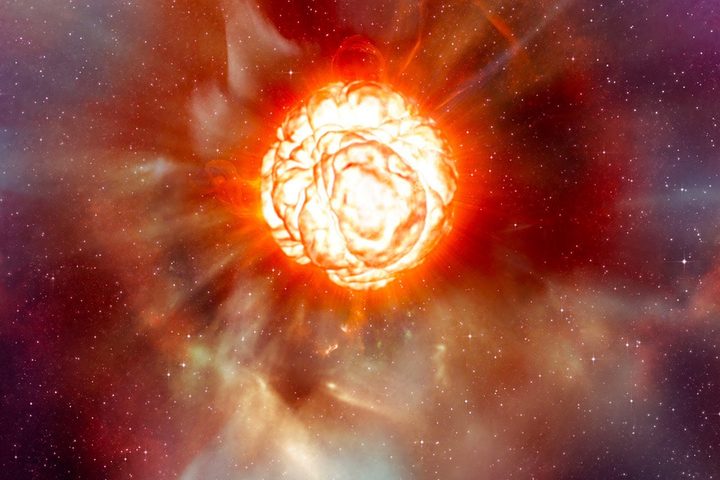
This artist’s impression shows the supergiant star Betelgeuse as it was revealed thanks to different state-of-the-art techniques on ESO’s Very Large Telescope (VLT), which allowed two independent teams of astronomers to obtain the sharpest ever views of the supergiant star Betelgeuse. They show that the star has a vast plume of gas almost as large as our Solar System and a gigantic bubble boiling on its surface. These discoveries provide important clues to help explain how these mammoths shed material at such a tremendous rate.
This artist’s impression shows the supergiant star Betelgeuse as it was revealed thanks to different state-of-the-art techniques on European Southern Observatory ’s Very Large Telescope. European Southern Observatory/L. Calçada

The researchers found that these red supergiant stars become suddenly much fainter in their last few months of life. Their brightness drops by as much as a hundred times as they produce dusty material that obscures the light they give off, making them appear fainter. This dropping brightness will be a clue to an impending supernova.

Recommended Videos

“The dense material almost completely obscures the star, making it 100 times fainter in the visible part of the spectrum. This means that, the day before the star explodes, you likely wouldn’t be able to see it was there,” lead author Benjamin Davies of Liverpool John Moores University explained in a statement. “Until now, we’ve only been able to get detailed observations of supernovae hours after they’ve already happened. With this early-warning system, we can get ready to observe them in real time, to point the world’s best telescopes at the precursor stars, and watch them getting literally ripped apart in front of our eyes.”

The research is published in the journal Monthly Notices of the Royal Astronomical Society.

Georgina Torbet
Georgina has been the space writer at Digital Trends space writer for six years, covering human space exploration, planetary…
Lightsails have hit another speed bump on the road to interstellar travel
The coolest interstellar travel idea may get betrayed by the light pushing it
LightSail in Earth orbit

Laser-powered lightsails are one of the coolest answers to spaceflight. It might not be as sci-fi-sounding as a warp drive, but now, its practicality has also come under question. Using lightsails, a spacecraft could unfurl an ultra-thin reflective sail and let a powerful laser push it toward another star, without relying on fuel.

The tech was simple and elegant--except it's also more complicated than it sounds. A new preprint from researchers Chao Shen and Jiaze Li of the Harbin Institute of Technology suggests that relativistic lightsails may run into a hidden propulsion problem once they start moving extremely fast.

Read more
The galaxy has an exoplanet size mystery, and NASA’s EVE mission wants to solve it
This planet-hunting mission wants to catch baby worlds before they grow up
Artist’s Illustration of Exoplanets Orbiting Barnard’s Star

Mankind venturing into space ended up creating more questions than it answered, and one of the dilemmas is related to the planet sizes. Astronomers have found plenty of rocky super-Earths and plenty of puffier sub-Neptunes, but far fewer planets with a radius of about 1.8 times Earth’s.

That gap is known as the radius valley, and a proposed mission called the Early eVolution Explorer, or EVE, wants to figure out why it exists. NASA has a simple plan: look at planets while they are still young. The mission concept, detailed in a new arXiv preprint and covered by Phys.org, would focus on newly formed star clusters to see what small planets look like before billions of years of evolution.

Read more
We just got a hot signal that a Tesla and SpaceX merger could happen, after all
Tesla

For years, the idea of Tesla and SpaceX becoming a single company has lived somewhere between ambitious business theory and Elon Musk fan fiction. The two companies already share DNA, leadership influence, engineering talent, and long-term goals. But every time the topic surfaced, it felt more like an interesting thought experiment than a realistic possibility. Now, one of the most important people at SpaceX has added fresh fuel to the conversation.

Speaking in a recent CNBC interview, SpaceX President and COO Gwynne Shotwell was asked about the possibility of closer ties between Tesla and SpaceX. Her response wasn’t a flat-out denial. In fact, she suggested that bringing the two companies together could make life a little easier for Musk. That may sound like an offhand comment, but coming from Shotwell, it’s noteworthy. She’s been at SpaceX since its earliest days and remains one of the company's most influential executives.

Read more