1. Home
  2. Space
  3. News

Enormous meteor strike blows 500 foot-wide crater into Martian surface

Add as a preferred source on Google

One of the biggest meteor strikes ever witnessed in the solar system has been recorded by two different Mars missions. The impact caused seismic waves to shake the planet and is helping scientists to understand more about the Martian interior.

The strike occurred on December 24, 2021, and scientists had already observed its results in the form of a magnitude 4 marsquake which was detected by the NASA InSight lander. But when reviewing images of the surface collected from orbit by the Mars Reconnaissance Orbiter, researchers realized they could see an enormous crater that appeared at the same time, showing that the quakes were caused by a large impact.

Flyover of Mars Impact Using HiRISE Data (Animation)

“It’s unprecedented to find a fresh impact of this size,” said Ingrid Daubar of Brown University, who leads InSight’s Impact Science Working Group, in a statement. “It’s an exciting moment in geologic history, and we got to witness it.”
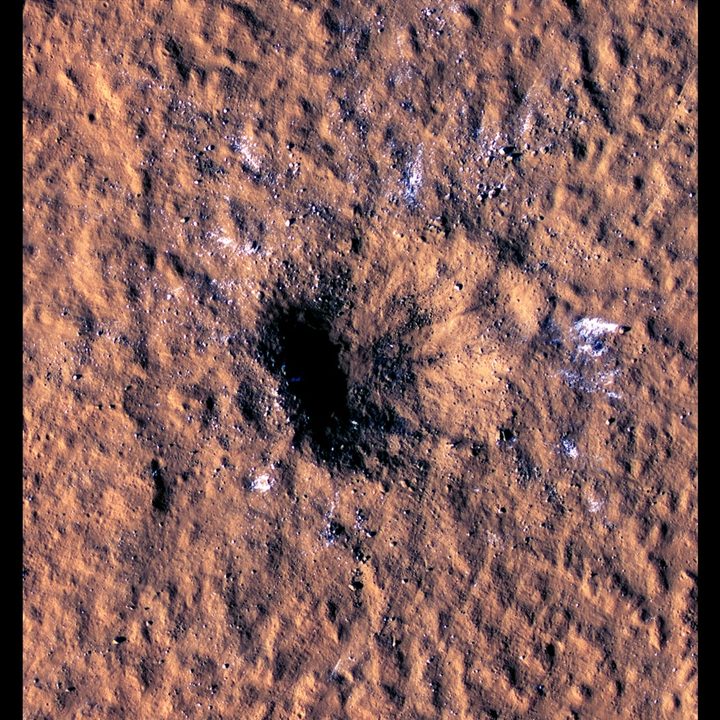
Boulder-size blocks of water ice can be seen around the rim of an impact crater on Mars.
Boulder-size blocks of water ice can be seen around the rim of an impact crater on Mars, as viewed by the High-Resolution Imaging Science Experiment (HiRISE camera) aboard NASA’s Mars Reconnaissance Orbiter. The crater was formed December 24, 2021, by a meteoroid strike in the Amazonis Planitia region. NASA/JPL-Caltech/University of Arizona

The meteor which struck the planet is estimated to be between 16 and 39 feet wide, and it hit the planet hard enough to create a crater that is almost 500 feet wide and 70 feet deep. As it struck the planet it exposed layers beneath the surface and threw up material that traveled as far as 23 miles from the crater, which is in the Amazonis Planitia region.

Recommended Videos

“The image of the impact was unlike any I had seen before, with the massive crater, the exposed ice, and the dramatic blast zone preserved in the Martian dust,” said Liliya Posiolova, who leads the Orbital Science and Operations Group at MSSS. “I couldn’t help but imagine what it must have been like to witness the impact, the atmospheric blast, and debris ejected miles downrange.”
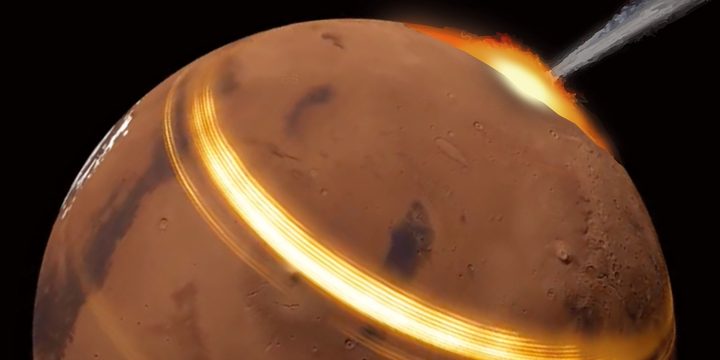
Illustration of an impact causing surface waves to spread across Mars.
Illustration of an impact causing surface waves to spread across Mars. ETH Zurich, Doyeon Kim, Martin van Driel, Christian Boehm

The impact caused seismic waves which not only traveled through the planet’s interior but also propagated across its surface. It’s rare to observe these surface waves and they are helpful for researchers who want to understand more about the structure of the planet’s crust.

“Until now, our knowledge of the Martian crust has been based on only a single point measurement under the InSight lander,” explained the lead author of one of the papers, Doyeon Kim of ETH Zurich, in another statement.

With this new data point, the researchers were able to see that the area of crust between the lander and the impact site seems to have a higher density, while previous measurements suggested that the crust below the lander has a lower density. It could be that there are different rock types on the surface, or the rocks beneath the lander could have been created by a different process than other regions of the planet.

The research is published in two papers in the journal Science.

Georgina Torbet
Georgina has been the space writer at Digital Trends space writer for six years, covering human space exploration, planetary…
Getting to Mars may require a pit stop in orbit, and NASA just tested the nozzle to make that happen
A gas pump nozzle for spacecraft sounds simple. It is not, and that's what makes this test worth paying attention to.
Architecture, Building, Factory

Getting a spacecraft to Mars or beyond requires an enormous amount of fuel, most of which has to be hauled from Earth, adding to the overall cost and weight of the spacecraft. NASA has been working on a different approach, one that could be more efficient and effective.

It wants to refuel a spacecraft in orbit before heading out for the mission. What’s even more interesting is that the space agency just finished testing a component that could make that possible: a cryocoupler.

Read more
Elon Musk’ Starlink could soon offer mobile services as a US carrier
Showcase of T-Mobile Starlink service on an iPhone.

Elon Musk’s Starlink has already changed how millions of people access the internet, especially in places where traditional broadband struggles to reach. Now, the satellite internet service could be preparing for an even bigger leap — becoming your mobile carrier.

According to a Financial Times report, SpaceX has told investors it’s considering launching a retail Starlink mobile service in the US. Instead of simply partnering with wireless carriers, the company could begin selling mobile plans directly to consumers, putting it in direct competition with Verizon, AT&T, and T-Mobile.

Read more
Lightsails have hit another speed bump on the road to interstellar travel
The coolest interstellar travel idea may get betrayed by the light pushing it
LightSail in Earth orbit

Laser-powered lightsails are one of the coolest answers to spaceflight. It might not be as sci-fi-sounding as a warp drive, but now, its practicality has also come under question. Using lightsails, a spacecraft could unfurl an ultra-thin reflective sail and let a powerful laser push it toward another star, without relying on fuel.

The tech was simple and elegant--except it's also more complicated than it sounds. A new preprint from researchers Chao Shen and Jiaze Li of the Harbin Institute of Technology suggests that relativistic lightsails may run into a hidden propulsion problem once they start moving extremely fast.

Read more