1. Home
  2. Space
  3. News

NASA inspects SLS moon rocket following Hurricane Nicole

Add as a preferred source on Google

As the authorities in Florida begin to assess the wider damage wrought by Hurricane Nicole on Thursday, a team at the Kennedy Space Center is currently performing detailed inspections of NASA’s next-generation Space Launch System (SLS) moon rocket.

The 98-meter-tall SLS rocket, with the Orion spacecraft at its tip, remained on the launchpad as the extreme weather passed through, exposing the vehicle to gusts of up to 82 mph. The rocket arrived on the launchpad last weekend ahead of its maiden flight, which could take place on Wednesday.

Recommended Videos

Tim Free, NASA’s associate administrator for exploration systems development, posted a statement at around 5 p.m. ET detailing the situation at the Kennedy Space Center.

“Teams monitored SLS and Orion remotely during the storm … Our team is conducting initial visual checkouts of the rocket, spacecraft, and ground system equipment with the cameras at the launchpad.”

Free said the feeds show “very minor damage” such as tears in weather coverings, adding that personnel will soon carry out additional on-site walkthrough inspections of the vehicle.

When Hurricane Ian approached the Space Coast at the end of September, NASA decided to move the SLS rocket from the launchpad to the shelter of the Vehicle Assembly Building four miles away. This time it deemed it safer to leave the rocket on the launchpad. Free explained why:

“We took the decision to keep Orion and SLS at the launchpad very seriously, reviewing the data in front of us and making the best decision possible with high uncertainty in predicting the weather four days out,” the official said. “With the unexpected change to the forecast, returning to the Vehicle Assembly Building was deemed to be too risky in high winds, and the team decided the launchpad was the safest place for the rocket to weather the storm.”

If the detailed inspections show the rocket and launch equipment to be intact, NASA is likely to stick with its target launch date of November 16. The uncrewed Artemis I mission will send Orion on a flyby of the moon to test the hardware ahead of the crewed Artemis II mission that will take the same route. If both of these missions go according to plan, NASA plans to put the first woman and first person of color on the lunar surface in the Artemis III mission, which could take place as early as 2025.

Trevor Mogg
Contributing Editor
Not so many moons ago, Trevor moved from one tea-loving island nation that drives on the left (Britain) to another (Japan)…
Amazon’s Starlink rival is set to launch satellite internet later this year
After launching nearly 400 satellites, Amazon says its Leo broadband service will go live later this year.
Atlas V launches 29 Amazon Leo satellites from Cape Canaveral, Florida

Amazon's long-awaited answer to SpaceX's Starlink is finally nearing liftoff. According to an exclusive report from Reuters, the company plans to begin offering its Leo satellite internet service later this year, after its latest rocket launch pushed the constellation to 394 satellites in orbit.

The pieces are finally falling into place for Project Kuiper

Read more
NASA is investing $590 million in private contractors to build humanity’s first Moon outpost
NASA is counting on private companies to land its Moon Base dream.
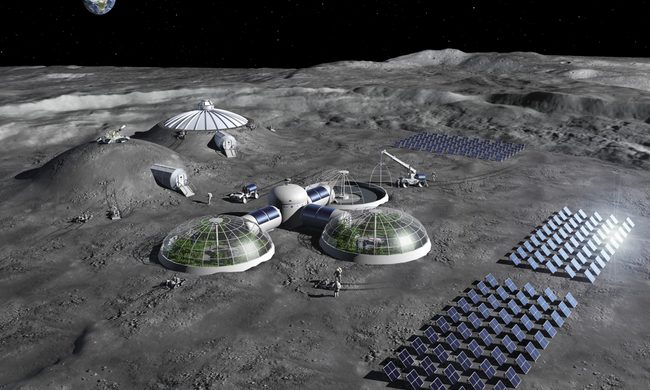
Artist impression of a Moon Base concept, with solar arrays for energy generation, greenhouses for food production, and habitats shielded with regolith.

Building a permanent base on the Moon sounds like science fiction, but NASA is making it feel a lot more real. The agency just handed $590 million in contracts to three private companies for four uncrewed lunar lander missions launching in late 2028.

These missions are part of Phase 1 of NASA's broader $30 billion Moon Base program, which needs to deliver landers, rovers, and scientific cargo up there before astronauts eventually move in. These efforts are closely tied NASA's Artemis program, which sent humans on a lunar flyby in April for the first time since the Apollo era.

Read more
Getting to Mars may require a pit stop in orbit, and NASA just tested the nozzle to make that happen
A gas pump nozzle for spacecraft sounds simple. It is not, and that's what makes this test worth paying attention to.
Architecture, Building, Factory

Getting a spacecraft to Mars or beyond requires an enormous amount of fuel, most of which has to be hauled from Earth, adding to the overall cost and weight of the spacecraft. NASA has been working on a different approach, one that could be more efficient and effective.

It wants to refuel a spacecraft in orbit before heading out for the mission. What’s even more interesting is that the space agency just finished testing a component that could make that possible: a cryocoupler.

Read more