1. Home
  2. Space
  3. News

How to watch tonight’s launch of NASA’s mega moon rocket

Add as a preferred source on Google

NASA is aiming to launch its next-generation Space Launch System (SLS) rocket on a mission to the moon in just a few hours from now.

Artemis I Launch to the Moon (Official NASA Broadcast) - Nov. 16, 2022

Following several postponed launch efforts in recent months due to technical issues and severe weather systems, NASA will attempt the rocket’s maiden launch early on Wednesday morning ET (Tuesday night PT) from the Kennedy Space Center in Florida.

Recommended Videos

The highly anticipated mission will see the world’s most powerful rocket send an uncrewed Orion spacecraft on a flyby of the moon as part of the Artemis I mission, marking the start of a new era of space exploration.

NASA set out the schedule in a tweet shared on Monday:

#Artemis I is launching to the Moon!

Nov. 15:
3:30pm ET (2030 UTC): Tanking coverage
10:30pm ET (0330 UTC): Launch broadcast

Nov. 16:
8:30am ET (1330 UTC): Trajectory burn
10am ET (1500 UTC): Earth views from @NASA_Orion

Stay tuned: https://t.co/sQWu67xTPq pic.twitter.com/srAEMfTQ63

— NASA (@NASA) November 14, 2022

How to watch

Preparations for launch, as well as the launch itself, can be viewed via the player embedded at the top of this page, or by heading to the NASA’s YouTube channel, which will carry the same feed.

Live coverage of tanking operations, with commentary, will begin at 3:30 p.m. ET (12:30 p.m. PT) on Tuesday, November 15.

Full launch coverage will begin at 10:30 p.m. ET (7:30 p.m. PT) on Tuesday, with the liftoff currently scheduled for 1:04 a.m. ET on Wednesday (10:04 p.m. PT on Tuesday).

What to expect

A slew of cameras on the ground and on the rocket itself will cover the launch from multiple angles as the 98-meter-tall SLS vehicle lights up the Florida sky on its way to space. Commentators will also talk viewers through the early stages of the flight, including the deployment of the Orion spacecraft, which will then make its way toward the moon before returning for a splashdown landing in December.

NASA will also livestream what promises to be spectacular Earth views from cameras on Orion later on Wednesday morning.

A successful Artemis I mission will pave the way for Artemis II, which will fly the same path, but this time with a crew aboard. After that, Artemis III will aim to put the first woman and first person of color on the lunar surface, possibly as early as 2025.

Trevor Mogg
Contributing Editor
Not so many moons ago, Trevor moved from one tea-loving island nation that drives on the left (Britain) to another (Japan)…
NASA is investing $590 million in private contractors to build humanity’s first Moon outpost
NASA is counting on private companies to land its Moon Base dream.
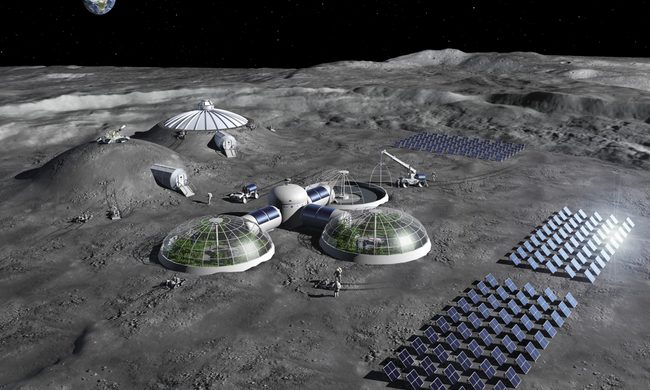
Artist impression of a Moon Base concept, with solar arrays for energy generation, greenhouses for food production, and habitats shielded with regolith.

Building a permanent base on the Moon sounds like science fiction, but NASA is making it feel a lot more real. The agency just handed $590 million in contracts to three private companies for four uncrewed lunar lander missions launching in late 2028.

These missions are part of Phase 1 of NASA's broader $30 billion Moon Base program, which needs to deliver landers, rovers, and scientific cargo up there before astronauts eventually move in. These efforts are closely tied NASA's Artemis program, which sent humans on a lunar flyby in April for the first time since the Apollo era.

Read more
Getting to Mars may require a pit stop in orbit, and NASA just tested the nozzle to make that happen
A gas pump nozzle for spacecraft sounds simple. It is not, and that's what makes this test worth paying attention to.
Architecture, Building, Factory

Getting a spacecraft to Mars or beyond requires an enormous amount of fuel, most of which has to be hauled from Earth, adding to the overall cost and weight of the spacecraft. NASA has been working on a different approach, one that could be more efficient and effective.

It wants to refuel a spacecraft in orbit before heading out for the mission. What’s even more interesting is that the space agency just finished testing a component that could make that possible: a cryocoupler.

Read more
Elon Musk’ Starlink could soon offer mobile services as a US carrier
Showcase of T-Mobile Starlink service on an iPhone.

Elon Musk’s Starlink has already changed how millions of people access the internet, especially in places where traditional broadband struggles to reach. Now, the satellite internet service could be preparing for an even bigger leap — becoming your mobile carrier.

According to a Financial Times report, SpaceX has told investors it’s considering launching a retail Starlink mobile service in the US. Instead of simply partnering with wireless carriers, the company could begin selling mobile plans directly to consumers, putting it in direct competition with Verizon, AT&T, and T-Mobile.

Read more