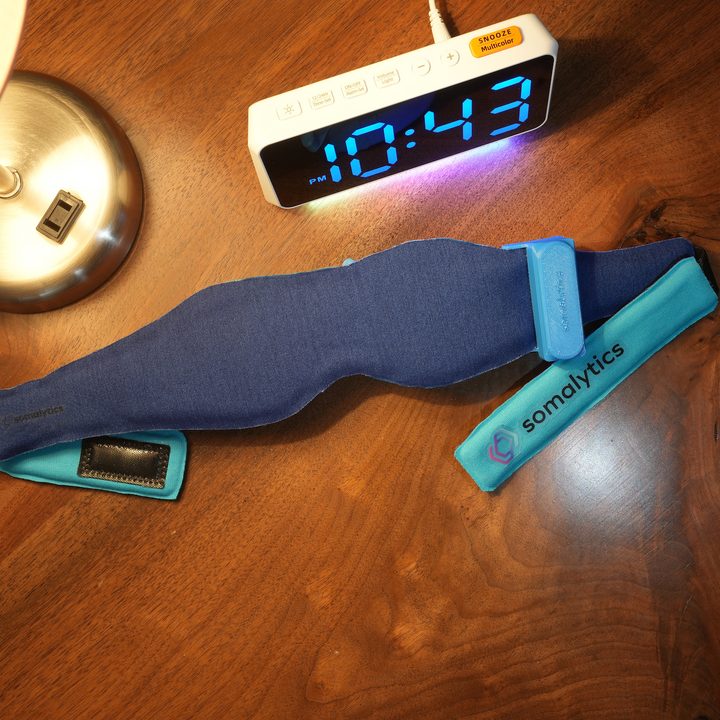
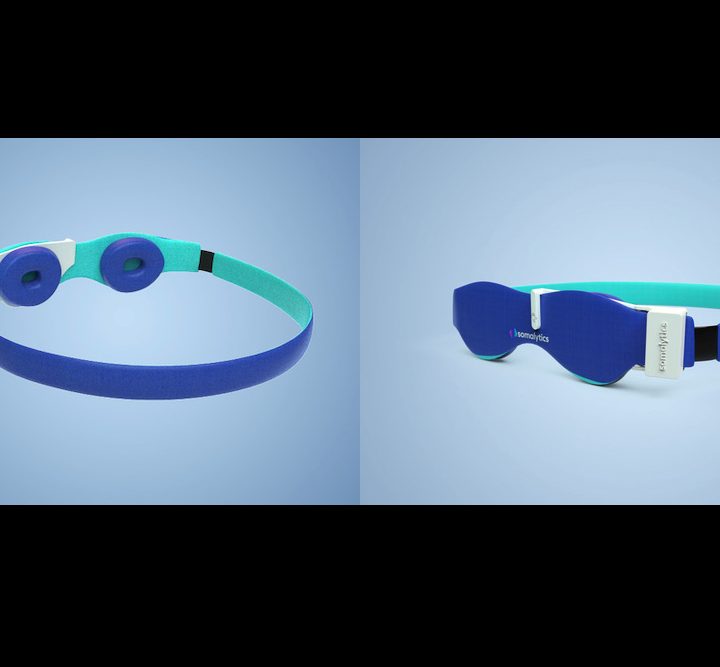
A sleep mask that tracks eye movement to help you better understand sleep patterns and quality is certainly unusual, and the prototype device in our photos shows it looks pretty mad too. That’s reason enough to talk about it, but the real reason Somalytics’ SomaSleep sleep mask is exciting is due to the amazing eye-tracking sensors hidden inside.
Digital Trends spoke to Somalytics’ CEO Barbara Barclay during CES 2023 about how the potential of these tiny sensors goes way beyond watching you while you sleep.
Introducing the Somalytics SomaSleep
The SomaSleep is the first product to use Somalytics’ SomaCap, the name given to the minuscule composite capacitive sensor that gives it the unique ability to track eye movement without the use of a camera. There are four SomaCap sensors monitoring each eye inside the mask, allowing it to track sleep stages in detail never before found outside a hospital sleep center.

“Essentially what happens [inside the mask] is the sensor has a little electrical field, think of it like a little force field, and an eyeball disrupts the electrical field,” Barclay explained. “It can detect eyes open or closed, and that’s never been possible before. We are using the movement of the eyeball and the eyelid to detect precisely where the eye is moving. From a wellness perspective, it gives you insight into what really went on while you were asleep.”
The mask being demonstrated at CES 2023 is a prototype, so not all features or design elements are final yet. It’s expected the battery will last for eight hours, and due to the low power consumption of the SomaCap sensors, it won’t need a big, heat-producing battery pack. Data will be collected and presented in an app, which is still in development, plus Somalytics will release an SDK for developers to integrate the product into their own apps.
Barclay explained why, initially, the SomaSleep mask won’t have additional sensors — making it unlike sleep tracking devices like the Oura Ring or the Apple Watch:
“We’ll be developing a portfolio of sleep products,” she continued. “After the sleep mask, we may have a mattress pad you lay on to identify multiple aspects of your movement and your respiration. I also think we will be able to capture heart rate from that. But, you know, to be honest, that’s something everybody already has. These sensors are capable of so many things.”
Capable of so many things
The SomaSleep mask is an intriguing product, but Barclay’s words that the SomaCap was, “capable of so many things,” showed that it was the sensors that made it really special. The SomaCap is a composite capacitive sensor that’s so sensitive it can understand human presence as close as 200mm, so small it can measure just 1mm, be as thin as a human hair, and be infused into paper. It has the potential to change a lot more than just sleep tracking. Barclay talked about what makes it unique:
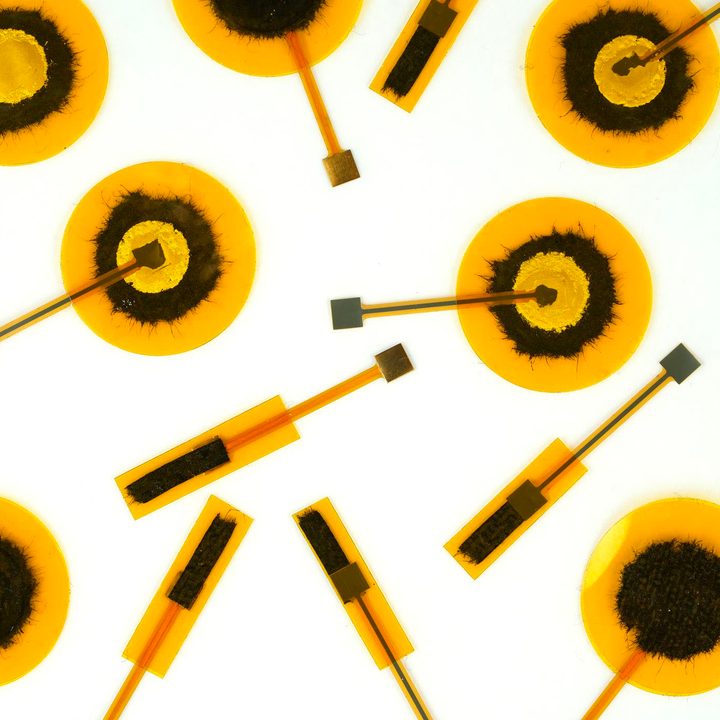
“You take a conductive substance, put it in paper, and now it’s a conductive structure because it has all the surface area to detect whatever you’re trying to detect, and then you package it up in plastic so that it’s waterproof. It consumes very little power, it’s highly sensitive to liquid, and it’s highly sensitive to human tissue.”
Barclay went on to give me an everyday example of where the small sensor could be used to make a simple, but hugely meaningful change:
“You go to the bathroom at the airport, and all the fancy touch-sensitive stuff doesn’t work. The toilet flushes when it shouldn’t, and the water doesn’t turn on when supposed to. All of those are typically infrared sensors, which are probably the most common thing used in these environments. They’re sensitive to dirt, they don’t like dark lighting, they don’t work well with dark skin, and they work at a very limited distance.”
[The SomaCap’s] unique properties enable it to see something that’s far away from the faucet, and is not affected by dirt no matter how dirty it gets,” Barclay continued. “It looks for the human charge when you’re sitting on the toilet, not motion, so it waits until you get up before flushing, because the minute you get up, the human charge disappears. Whether you’re turning on lights, turning an appliance on, or measuring the amount of water in a glass you’re trying to fill from your refrigerator. This is a better way to do it that’s less expensive, with low power consumption, and a very small form factor.”
Beyond touch and sleep
The SomaCap’s ability clearly goes way beyond watching for eye movement in a sleep mask, but it also goes beyond replacing the often unreliable infrared and other touch-sensitive systems we commonly use today too. Barclay talked about working with car makers, such as Hyundai, on integrating the sensors into cars, and also mentioned a pair of smart glasses that track eye movement with incredible precision without cameras.
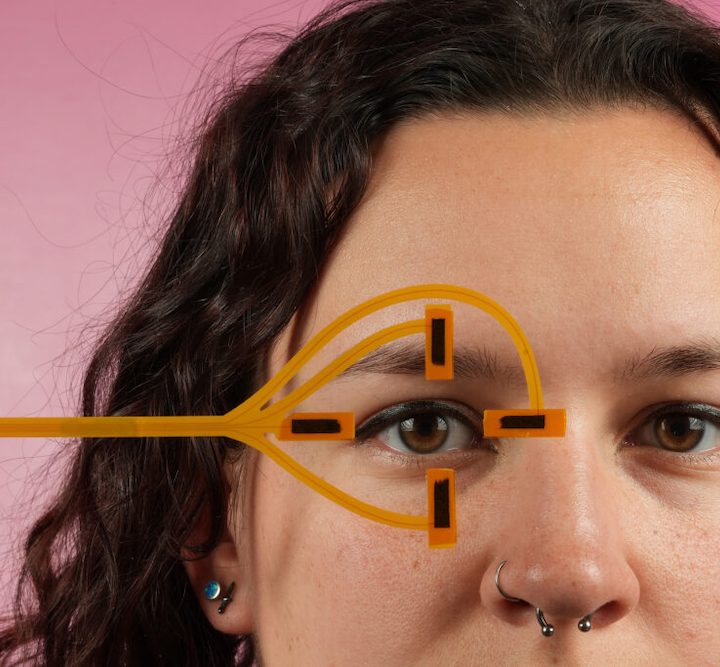
“The speed of the fastest wearable eye tracker is 200Hz, and the processing time is usually about 26 milliseconds,” Barclay said about existing eye-tracking systems in virtual reality (VR) headsets. “It doesn’t seem like a lot, but it’s long enough for your brain to know what’s going on. We’ll have maybe a three-millisecond delay and 1,000hz. Not this year. We don’t need it for sleep. But ultimately for VR.”
Removing cameras from smart glasses and VR headsets reduces bulk, lowers power consumption, and negates privacy concerns. Pair all this with the speed and low latency Barclay claims the SomaCap sensors are capable of, and a lot of the promise we’ve been told about 5G suddenly starts to look much more likely.
Only the beginning
Somalytics plans to release the SomaSleep mask later this year, when it will cost $200, but is open to working with other companies on it in the meantime. Plus, it isn’t keeping the SomaCap to itself, either.
“My preference is to partner with somebody who will help us develop [the SomaSleep] with their point of view and the product in mind,” she said. “We’ve already identified a development partner for the eye tracking glasses which are coming after this, and we hope to have that finalized within the next few months. I have the path planned out for those first things related to eye tracking, but we’ve been working with quite a number of Fortune 500 companies that are under NDA, and they’re doing research and development for different applications, and I think in 2023, at least a couple of them will pull the trigger.”
Not bad from a minuscule sensor that’s starting life inside a sleep mask.