1. Home
  2. Computing
  3. News

Apple announces new MacBook Pro with M2 Pro and M2 Max chips

Add as a preferred source on Google

Apple has unveiled new versions of the 14-inch and 16-inch MacBook Pro, ending months of speculation surrounding the devices. New features include the latest M2 Pro and M2 Max chips — but not much else.

Almost everything else remains the same as what we saw in the M1 Pro and M1 Max versions of the MacBook Pro: the same flat-edged design, the same mini-LED display, and the same port arrangement. That’s not particularly surprising, as the M1 versions of these laptops themselves featured a major design overhaul. Another big change so soon was not really in the cards.

A person sitting in a vehicle using a MacBook Pro on their lap.
Apple

Before the announcement, the M2 Pro and M2 Max chips were rumored to offer a relatively minor performance uptick compared to their predecessors. That was mostly based on how the M2 chip was not a large improvement over the M1. Still, Apple’s own chips are known for their power and efficiency, and the M2 Pro and M2 Max may well offer similar benefits.

Recommended Videos

According to Apple’s press release, the M2 Pro is made with a 5-nanometer process and offers 40% faster image rendering times in Adobe Photoshop compared to the M1 Pro. It comes with up to 32GB of unified memory and can be configured to come with 10 or 12 CPU cores and up to 19 GPU cores.

The M2 Max, meanwhile, has 67 billion transistors — three times that of the base-level M2 — and can come with up to 96GB of unified memory. It has the same 12-core CPU as the M2 Pro, but 38 GPU cores instead of the M2 Pro’s 19. Those boosted specs result in 30% faster effects rendering in Cinema 4D compared to the M1 Max, Apple says. Color grading in DaVinci Resolve is also 30% faster.

We will have to see how Apple’s numbers stack up when the first reviews are published. According to numerous outlets, those could appear as early as Monday next week.

Mac Mini finally ditches Intel
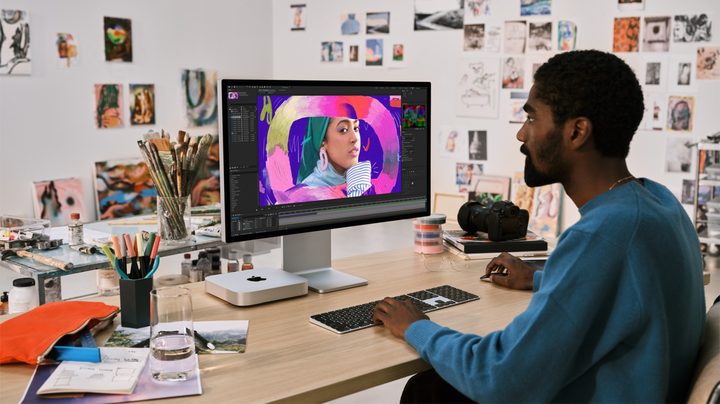
A person sitting at a desk using a Mac mini.
Apple

As well as the MacBook Pros, Apple also launched a new Mac Mini with M2 and M2 Pro chips, and dropped the price of the entry-level model by $100 to $599. That means the Mac Mini range now has no Intel options, after being one of the last Apple Macs to still contain an Intel chip.

That means the Mac Pro remains the only Mac that hasn’t entirely transitioned to Apple silicon. According to the rumors, though, we probably won’t have long to wait for that to happen.

Apple is still heavily rumored to be preparing for a special March event where it will release a host of new products. That includes an Apple silicon Mac Pro, a new Mac Mini, and potentially even a mixed-reality headset. With the MacBook Pro just announced, that’s one less product due at the show — but there’s still plenty more to look forward to.


Alex Blake
Alex Blake has been working with Digital Trends since 2019, where he spends most of his time writing about Mac computers…
What happens when AI detectors fail? Researchers say we must be trained to spot fake AI faces
Researchers say spotting AI faces may soon depend more on people than software
Zuckerberg Deepfake

Artificial intelligence has become remarkably good at creating fake human faces. So good, in fact, that the old tricks people relied on - counting fingers, spotting warped earrings, or looking for distorted backgrounds - are quickly becoming obsolete. According to a new study highlighted by the BBC, the next line of defence may not be a better AI detector at all. It might simply be a better-trained human.

Researchers from the University of Aberdeen, working alongside Australia's National University, found that people can dramatically improve their ability to distinguish AI-generated faces from real ones after a relatively short period of structured training. Instead of hunting for obvious visual glitches, participants were taught to recognise subtle patterns that modern image generators still struggle to replicate consistently.

Read more
Google’s new Magic Pointer Play Store listing reveals a Gemini shortcut built for Googlebooks
The unannounced app turns the cursor into a contextual AI tool for search, image creation, and shopping
Plant, Text, Business Card

Google has quietly published a new Play Store listing for Magic Pointer, an unannounced app built for Googlebooks. Updated on July 10, the app turns the cursor into a Gemini shortcut that can act on whatever a user selects on screen.

Magic Pointer can send an image to Lens, generate a related image, or surface a shopping action without forcing users to open a separate chatbot. Regular Android devices currently show as incompatible, so the listing offers an early preview rather than a broad release.

Read more
You can stop using AI, but this new report says you probably can’t escape it
A UK survey found that most people feel AI exposure is unavoidable, raising harder questions about consent, privacy, and whether opting out is still realistic
AI Chatbots

More people are trying to use less AI, but avoiding it altogether may already be impossible.

A survey of 2,055 UK adults found that 42% deliberately limit how much AI they use. Another 70% said avoiding AI exposure would be difficult or impossible, even when they actively wanted less of it.

Read more