1. Home
  2. Space
  3. News

A failed Webb telescope calibration leads to the discovery of this tiny asteroid

Add as a preferred source on Google

With any new technology, there are bound to be failures — and that’s true of cutting-edge astronomy instruments like the James Webb Space Telescope as well. But failures can have a silver lining, as was demonstrated recently when an unsuccessful attempt to calibrate a Webb instrument to a well-known asteroid turned up a delightful surprise: the discovery of a new, different asteroid that is just a few hundred feet across.
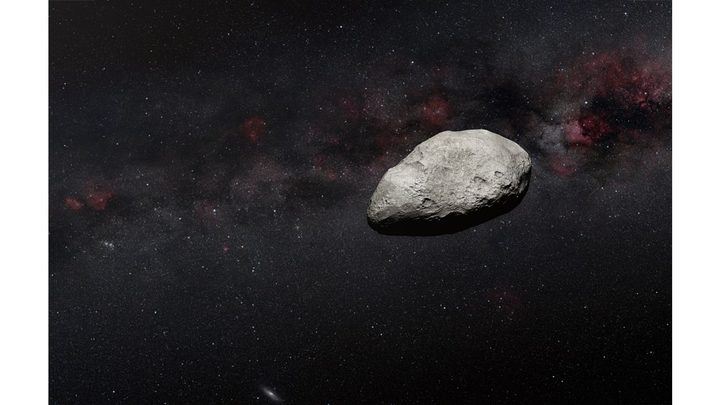
An asteroid roughly the size of Rome’s Colosseum — between 300 to 650 feet (100 to 200 meters) in length — has been detected by an international team of European astronomers using NASA's James Webb Space Telescope. They used data from the calibration of the MIRI instrument, in which the team serendipitously detected an interloping asteroid. The object is likely the smallest observed to date by Webb and may be an example of an object measuring under 1 kilometer in length within the main asteroid belt, located between Mars and Jupiter. More observations are needed to better characterize this object’s nature and properties.
An asteroid roughly the size of Rome’s Colosseum — between 300 to 650 feet in length — has been detected by a team of European astronomers using NASA’s James Webb Space Telescope. They used data from the calibration of the MIRI instrument to serendipitously detect an interloping asteroid. The object is likely the smallest observed by Webb, and may be an example of an object measuring under 1 kilometer in length within the main asteroid belt, located between Mars and Jupiter.  ARTWORK: NASA, ESA, CSA, N. Bartmann (ESA/Webb), Martin Kornmesser (ESA), Serge Brunier (ESO), Nick Risinger (Photopic Sky Survey)

Researchers were looking through the data collected during the calibration of Webb’s Mid-Infrared Instrument (MIRI) when it was pointed toward known asteroid 1998 BC1 — a procedure that had failed due to technical issues. They hoped that they could use this data to test out some new techniques, but when they went digging, they spotted something unexpected. There was a tiny asteroid around 100 to 200 meters (300 to 650 feet) long that happened to be passing through the instrument’s field of view at the same time.

Recommended Videos

“Our results show that even ‘failed’ Webb observations can be scientifically useful, if you have the right mindset and a little bit of luck,” said lead author of the research, Thomas Müller, in a statement. “Our detection lies in the main asteroid belt, but Webb’s incredible sensitivity made it possible to see this roughly 100-meter object at a distance of more than 100 million kilometers.”

The smaller targets like asteroids are, the harder they are to detect as they reflect so little light. So it’s exciting that Webb was able to detect this new object, thought to be the smallest asteroid Webb has observed so far.

The discovery needs to be confirmed before the small asteroid can be named, but it could help researchers understand more about the formation of the solar system. Asteroids are remnants from the formation of the planets, and studying them can offer a glimpse billions of years into the past.

“This is a fantastic result which highlights the capabilities of MIRI to serendipitously detect a previously undetectable size of asteroid in the main belt,” said Webb support scientist Bryan Holler. “Repeats of these observations are in the process of being scheduled, and we are fully expecting new asteroid interlopers in those images.”

The research is published in the journal Astronomy and Astrophysics.

Georgina Torbet
Georgina has been the space writer at Digital Trends space writer for six years, covering human space exploration, planetary…
Space is becoming Bezos and Musk’s next data center site, and we have every reason to worry
The AI boom is coming for the night sky
How Vast's space station will look in orbit.

AI data centers already consume vast amounts of electricity and water on Earth, so Silicon Valley has begun looking somewhere considerably more spacious... literally.

Elon Musk's SpaceX and Jeff Bezos' Blue Origin, along with several other companies, have proposed enormous constellations of satellites designed to operate as orbital data centers. However, environmental groups and former space officials are now warning that putting them into orbit at the proposed scale could have severe consequences for Earth's atmosphere and the night sky.

Read more
The first possible exomoon is here, and it makes our Moon look hilariously tiny
Scientists may have found the first exomoon, except this one is the size of Jupiter
This artist’s concept depicts a potential volcanic moon between the exoplanet WASP-49 b, left, and its parent star. New evidence indicating that a massive sodium cloud observed near WASP-49 b is produced by neither the planet nor the star has prompted researchers to ask if its origin could be an exomoon.

We have already discovered more than 6,000 planets outside of our immediate neighborhood. Yet, finding a moon orbiting one of those distant worlds has proved considerably harder. Astronomers may finally have something close to the real deal, but this particular object stretches the word “moon” almost beyond recognition.

Using the European Southern Observatory’s Very Large Telescope in Chile, researchers detected strong evidence for a moon-like object in the CD-35 2722 system. Further observations are still necessary to confirm the discovery, but it could become the first confidently detected natural satellite outside our solar system. There is still one tiny complication though. This moon is apparently massive.

Read more
China’s answer to SpaceX’s reusable rockets literally catches boosters in a net
SpaceX catches boosters on legs. China just used a net.
Ammunition, Missile, Weapon

SpaceX's playbook for recovering a rocket booster generally involves legs, a precisely controlled vertical landing, and either a concrete pad or a drone ship. 

China just managed to pull off something similar, but in a slightly different way, and on July 10, it tested the method as well.

Read more