1. Home
  2. Space
  3. News

How James Webb is peering into galaxies to see stars being born

Add as a preferred source on Google

Recently astronomers used the James Webb Space Telescope to look at the structures of dust and gas which create stars in nearby galaxies. Now, some of the researchers have shared more about the findings and what they mean for our understanding of how galaxies form and evolve.

The project, called Physics at High Angular resolution in Nearby Galaxies, or PHANGS, used James Webb to observe several galaxies which are similar to our own Milky Way to see how stars are forming within them.
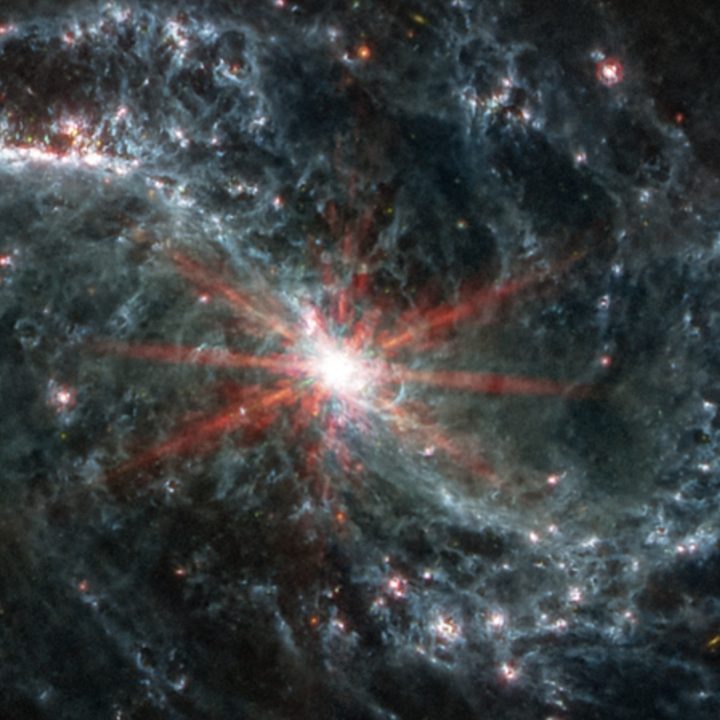
A view of the inside of a distant spiral galaxy.
Researchers are getting their first glimpses inside distant spiral galaxies to see how stars formed and how they change over time, thanks to the James Webb Space Telescope’s ability to pierce the veil of dust and gas clouds. NASA/Space Telescope Science Institute

“We’re studying 19 of our closest analogues to our own galaxy,” explained one of the researchers, Erik Rosolowsky of the University of Alberta, in a statement. “In our own galaxy, we can’t make a lot of these discoveries because we’re stuck inside it.”

Recommended Videos

By using Webb’s infrared instruments, the researchers can look through clouds of dust and gas which could be opaque if viewed in the visible light range. As objects get warmer, they give off more infrared light, so Webb’s instruments can see where pockets of warmer dust and gas sit, and how this relates to areas where stars are forming.

“At 21 micrometers [the infrared wavelength used for the images collected], if you look at a galaxy you will see all of those dust grains heated with light from the stars,” said Hamid Hassani, another of the researchers. “The infrared light is really key to tracing the cold and distant universe.”

The team has so far examined 15 galaxies, out of a total of 19 that they will examine for their project. For the galaxies imaged so far, the researchers took information about the distribution and warmth of stars and worked out the ages of those stars. That came with some surprises, as many of the images they were observing showed bright stars that were younger than they were expecting.

“The age of these [stellar] populations is very young. They’re really just starting to produce new stars and they are really active in the formation of stars,” said  Hassani.

It is the process of star formation which makes a galaxy grow and thrive. Star formation is a delicate balance of having enough material for new stars to form, and the stellar winds created by young stars blow this material away.

“If you have a star forming, that galaxy is still active,” Hassani said. “You have a lot of dust and gas and all of these emissions from the galaxy that trigger the next generation of the next massive star forming and just keep the galaxy alive.”

The research is published in The Astrophysical Journal Letters.

Georgina Torbet
Georgina has been the space writer at Digital Trends space writer for six years, covering human space exploration, planetary…
Lightsails have hit another speed bump on the road to interstellar travel
The coolest interstellar travel idea may get betrayed by the light pushing it
LightSail in Earth orbit

Laser-powered lightsails are one of the coolest answers to spaceflight. It might not be as sci-fi-sounding as a warp drive, but now, its practicality has also come under question. Using lightsails, a spacecraft could unfurl an ultra-thin reflective sail and let a powerful laser push it toward another star, without relying on fuel.

The tech was simple and elegant--except it's also more complicated than it sounds. A new preprint from researchers Chao Shen and Jiaze Li of the Harbin Institute of Technology suggests that relativistic lightsails may run into a hidden propulsion problem once they start moving extremely fast.

Read more
The galaxy has an exoplanet size mystery, and NASA’s EVE mission wants to solve it
This planet-hunting mission wants to catch baby worlds before they grow up
Artist’s Illustration of Exoplanets Orbiting Barnard’s Star

Mankind venturing into space ended up creating more questions than it answered, and one of the dilemmas is related to the planet sizes. Astronomers have found plenty of rocky super-Earths and plenty of puffier sub-Neptunes, but far fewer planets with a radius of about 1.8 times Earth’s.

That gap is known as the radius valley, and a proposed mission called the Early eVolution Explorer, or EVE, wants to figure out why it exists. NASA has a simple plan: look at planets while they are still young. The mission concept, detailed in a new arXiv preprint and covered by Phys.org, would focus on newly formed star clusters to see what small planets look like before billions of years of evolution.

Read more
We just got a hot signal that a Tesla and SpaceX merger could happen, after all
Tesla

For years, the idea of Tesla and SpaceX becoming a single company has lived somewhere between ambitious business theory and Elon Musk fan fiction. The two companies already share DNA, leadership influence, engineering talent, and long-term goals. But every time the topic surfaced, it felt more like an interesting thought experiment than a realistic possibility. Now, one of the most important people at SpaceX has added fresh fuel to the conversation.

Speaking in a recent CNBC interview, SpaceX President and COO Gwynne Shotwell was asked about the possibility of closer ties between Tesla and SpaceX. Her response wasn’t a flat-out denial. In fact, she suggested that bringing the two companies together could make life a little easier for Musk. That may sound like an offhand comment, but coming from Shotwell, it’s noteworthy. She’s been at SpaceX since its earliest days and remains one of the company's most influential executives.

Read more