1. Home
  2. Space
  3. News

Launch of Europe’s Jupiter Icy Moons Explorer delayed by 24 hours

Add as a preferred source on Google

The launch of the European Space Agency (ESA)’s JUICE mission to the icy moons of Jupiter has been delayed by 24 hours due to weather conditions. Risk of lightning near the launch pad at Europe’s Spaceport in Kourou, French Guiana meant that the launch was scrubbed around 10 minutes prior to the scheduled liftoff today, Thursday, April 13.

Juice launch to Jupiter

The JUICE mission, which will visit three of Jupiter’s largest moons — Europa, Ganymede, and Callisto — aims to learn about whether these moons could be potentially habitable as they are thought to host liquid water oceans beneath thick icy crusts. The spacecraft is to be launched using an Ariane 5 rocket and will spend approximately eight years traveling to the Jupiter system before arriving at Jupiter in July 2031.
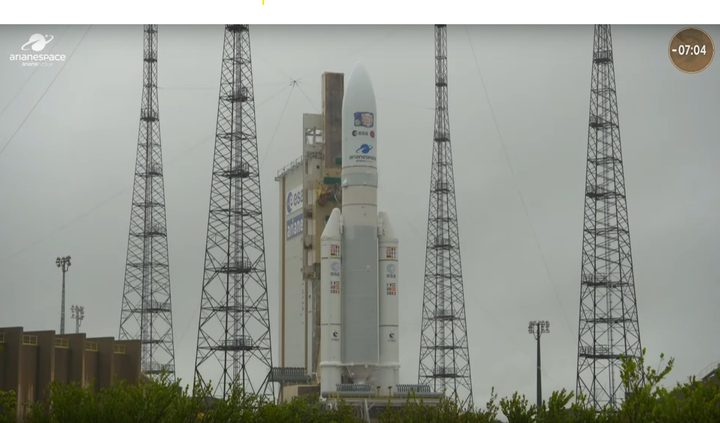
An Ariane 5 rocket containing the Juice spacecraft on the launchpad at Europe’s Spaceport in Kourou, French Guiana, on Thursday April 13 2023.
An Ariane 5 rocket containing the Juice spacecraft on the launch pad at Europe’s Spaceport in Kourou, French Guiana, on Thursday, April 13, 2023. ESA / ArianeSpace

The launch of the mission will now be pushed back until tomorrow, with hopes for better weather then. “It’s part of our business,” said Stéphane Israël, CEO of ArianeSpace, during a livestream of the launch, confirming that the delay was due to the risk of lightning. “What is important is that the launcher and JUICE are in stable configuration and in full security. We will be back tomorrow morning.”

Recommended Videos

The launch is now scheduled for 8:14 a.m. EST (5:14 a.m. PT) tomorrow, Friday, April 14. The launch time has been brought forward by one minute to allow for JUICE’s extremely tight launch window.

The JUICE launch window is just one second long, because of the need to conserve fuel on the journey to Jupiter. The spacecraft needs to hit a particular trajectory for this journey, which will involve gravity-assist flybys of several planets including Earth and Venus to give the craft a boost along its way. To join this trajectory as efficiently as possible, the launch needs to occur within a very specific window each day with one-second windows available until the end of April.

To watch the second launch attempt tomorrow, you can head over to ESA’s Web TV channel on YouTube, where the launch will be livestreamed with coverage beginning around 7:45 a.m. ET (4:45 a.m. PT).

Georgina Torbet
Georgina has been the space writer at Digital Trends space writer for six years, covering human space exploration, planetary…
Getting to Mars may require a pit stop in orbit, and NASA just tested the nozzle to make that happen
A gas pump nozzle for spacecraft sounds simple. It is not, and that's what makes this test worth paying attention to.
Architecture, Building, Factory

Getting a spacecraft to Mars or beyond requires an enormous amount of fuel, most of which has to be hauled from Earth, adding to the overall cost and weight of the spacecraft. NASA has been working on a different approach, one that could be more efficient and effective.

It wants to refuel a spacecraft in orbit before heading out for the mission. What’s even more interesting is that the space agency just finished testing a component that could make that possible: a cryocoupler.

Read more
Elon Musk’ Starlink could soon offer mobile services as a US carrier
Showcase of T-Mobile Starlink service on an iPhone.

Elon Musk’s Starlink has already changed how millions of people access the internet, especially in places where traditional broadband struggles to reach. Now, the satellite internet service could be preparing for an even bigger leap — becoming your mobile carrier.

According to a Financial Times report, SpaceX has told investors it’s considering launching a retail Starlink mobile service in the US. Instead of simply partnering with wireless carriers, the company could begin selling mobile plans directly to consumers, putting it in direct competition with Verizon, AT&T, and T-Mobile.

Read more
Lightsails have hit another speed bump on the road to interstellar travel
The coolest interstellar travel idea may get betrayed by the light pushing it
LightSail in Earth orbit

Laser-powered lightsails are one of the coolest answers to spaceflight. It might not be as sci-fi-sounding as a warp drive, but now, its practicality has also come under question. Using lightsails, a spacecraft could unfurl an ultra-thin reflective sail and let a powerful laser push it toward another star, without relying on fuel.

The tech was simple and elegant--except it's also more complicated than it sounds. A new preprint from researchers Chao Shen and Jiaze Li of the Harbin Institute of Technology suggests that relativistic lightsails may run into a hidden propulsion problem once they start moving extremely fast.

Read more