1. Home
  2. Space
  3. News

Virgin Galactic video shows what’s in store for first commercial passengers

Add as a preferred source on Google

Virgin Galactic is just hours away from launching its first-ever commercial flight to the edge of space.

Thursday’s mission comes after years of testing that included a string of setbacks, the most significant of which involved the tragic death of test pilot Michael Alsbury in a crash in 2014.

Recommended Videos

Following two fully crewed test flights, the most recent of which took place in May, Virgin Galactic is now ready to send paying passengers to an altitude of about 53 miles (86 kilometers), around seven times higher than a commercial passenger jet though several miles short of the point known as the Kármán line where space is generally considered to begin.

The passenger list includes Colonel Walter Villadei and Lieutenant Colonel Angelo Landolfi from the Italian Air Force, and Pantaleone Carlucci from the National Research Council of Italy.

A video released by the company last year offers a detailed look at the various stages of the 90-minute suborbital experience.

Virgin Galactic Spaceflight System

Thursday’s passengers and crew will take off from Spaceport America in New Mexico. They’ll travel inside VSS Unity, which at the start is carried by another aircraft called VMS Eve.

At 50,000 feet, Eve will release Unity, which will immediately fire up its rocket engine before hurtling toward the edge of space.

At its highest point, the passengers will have a few moments to enjoy the views and experience weightlessness inside the cabin. Thursday’s mission is mainly focused on scientific research, so the passengers will also busy themselves with handling some of the payloads during their short time in microgravity conditions.

Finally, VSS Unity will glide back to Earth for a runway landing at Spaceport America.

Virgin Galactic says it wants to fly its second mission in August and begin serving the hundreds of so-called “space tourists” who’ve spent up to $450,000 for the spectacular ride.

The only comparable experience is offered by Blue Origin, a rocket company owned by Amazon founder Jeff Bezos. But whereas Virgin Galactic uses a plane, Blue Origin’s involves a crew capsule atop a single-stage rocket. Following six successful crewed flights since the first one in July 2021, Blue Origin’s New Shepard rocket suffered a midair failure last September during a crewless mission, prompting the company to suspend operations while it investigates the incident.

Coverage of Virgin Galactic’s first commercial flight begins at 11 a.m. ET on Thursday, June 29. Check this page for all the information you need to watch the event as it unfolds.

Trevor Mogg
Contributing Editor
Not so many moons ago, Trevor moved from one tea-loving island nation that drives on the left (Britain) to another (Japan)…
Amazon’s Starlink rival just crossed a major milestone, but don’t expect perfect internet just yet
Amazon finally showed up to the space internet party
Amazon Leo satellite layout across all launch vehicles

Amazon has taken a significant step toward launching its long-awaited satellite internet service. Following its latest rocket launch, the company now has 396 Project Kuiper satellites in low-Earth orbit, enough to begin offering continuous service across select regions. The milestone keeps Amazon on track for its previously announced goal of launching commercial service by mid-2026.

https://twitter.com/Weber44Chris/status/2072575499461963938?ref_src=twsrc%5Etfw%7Ctwcamp%5Etweetembed%7Ctwterm%5E2072575499461963938%7Ctwgr%5Ed727a1b853cbf519585e7bf2655943afb2f91bb8%7Ctwcon%5Es1_&ref_url=https%3A%2F%2Fwww.theverge.com%2Fscience%2F960563%2Famazon-leo-service-tipping-point

Read more
Amazon’s Starlink rival is set to launch satellite internet later this year
After launching nearly 400 satellites, Amazon says its Leo broadband service will go live later this year.
Atlas V launches 29 Amazon Leo satellites from Cape Canaveral, Florida

Amazon's long-awaited answer to SpaceX's Starlink is finally nearing liftoff. According to an exclusive report from Reuters, the company plans to begin offering its Leo satellite internet service later this year, after its latest rocket launch pushed the constellation to 394 satellites in orbit.

The pieces are finally falling into place for Project Kuiper

Read more
NASA is investing $590 million in private contractors to build humanity’s first Moon outpost
NASA is counting on private companies to land its Moon Base dream.
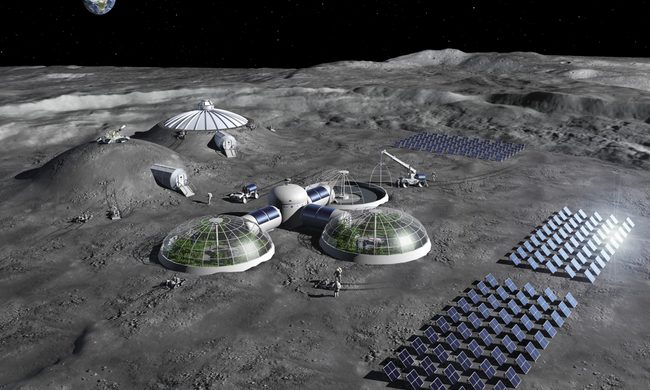
Artist impression of a Moon Base concept, with solar arrays for energy generation, greenhouses for food production, and habitats shielded with regolith.

Building a permanent base on the Moon sounds like science fiction, but NASA is making it feel a lot more real. The agency just handed $590 million in contracts to three private companies for four uncrewed lunar lander missions launching in late 2028.

These missions are part of Phase 1 of NASA's broader $30 billion Moon Base program, which needs to deliver landers, rovers, and scientific cargo up there before astronauts eventually move in. These efforts are closely tied NASA's Artemis program, which sent humans on a lunar flyby in April for the first time since the Apollo era.

Read more