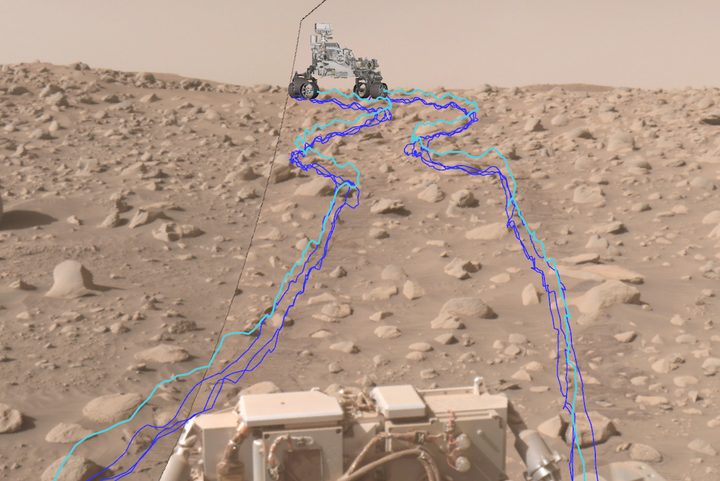
NASA’s Mars rover, Perseverance, has used its self-driving smarts to successfully navigate its most challenging route since arriving on the planet two-and-a-half years ago. Even better, its advanced technology meant it took just a third of the time that it would’ve taken other NASA Mars rovers.
While the mission team at NASA’s Jet Propulsion Laboratory sends general route maps for Perseverance to follow, the rover uses its autonomous navigation systems to perform the actual drive, steering clear of rocks and other hazards as it goes.
Its trickiest drive yet involved traversing Snowdrift Peak, a location inside Jezero Crater packed with large boulders.
The straight-line route through Snowdrift stretches 1,706 feet (520 meters), but by the time the rover exited the opposite side of the field, it had logged 2,490 feet (759 meters), the route made longer by all of its maneuvering around the boulders.
“It was much denser than anything Perseverance has encountered before — just absolutely littered with these big rocks,” Tyler Del Sesto, deputy rover planner lead for Perseverance at JPL, said in an online post.
Del Sesto added that it didn’t want to send Perseverance around Snowdrift Peak because it would’ve taken weeks, adding that “more time driving means less time for science, so we just dove right in.”
The successful drive by the car-sized rover is a testament to the team that designed Perseverance and its autopilot system.
But Del Sesto doffed his cap to other NASA rovers that paved the way, including Curiosity which continues to operate on the Martian surface. “Of course, everybody on the team knows we only got to this level of performance by standing on the shoulders of giants — Sojourner, Spirit, Opportunity, and Curiosity were the trailblazers,” the rover planner said.
To proceed safely, Sojourner had to stop every 5.1 inches (13 centimeters) for its onboard computer to analyze and process what was just ahead of it before charting its next move. The next Mars rovers, Spirit and Opportunity, could drive distances up to 1.6 feet (0.5 meters) before stopping to work out their next action. Curiosity, which arrived on Mars in 2012, recently received a software upgrade to help it make faster driving decisions.
But thanks to its better cameras and improved software, Perseverance can take images quickly enough to process its route in real-time, with additional computing power eliminating the need to stop to decide its next move.
“This autonomous capability has allowed Perseverance to set new records for Mars off-roading, including a single-day drive distance of 1140.7 feet (347.7 meters) and longest drive without human review: 2296.2 feet (699.9 meters),” JPL points out. “But those achievements took place back when the rover was driving across the relatively flat terrain of Jezero Crater’s floor, without large rocks and other craters standing in its way. That’s why this recent navigation of boulder-festooned Snowdrift Peak impressed even the engineers who plan rover outings.”