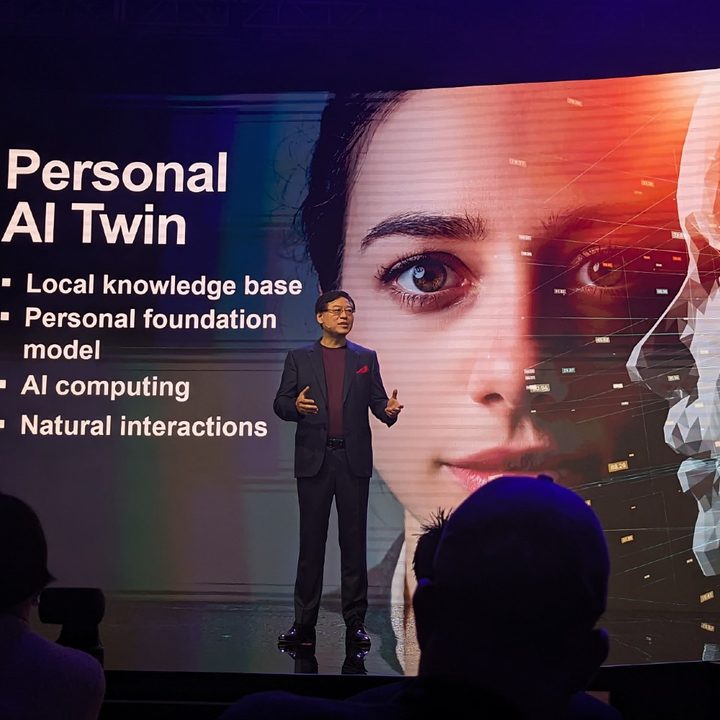
Lenovo showcased its progress and aspirations at its Tech World 2023 keynote on Tuesday, announcing its “AI for All” concept, which is aimed at spreading AI goodness to as many commercial and personal spaces as possible. But the idea of an “AI twin” was what caught my attention most as an attendee.
Yes, the idea of a company creating an AI twin of you online sounds downright disturbing — but don’t worry, in practice it’s not as creepy as it might appear. The general idea is for an AI assistant that has “in-depth knowledge” of you and, perhaps, your company, which will allow it to perform intelligent tasks on your behalf.
In many ways, Lenovo’s personal AI twin works identically to any AI assistant. With the data it gathers from from a user’s personal device, it will anticipate your needs and offer solutions, proactively and independently, Lenovo CEO Yang Yuanqing said at the Tech World keynote.
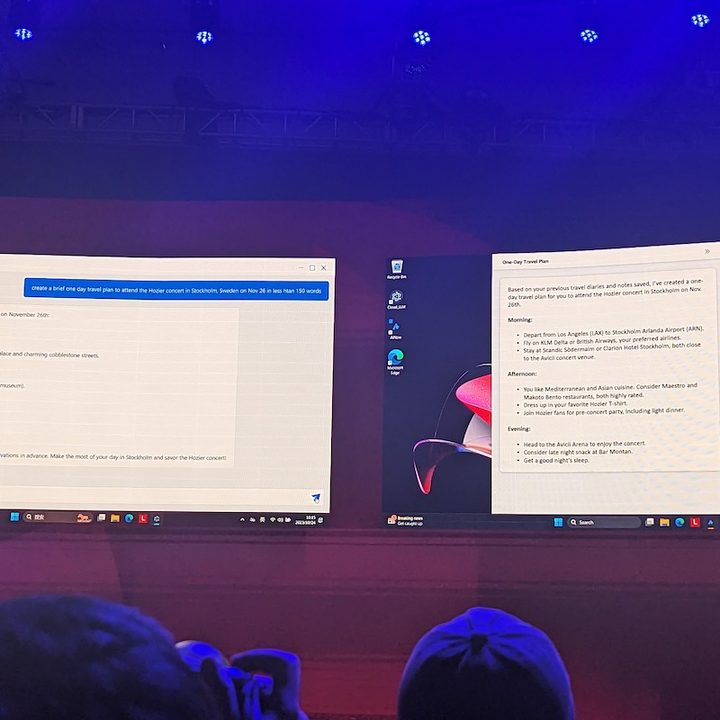
The brand demoed the tool, comparing how it could draft an itinerary for a trip to Sweden for a specific time frame in less than 150 words against a standard AI assistant. While the standard AI assistant gave a generic plan that it might generate for anyone, Lenovo’s personal AI twin generated a trip schedule based on the user’s personal tastes, including giving the best airports to fly out of, suggesting specific restaurants, and giving detailed activities to do while traveling.
That might sound invasive from a data privacy standpoint, but Lenovo intends for the tool to have a strong focus on data privacy, with the AI only learning about the things you want it to learn, Dr. Yong Rui, Lenovo’s chief technology officer, told journalists at the event. As PCs become more inundated with artificial intelligence and on-device processing of AI, an AI twin is there to help users control the flow of their private data on the web.
In a later demo, a guide demonstrated the tool answering based on information stored locally on a device. He inputted his query and populated an answer. Then he showed where on the computer the file with the applicable information was located.
The company also highlighted that the tool is powerful enough to be used offline. The keynote demo was done in airplane mode, while the second demo was not connected to the internet. Dr. Rui noted that the foundational models on which the AI twin is based is so compressed that it can work without talking to the cloud at all.
Lenovo envisions a tool that ensures data is never sent to the public cloud, unless you give authorization. The tool functions using public databases, but does not extract from users’ data to train public models. The encroaching on users’ private data for public and corporate consumption has been an ongoing concern about the quickly developing AI space that isn’t stopping any time soon.
The personal AI twin effort is still in a development stage and the company has yet to decide how it will present the tool, whether it be an app or another experience. Ultimately, it will be up to customers, Dr. Rui said.
Either way, like so many tech companies these days, Lenovo certainly seems all-in on embracing AI with open arms.
Lenovo says the keynote was an “announcement of development,” adding that the tool is ready to be shipped with devices but the brand cannot share an exact timeline for availability.