1. Home
  2. Space
  3. News

This infrared Earth image looks like a work of art

Add as a preferred source on Google

You only have to switch to Satellite View on Google Maps to see how beautiful Earth looks from up high, but images from spacecraft capturing data in the near-infrared channel also create images of stunning beauty.

Take this one (below) captured earlier this year by the Copernicus Sentinel-2 mission and shared a few days ago by the European Space Agency.
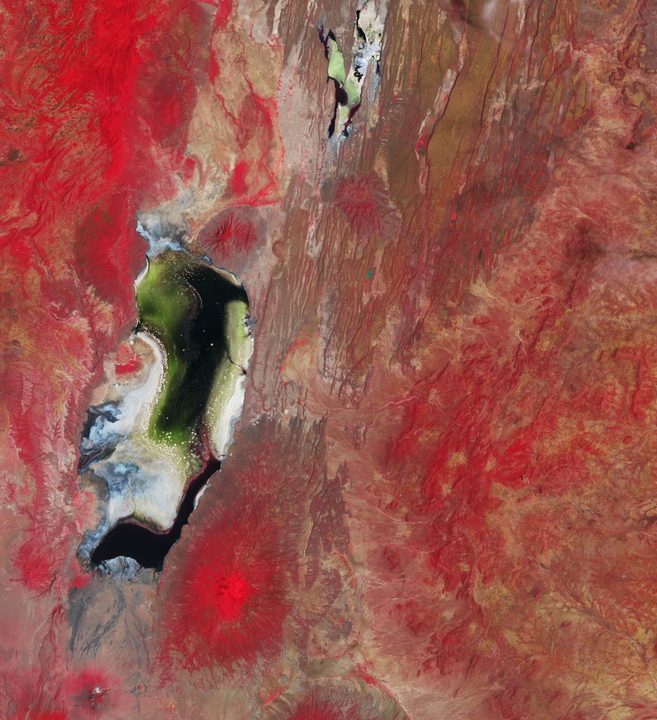
A near-infrared image of Kenya and Tanzania.
On ESA’s website, you can zoom in to explore the image at its full resolution or click on the various circles that you’ll see on the image for more information on what you’re looking at. ESA

It shows the waters of two salty lakes in East Africa: Lake Natron in northern Tanzania and Lake Magadi in southern Kenya.

Recommended Videos

The vivid colors are down to the image processing via Sentinel-2’s near-infrared channel, which helps to reveal different information than what you’d find in a natural-color image.

“While heavy shades of red highlight vegetated areas and dominate this false-color image, the seasonal flowering of algae in the lakes appears green,” ESA explains. “The bright white and blue areas along the shores depict a mixture of sand, salt, and mud flats. Salt crusts, resulting from evaporation caused by high temperatures, can be spotted as white dots speckling the waters.”

At 34.8 miles (56 kilometers) long, Lake Natron is the largest of the two lakes and has a depth of just 9.8 feet (3 meters). It’s recognized as a wetland of international importance as it’s the only regular breeding area for lesser flamingos in East Africa, with as many as 2.5 million of them flocking to the area.

The smaller Lake Magadi, seen at the center top of the image, is located in a vast depression in an area of volcanic rock. Like Natron, Magadi features a high salt content, which in some places is up to 131 feet (40 meters) thick.

Sentinel-2 is a two-satellite mission supplying the coverage and data delivery for Europe’s Copernicus Programme, an ambitious endeavor that brings together huge amounts of information gathered from environmental satellites, as well as air and ground stations and sensors, to build a comprehensive understanding of Earth’s health.

If you’d like to enjoy more Earth images taken from orbiting spacecraft, then check out these beautiful natural-color shots captured by French astronaut Thomas Pesquet during a stay at the International Space Station two years ago.

Trevor Mogg
Contributing Editor
Not so many moons ago, Trevor moved from one tea-loving island nation that drives on the left (Britain) to another (Japan)…
Space is becoming Bezos and Musk’s next data center site, and we have every reason to worry
The AI boom is coming for the night sky
How Vast's space station will look in orbit.

AI data centers already consume vast amounts of electricity and water on Earth, so Silicon Valley has begun looking somewhere considerably more spacious... literally.

Elon Musk's SpaceX and Jeff Bezos' Blue Origin, along with several other companies, have proposed enormous constellations of satellites designed to operate as orbital data centers. However, environmental groups and former space officials are now warning that putting them into orbit at the proposed scale could have severe consequences for Earth's atmosphere and the night sky.

Read more
The first possible exomoon is here, and it makes our Moon look hilariously tiny
Scientists may have found the first exomoon, except this one is the size of Jupiter
This artist’s concept depicts a potential volcanic moon between the exoplanet WASP-49 b, left, and its parent star. New evidence indicating that a massive sodium cloud observed near WASP-49 b is produced by neither the planet nor the star has prompted researchers to ask if its origin could be an exomoon.

We have already discovered more than 6,000 planets outside of our immediate neighborhood. Yet, finding a moon orbiting one of those distant worlds has proved considerably harder. Astronomers may finally have something close to the real deal, but this particular object stretches the word “moon” almost beyond recognition.

Using the European Southern Observatory’s Very Large Telescope in Chile, researchers detected strong evidence for a moon-like object in the CD-35 2722 system. Further observations are still necessary to confirm the discovery, but it could become the first confidently detected natural satellite outside our solar system. There is still one tiny complication though. This moon is apparently massive.

Read more
China’s answer to SpaceX’s reusable rockets literally catches boosters in a net
SpaceX catches boosters on legs. China just used a net.
Ammunition, Missile, Weapon

SpaceX's playbook for recovering a rocket booster generally involves legs, a precisely controlled vertical landing, and either a concrete pad or a drone ship. 

China just managed to pull off something similar, but in a slightly different way, and on July 10, it tested the method as well.

Read more