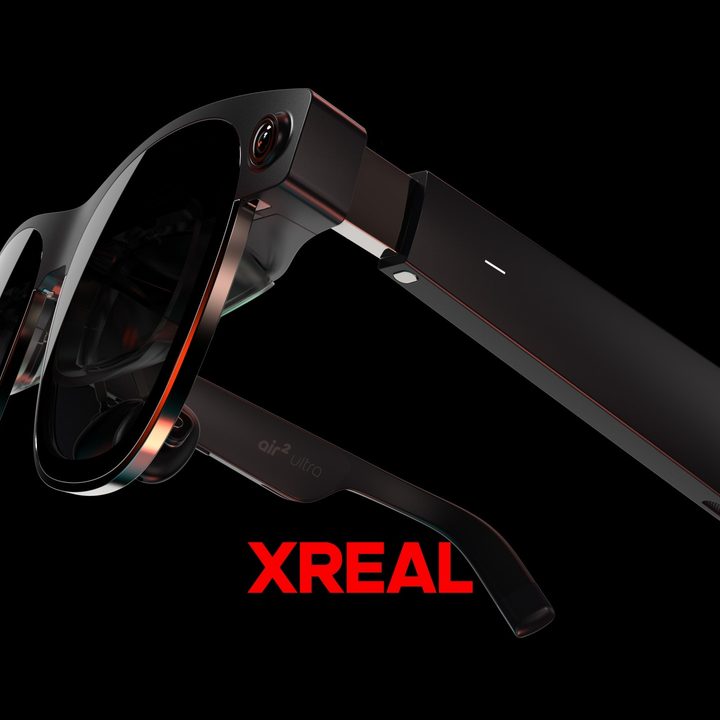
Xreal just announced its latest pair of AR glasses ahead of CES 2024. The Xreal Air 2 Ultra are a pair of AR glasses that have spatial computing capabilities that allow you to control interfaces with hand gestures.
Based on the Xreal Air 2 smart glasses, this new product adds tracking and 3D sensing technology without the bulk and weight of earlier solutions.
Weighing less than 3 ounces (80 grams), the Air 2 Ultra is claimed to be comfortable enough for hours of use. The glasses look stylish, but are thicker than normal glasses, they feature two sensors at the outer corners of the frame, and have wider earpieces to accommodate the hardware necessary for more advanced processing.
While the Air 2 smart glasses that launched in November 2023 serve mainly as alternatives to a TV or monitor, Xreal added some AR capabilities via its Beam accessory and the Nebula app for Mac, Windows, and Android. This was limited to three degrees of freedom (3Dof), allowing up to three displays that are fixed in place around your head.
The Xreal Air 2 Ultra goes further with hardware that enables depth sensing, 3D environment mapping, hand-tracking, and six degrees of freedom (6DoF). That means you should be able to place virtual objects in a room, on surfaces and walls, then interact with this augmented reality experience as you turn your head and walk around, with everything staying in place.
Of course, traditional two-dimensional screens are also supported for watching videos, creating virtual monitors for work, and playing games on a giant hovering screen with nothing more than easily pocketable glasses, a cable, and a phone.

The display has a 52-degree field of view, while most smart glasses have an field of view under 50 degrees. The display density of 42 pixels per degree should provide plenty of sharpness in the sweet spot. The 500-nit brightness and 120Hz refresh rate match the excellent performance of the Xreal Air 2.
While the sensors in the frames look like cameras, they measure depth and can’t be used to record video or take photos. Instead, they map your room and track your head and hand movement. The Xreal Air 2 Ultra represent a significant upgrade compared to the hardware capabilities of earlier smart glasses.
Xreal describes the Air 2 Ultra as a spatial computing alternative to Apple’s Vision Pro, but these are very different products. The $3,500 Vision Pro, arriving within the next three months, is a self-contained computer that could replace your laptop if Apple unlocks its potential with visionOS. The Xreal Air 2 Ultra, expected to ship by March, costs $699 and requires a compatible phone or a computer for operation.
It’s important to note that the Xreal Air 2 Ultra is currently a developer’s kit meant for creating AR and spatial computing apps, but consumers can order as well. We asked Xreal about the AR apps that will be available at launch. Stand by for more details.
Owners of the Xreal Light qualify for a $100 discount. For more details and to preorder, visit Xreal’s developer website.
All three of Xreal’s latest devices are directly compatible with the iPhone 15, but only for use as a display. Xreal doesn’t make a Nebula app for the iPhone. For earlier iPhone models with a Lightning port, an adapter is needed. Android compatibility is limited to devices that support DisplayPort Alt mode.
The Xreal Air 2 Ultra will be available at $699. Preorders are available now, but the expected ship date will be in March 2024.