1. Home
  2. Space
  3. News

See 19 gorgeous face-on spiral galaxies in new James Webb data

Add as a preferred source on Google

A stunning new set of images from the James Webb Space Telescope illustrates the variety of forms that exist within spiral galaxies like our Milky Way. The collection of 19 images shows a selection of spiral galaxies seen from face-on in the near-infrared and mid-infrared wavelengths, highlighting the similarities and differences that exist across these majestic celestial objects.

“Webb’s new images are extraordinary,” said Janice Lee of the Space Telescope Science Institute, in a statement. “They’re mind-blowing even for researchers who have studied these same galaxies for decades. Bubbles and filaments are resolved down to the smallest scales ever observed, and tell a story about the star formation cycle.”
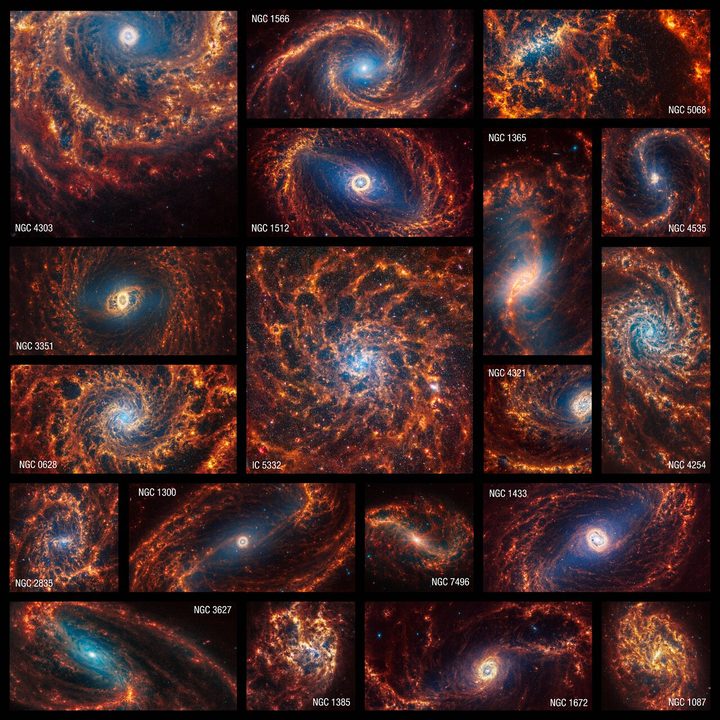
This collection of 19 face-on spiral galaxies from the NASA/ESA/CSA James Webb Space Telescope in near- and mid-infrared light is at once overwhelming and awe-inspiring. Webb’s NIRCam (Near-Infrared Camera) captured millions of stars in these images. Older stars appear blue here, and are clustered at the galaxies’ cores. The telescope’s MIRI (Mid-Infrared Instrument) observations highlight glowing dust, showing where it exists around and between stars – appearing in shades of red and orange. Stars that haven’t yet fully formed and are encased in gas and dust appear bright red.
This collection of 19 face-on spiral galaxies in near- and mid-infrared light is at once overwhelming and awe-inspiring. The James Webb Space Telescope’s NIRCam (Near-Infrared Camera) captured millions of stars in these images. Older stars appear blue here, and are clustered at the galaxies’ cores. The telescope’s MIRI (Mid-Infrared Instrument) observations highlight glowing dust, showing where it exists around and between stars – and appearing in shades of red and orange. Stars that haven’t yet fully formed and are encased in gas and dust appear bright red. NASA, ESA, CSA, STScI, J. Lee (STScI), T. Williams (Oxford), PHANGS Team, E. Wheatley (STScI)

These images were collected as part of the Physics at High Angular resolution in Nearby GalaxieS (PHANGS) program, which includes data not only from Webb, but also from other telescopes like the Hubble Space Telescope, the Atacama Large Millimeter/submillimeter Array, and others. The aim of the project is to survey nearby galaxies to understand how stars form, and the Webb data adds information in the infrared wavelength to existing data in the ultraviolet, visible light, and radio wavelengths.

Recommended Videos

“Stars can live for billions or trillions of years,” said researcher Adam Leroy of the Ohio State University. “By precisely cataloging all types of stars, we can build a more reliable, holistic view of their life cycles.”

The full catalog of images, which you can see on the Webb Telescope website, show a number of interesting features. The spiral arms reaching out from the bright center are the defining feature of this type of galaxy. These arms show stars in blue and dust in red, and a notable feature in some is areas of spherical shells without dust, which are thought to have been created by stars that exploded and pushed away matter from their immediate environment.

Other areas of interest are the bright cores, with data suggesting that star formation begins at the core and spreads outward to the arms, so more stars that are more distant from the center are likely to be younger.

The researchers are also releasing a catalog of information on 100,000 star clusters, which they hope other researchers can make use of. “The amount of analysis that can be done with these images is vastly larger than anything our team could possibly handle,” said Erik Rosolowsky of the University of Alberta. “We’re excited to support the community so all researchers can contribute.”


Georgina Torbet
Georgina has been the space writer at Digital Trends space writer for six years, covering human space exploration, planetary…
Elon Musk’ Starlink could soon offer mobile services as a US carrier
Showcase of T-Mobile Starlink service on an iPhone.

Elon Musk’s Starlink has already changed how millions of people access the internet, especially in places where traditional broadband struggles to reach. Now, the satellite internet service could be preparing for an even bigger leap — becoming your mobile carrier.

According to a Financial Times report, SpaceX has told investors it’s considering launching a retail Starlink mobile service in the US. Instead of simply partnering with wireless carriers, the company could begin selling mobile plans directly to consumers, putting it in direct competition with Verizon, AT&T, and T-Mobile.

Read more
Lightsails have hit another speed bump on the road to interstellar travel
The coolest interstellar travel idea may get betrayed by the light pushing it
LightSail in Earth orbit

Laser-powered lightsails are one of the coolest answers to spaceflight. It might not be as sci-fi-sounding as a warp drive, but now, its practicality has also come under question. Using lightsails, a spacecraft could unfurl an ultra-thin reflective sail and let a powerful laser push it toward another star, without relying on fuel.

The tech was simple and elegant--except it's also more complicated than it sounds. A new preprint from researchers Chao Shen and Jiaze Li of the Harbin Institute of Technology suggests that relativistic lightsails may run into a hidden propulsion problem once they start moving extremely fast.

Read more
The galaxy has an exoplanet size mystery, and NASA’s EVE mission wants to solve it
This planet-hunting mission wants to catch baby worlds before they grow up
Artist’s Illustration of Exoplanets Orbiting Barnard’s Star

Mankind venturing into space ended up creating more questions than it answered, and one of the dilemmas is related to the planet sizes. Astronomers have found plenty of rocky super-Earths and plenty of puffier sub-Neptunes, but far fewer planets with a radius of about 1.8 times Earth’s.

That gap is known as the radius valley, and a proposed mission called the Early eVolution Explorer, or EVE, wants to figure out why it exists. NASA has a simple plan: look at planets while they are still young. The mission concept, detailed in a new arXiv preprint and covered by Phys.org, would focus on newly formed star clusters to see what small planets look like before billions of years of evolution.

Read more