  1. Home
  2. Space
  3. News

Russian cosmonaut breaks record for time spent in space

Add as a preferred source on Google

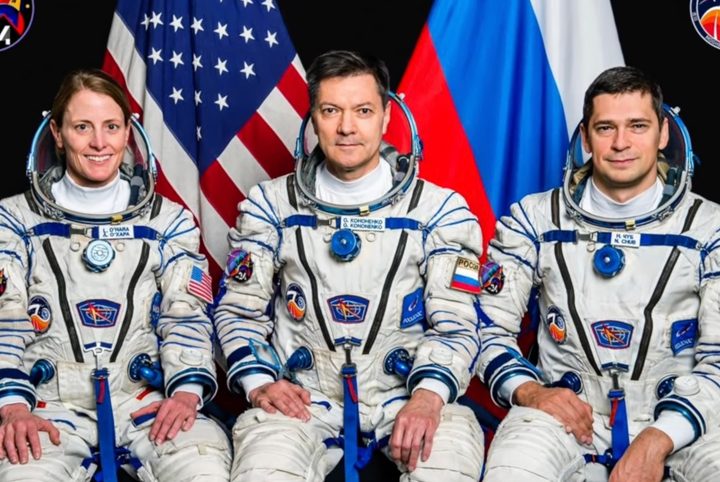
Oleg Kononenko, prior to his latest launch to the International Space Station in September 2023.
Oleg Kononenko (center), prior to his latest launch to the International Space Station in September 2023. Alongside him are NASA astronaut Loral O’Hara and Roscosmos cosmonaut Nikolai Chub. Roscosmos/NASA

A Russian cosmonaut has just set a new record for the longest time spent in space.

Recommended Videos

Set over five missions, Oleg Kononenko on Sunday has now spent more than 878 days, or nearly two-and-a-half years, in orbit.

Kononenko, 59, snatched the record from compatriot Gennady Padalka, who retired in 2017 following five trips to space.

Currently aboard the International Space Station (ISS) about 250 miles above Earth, Kononenko, whose latest mission started in September last year, is set to return to Earth in seven months, with his record set to extend to 1,110 days in orbit.

“I fly into space to do what I love, not to set records,” the cosmonaut, who first flew to space in 2008, told Russian news agency Tass. “I’ve dreamt of and aspired to become a cosmonaut since I was a child.”

Kononenko added: “That interest — the opportunity to fly into space, to live and work in orbit — motivates me to continue flying. I am proud of all my achievements, but I am more proud that the record for the total duration of human stay in space is still held by a Russian cosmonaut.”

He said that video calls and messaging enabled him to keep in touch with family and friends back on terra firma, adding that whenever he returns to Earth, it always occurs to him exactly what he’s been missing most.

“It is only upon returning home that the realization comes that for hundreds of days in my absence, the children have been growing up without father,” Kononenko said. “No one will return this time to me.”

The most days accumulated in space by a NASA astronaut is currently 678 days by retired American astronaut Peggy Whitson across four missions.

Meanwhile, the record for the longest single stay is held by Russian cosmonaut Valeri Polyakov, who lived aboard the Mir space station for 437 days and 18 hours in the mid-1990s. American astronaut Frank Rubio recently set a new single-stay record for NASA astronauts when he returned home in September after logging 371 days in orbit.

Trevor Mogg
Contributing Editor
Not so many moons ago, Trevor moved from one tea-loving island nation that drives on the left (Britain) to another (Japan)…
You can now walk through space and gaze into a black hole at this VR exhibit
Smithsonian Starstruck lets you drift past dying stars and see the origin point of the universe for as little as $18 a person.
Smithsonian Starstruck featured

Most planetarium shows ask you to sit still and look up. The Smithsonian's new VR exhibit takes a different approach, letting visitors walk through the vast expanse of the universe, drifting past stars, planets, and a black hole to get a physical sense of its true scale.

A $29 ticket to the edge of the galaxy

Read more
Scientists warn Elon Musk’s orbital data centers could blind Earth’s biggest telescopes
A new ESO study suggests millions of satellites could make parts of the night sky effectively unusable for astronomy.
One hour of satellites over the northern Atacama Desert in Chile (October 2025)

The race to blanket Earth with satellite internet has unlocked faster connectivity for millions. But according to the European Southern Observatory (ESO), it could also make one of humanity's oldest hobbies, and one of its most important sciences, a whole lot harder. The organization warns that the rapid growth of satellite mega-constellations could severely disrupt observations made by some of the world's most powerful telescopes.

Astronomers say the night sky is reaching its limit

Read more
Amazon’s Starlink rival just crossed a major milestone, but don’t expect perfect internet just yet
Amazon finally showed up to the space internet party
Amazon Leo satellite layout across all launch vehicles

Amazon has taken a significant step toward launching its long-awaited satellite internet service. Following its latest rocket launch, the company now has 396 Project Kuiper satellites in low-Earth orbit, enough to begin offering continuous service across select regions. The milestone keeps Amazon on track for its previously announced goal of launching commercial service by mid-2026.

https://twitter.com/Weber44Chris/status/2072575499461963938?ref_src=twsrc%5Etfw%7Ctwcamp%5Etweetembed%7Ctwterm%5E2072575499461963938%7Ctwgr%5Ed727a1b853cbf519585e7bf2655943afb2f91bb8%7Ctwcon%5Es1_&ref_url=https%3A%2F%2Fwww.theverge.com%2Fscience%2F960563%2Famazon-leo-service-tipping-point

Read more