1. Home
  2. Space
  3. News

Hubble spies baby stars being born amid chaos of interacting galaxies

Add as a preferred source on Google

When two galaxies collide, the results can be destructive, with one of the galaxies ending up ripped apart, but it can also be constructive too. In the swirling masses of gas and dust pulled around by the gravitational forces of interacting galaxies, there can be bursts of star formation, creating new generations of stars. The Hubble Space Telescope recently captured one such hotbed of star formation in galaxy AM 1054-325, which has been distorted into an unusual shape due to the gravitational tugging of a nearby galaxy.
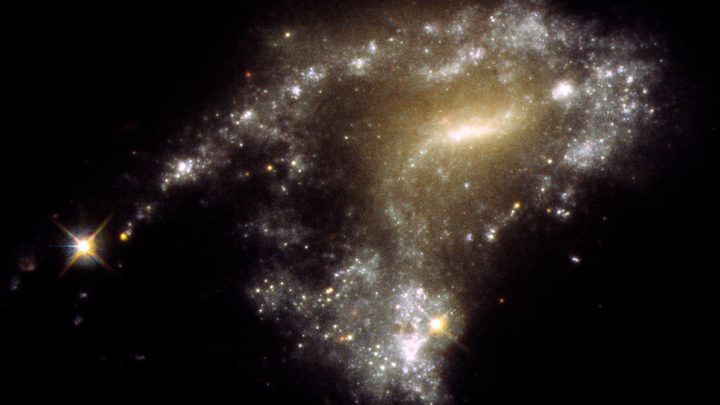
Galaxy AM 1054-325 has been distorted into an S-shape from a normal pancake-like spiral shape by the gravitational pull of a neighboring galaxy, seen in this Hubble Space Telescope image. A consequence of this is that newborn clusters of stars form along a stretched-out tidal tail for thousands of light-years, resembling a string of pearls. They form when knots of gas gravitationally collapse to create about 1 million newborn stars per cluster.
Galaxy AM 1054-325 has been distorted into an S-shape from a normal pancake-like spiral shape by the gravitational pull of a neighboring galaxy, as seen in this Hubble Space Telescope image. A consequence of this is that newborn clusters of stars form along a stretched-out tidal tail for thousands of light-years, resembling a string of pearls. NASA, ESA, STScI, Jayanne English (University of Manitoba)

The S-shape of this galaxy has created a long trail, called a tidal tail, which is thousands of light-years long and where millions of new stars are being born. Researchers have studied 12 interacting galaxies to discover a total of 435 clusters of new stars, with each cluster hosting as many as 1 million baby stars.

Recommended Videos

“It’s a surprise to see lots of the young objects in the tails. It tells us a lot about cluster formation efficiency,” said lead author Michael Rodruck of Randolph-Macon College in Virginia in a statement. “With tidal tails, you will build up new generations of stars that otherwise might not have existed.”

The study combined new observations from Hubble with older archival data to work out both the ages and masses of star clusters in these tidal tails. The biggest surprise was that the clusters are very young, at just 10 million years old. However, it is uncertain whether these clusters will survive for long. They could glom together in a group and form globular star clusters, or they could stay with the gravitational pull of the original galaxy and form a halo around it. Individual stars may even detach from the structure entirely and become lonely single intergalactic stars.

“These observations tell us how stars form and what regulates those processes. This knowledge is critical in understanding how stars in our own galaxy were formed,” said researcher Sanchayeeta Borthakur of Arizona State University.

The research is published in the Monthly Notices of the Royal Astronomical Society.

Georgina Torbet
Georgina has been the space writer at Digital Trends space writer for six years, covering human space exploration, planetary…
Getting to Mars may require a pit stop in orbit, and NASA just tested the nozzle to make that happen
A gas pump nozzle for spacecraft sounds simple. It is not, and that's what makes this test worth paying attention to.
Architecture, Building, Factory

Getting a spacecraft to Mars or beyond requires an enormous amount of fuel, most of which has to be hauled from Earth, adding to the overall cost and weight of the spacecraft. NASA has been working on a different approach, one that could be more efficient and effective.

It wants to refuel a spacecraft in orbit before heading out for the mission. What’s even more interesting is that the space agency just finished testing a component that could make that possible: a cryocoupler.

Read more
Elon Musk’ Starlink could soon offer mobile services as a US carrier
Showcase of T-Mobile Starlink service on an iPhone.

Elon Musk’s Starlink has already changed how millions of people access the internet, especially in places where traditional broadband struggles to reach. Now, the satellite internet service could be preparing for an even bigger leap — becoming your mobile carrier.

According to a Financial Times report, SpaceX has told investors it’s considering launching a retail Starlink mobile service in the US. Instead of simply partnering with wireless carriers, the company could begin selling mobile plans directly to consumers, putting it in direct competition with Verizon, AT&T, and T-Mobile.

Read more
Lightsails have hit another speed bump on the road to interstellar travel
The coolest interstellar travel idea may get betrayed by the light pushing it
LightSail in Earth orbit

Laser-powered lightsails are one of the coolest answers to spaceflight. It might not be as sci-fi-sounding as a warp drive, but now, its practicality has also come under question. Using lightsails, a spacecraft could unfurl an ultra-thin reflective sail and let a powerful laser push it toward another star, without relying on fuel.

The tech was simple and elegant--except it's also more complicated than it sounds. A new preprint from researchers Chao Shen and Jiaze Li of the Harbin Institute of Technology suggests that relativistic lightsails may run into a hidden propulsion problem once they start moving extremely fast.

Read more